

Think scouting reports are just highlight reels and stat sheets? Think again.
Coaches build opponent scouting reports through film analysis and data because the two together tell a team what the other side will actually do on the ice.
They start by collecting full-game film from multiple angles, tag shifts and plays by situation, then cross-check those clips with metrics like possession, expected goals, zone starts, and scoring-chance rates.
This article shows the step-by-step workflow, from collection to translation into a player-ready game plan that shapes practice and in-game calls.
Core Workflow Coaches Use to Scout Opponents

Opponent scouting starts with collection. Coaches pull every available piece of intelligence: full-game film from multiple angles, stat sheets, play-by-play logs, prior scouting notes if the opponent’s been faced before. Most staffs assign one assistant to lead each report, and that coach watches anywhere from seven to ten full games. Depends on how much recent film exists and how much the opponent’s system has changed. The goal during collection is breadth. Gather everything that shows how this team actually plays, not how they’re supposed to play.
Once the raw material’s in hand, evaluation begins. The assigned coach tags and clips film using a video platform, coding each play by situation, formation, personnel grouping, outcome. At the same time, statistical splits get calculated: success rates by down and distance, efficiency in the red zone, turnover tendencies, matchup-specific performance. This dual track lets the coach identify patterns that only appear when you combine what you see with what the numbers confirm. A team might look balanced on paper but throw the ball 70 percent of the time on first down when trailing.
Synthesis is where intelligence becomes insight. The coach organizes all tagged clips and statistical findings into categories: offensive tendencies, defensive looks, special-teams execution, personnel rotations, coach behavior in situational moments like timeouts and end-of-game possessions. From these categories, the staff distills three to five high-leverage keys. The handful of tendencies that, if exploited or neutralized, will tilt the outcome. The output at this stage is a draft scouting report: a structured document that translates hours of film into a playable game plan.
The final step is strategy translation. The scouting report becomes the foundation for the game plan and the practice script. Coaches decide which opponent tendencies to attack, which defensive looks require new answers, which special-teams phases present risk or opportunity. Practice periods are built around these priorities, with a scout team replicating the opponent’s formations and favorite actions so the starting unit can rehearse decision-making in live reps. The report also informs in-game adjustments. Coaches know what the opponent’s likely to do after a timeout or when protecting a lead, so they can call counters before the opponent even runs the play.
Methods Coaches Use for Video and Film Breakdown

Film breakdown is the engine of opponent scouting. Coaches begin by watching each game in full, usually twice: once to get a feel for tempo and identity, then a second time to tag and clip every play. Tagging means assigning metadata. Down and distance, hash, formation, motion, play type, result. That way clips can be filtered and reviewed by situation later. A single game might produce 60 to 80 tagged clips. After several games, the coach has a searchable library organized by offensive set, defensive front, third-down tendency, red-zone package, or any other filter that reveals a pattern.
Most staffs use All-22 or end-zone film for alignment and pre-snap reads, then supplement with broadcast angles to study individual technique. Quarterback footwork, route stems, pass-rush moves. Frame-by-frame review catches details that disappear at full speed: a guard’s lean before a run play, a safety’s eyes tipping coverage, a receiver’s split widening before motion. The best scouts don’t just watch plays. They study the two seconds before the snap and the split-second after the catch, because that’s where tendencies hide.
When breaking down film, coaches focus on five key areas:
Formational tendencies. Which personnel groups and alignments appear most often, and do specific formations predict run or pass?
Tempo and pace. Does the opponent script the opening drive, huddle in obvious situations, or use no-huddle to limit substitutions?
Preferred actions. What plays get called on first down, in the red zone, or out of timeouts?
Misdirection and counters. How often does the opponent use play-action, motion, or jet sweeps to stress defensive keys?
Substitution patterns. When do starters rotate out, and does the quality drop when backups enter?
Effective film breakdown isn’t about watching more. It’s about watching smarter. A well-tagged library turns ten games of footage into a decision-making tool that answers specific questions in seconds. “What does this team do on third-and-short from a tight formation?” And that speed matters when you’re building a practice script on a short week.
Statistical and Data-Driven Scouting Tools

Analytics add context that film alone can’t provide. A coach might see an opponent complete several deep passes, but the numbers reveal those throws only happened when the defense was in a specific coverage and the hash favored the quarterback’s arm. Stats quantify frequency, efficiency, and risk in ways that prevent gut-feel mistakes. Modern scouting platforms compile play-by-play data and calculate situational success rates, so coaches know not just what an opponent does, but when it works and when it doesn’t.
Key metrics include efficiency measures like yards per play and success rate. The percentage of plays that gain enough yardage to stay on schedule. Down-and-distance splits show whether a team’s predictable: run-heavy on early downs, pass-heavy on obvious passing situations, or balanced enough to keep defenses honest. Red-zone touchdown percentage and third-down conversion rate flag execution strengths and pressure points. Turnover rates, both forced and committed, help coaches decide whether to play conservatively or attack. For special teams, return averages and coverage yards allowed indicate whether to kick away from a returner or challenge a suspect coverage unit.
The real value emerges when data and video are cross-referenced. A stat sheet might show an opponent converts 45 percent of third downs, but film reveals that half those conversions came against zone coverage on third-and-medium. That insight becomes a game-plan adjustment: play more man coverage on money downs. Similarly, a tendency chart might show an opponent runs the ball 65 percent of the time from a specific personnel grouping, but advanced metrics reveal those runs gain only 3.2 yards per carry. Worth defending but not worth selling out to stop. Coaches use analytics to separate what opponents do often from what they do well, then build plans that force low-efficiency actions and take away high-value plays.
Building the Opponent Scouting Report
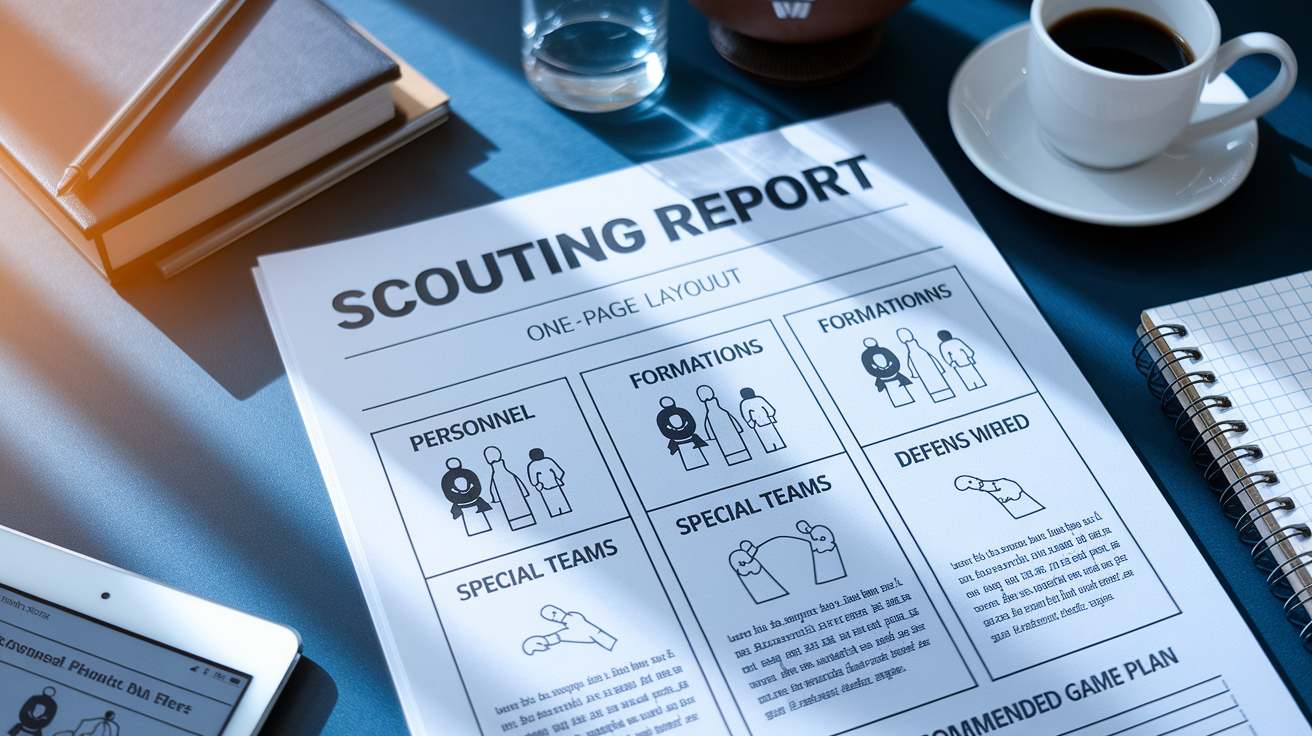
The scouting report is the distillation of everything learned during collection and analysis. Its purpose is to give players an answer key. A clear, usable guide that tells them what to expect and how to respond. The best reports are detailed enough to inform but short enough to be retained. A staff might produce a full breakdown for internal use, but the player-facing version’s typically one page, front and back, or a handful of short video edits.
A standard report includes six core components:
Personnel overview. Key players with stats, tendencies, handedness, and exploitable weaknesses. Rotation depth and substitution cues.
Offensive tendencies. Base formations, favorite plays by down and distance, tempo patterns, play-action frequency, red-zone packages.
Defensive structure. Front alignments, coverage shells, blitz packages, and how the defense adjusts to formations or motion.
Special-teams execution. Return schemes, coverage alignments, fake tendencies, and any breakdowns or stars in the six core phases.
Situational keys. What the opponent does out of timeouts, in two-minute situations, and when protecting or chasing a lead.
Recommended game plan. Three to five high-leverage tactical adjustments, matchups to target, and plays to rehearse in practice.
Clarity matters more than comprehensiveness. Coaches avoid jargon-heavy language and focus on observable cues players can recognize in real time. Instead of writing “they run zone-read from 11 personnel,” the report says “when the slot receiver motions across, watch for the quarterback to pull and attack the edge.” Video clips are time-stamped and organized by situation so players can review exactly what they’ll see. Many staffs now distribute reports via mobile apps or as print-friendly PDFs with clean layouts and visual aids. Spray charts, formation diagrams, still frames that highlight alignment keys.
The report must also account for what the opponent might change. Experienced staffs know that opponents scout back, so the report includes contingency notes: “If they shift to more man coverage, we’ll counter with these route adjustments.” That preparation prevents panic when the other team makes an in-game adjustment. A good scouting report doesn’t just describe the opponent. It anticipates the chess match and gives the staff moves two steps ahead.
Applying Scouting Insights to Game Plans and Practice

Scouting intelligence only matters if it changes what a team does. Once the report’s finalized, coaches convert tendencies into tactics. If the opponent’s defensive ends crash hard on run action, the game plan will feature play-action passes and bootlegs. If a linebacker struggles in coverage, the offense will design matchups to isolate him. If the opponent’s punt-return unit is undisciplined, special teams will rehearse a fake. Every identified weakness becomes a scripted opportunity, and every opponent strength dictates an adjustment or a counter.
Practice is where scouting becomes muscle memory. Coaches build a scout team, usually backups and younger players, and assign them to replicate the opponent’s system. The scout-team offense runs the opponent’s top-ten plays from the correct formations, at the correct tempo, with motion and shifts included. The scout-team defense aligns in the opponent’s fronts and coverages, bringing the pressures and stunts that showed up on film. Situational periods simulate high-leverage moments: third-and-long, red zone, two-minute drill. Reps are deliberately sequenced so the starting unit experiences the same decision trees they’ll face in the game. If film shows the opponent likes to run a specific blitz on third-and-medium, the scout team runs that blitz five times in practice so the offensive line and quarterback can recognize it instantly.
Communication discipline is critical during this phase. Coaches provide the full analytical breakdown to the staff but simplify the player-facing message to three or four keys. Overloading athletes with information slows reaction time. The goal is confident recognition, not perfect recall. Short video edits, often just 90 seconds per topic, are shown incrementally over the week, not all at once. Players watch one edit on team identity and tempo, another on offensive sets, a third on defensive looks, and a final one on special teams and situational plays. By game day, they’ve absorbed the essential patterns without feeling buried. The one-page scouting sheet serves as a pre-game and halftime reference, reinforcing the same keys in a format that fits in a playbook or a phone screen.
Final Words
On game day coaches flip film, pull stats, and turn patterns into a clear play plan.
This post followed that flow: how intel is collected, how video is broken down, how analytics add context, how that work becomes a concise scouting report, and how reports shape practice and tactics.
That’s how coaches build opponent scouting reports for game preparation: gather film and data, tag tendencies, write a practical report, and rehearse it on ice. Do it consistently and the team shows up ready and confident.
FAQ
Q: How to make scouting reports?
A: Making scouting reports starts with collecting game film, stats, and coach notes, then identifying formations, player tendencies, and exploitable weaknesses, and finishing with a concise, actionable report for players and staff.
Q: How do professional coaches prepare for games?
A: Professional coaches prepare for games by evaluating opponent scouting reports, combining film and data, scripting practice for key situations, setting matchups, and communicating clear tactical goals to players.
Q: What are the 7 methods of scouting?
A: The seven methods of scouting are video review, live in-person observation, analytics/data platforms, written scouting reports, player-specific clip reels, formation and pattern tracking, and opponent-tendency mapping for actionable game planning.
Q: What are the six tasks of a coach?
A: The six tasks of a coach are planning effective practices, preparing game strategy, developing player skills, managing lineups and matchups, communicating feedback, and supporting player welfare and team culture.