

Points lie.
A winger can score 40 goals with soft minutes while a shutdown center faces the opponent’s best and finishes with fewer points.
Standard box score misses possession, chance quality, deployment, and matchup context.
Advanced metrics, like Corsi, Fenwick, expected goals, zone starts, and quality of competition, show who actually drives play, creates dangerous chances, and survives tough minutes.
This post explains those metrics, how to read them, and how to use them so you can spot true contributors beyond the scoreboard.
Core Metrics for Evaluating Hockey Performance Beyond Points

Points lie. A winger can score 40 goals getting easy matchups and protected ice time while a shutdown center grinds against the opponent’s best forwards every shift and barely hits 30 points. Standard stats don’t tell you who actually controlled the game, who killed dangerous chances, or who shifted momentum when everything was on the line.
That’s where advanced analytics come in. These metrics track possession, shot quality, deployment, and impact in situations that matter but never make the highlight reel. Corsi counts every shot attempt (goals, saves, misses, blocks) to show which team had the puck. Fenwick does the same thing but drops blocked shots, focusing only on attempts that got through. Expected goals (xG) puts a number on every scoring chance based on distance, angle, traffic, and shot type. So you’re not just seeing how many shots a player created, you’re seeing how dangerous they actually were. Zone starts show whether a coach trusts someone in their own end or only sends them out for offensive draws. Quality of competition tracks which opposing players a skater faces most often, separating cake walks from brutal matchups.
Here are five metrics that belong in every evaluation:
- Corsi — Every shot attempt for and against while a player’s on the ice. Broadest read on puck possession.
- Fenwick — Shot attempts that reached the net (blocks don’t count). Cleaner possession signal.
- Expected Goals (xG) — Scoring chance quality, weighted by probability. Shows what a player created and what they gave up.
- Zone Starts — Where shifts begin: offensive zone, defensive zone, or neutral ice. Tells you what the coach is asking for.
- Quality of Competition — Skill level of opponents faced. Separates easy minutes from the hard ones.
Breaking Down Possession Metrics

Corsi and Fenwick track possession, and possession wins games. When a player’s on-ice shot attempt share sits above 50 percent, their team’s generating more than it’s allowing. Do that over a full season and you’re tilting territory, creating scoring chances, and making life easier on your goalie. These metrics catch players who drive results even when the puck’s not going in.
They also reveal quiet value. A defensive forward might finish with 20 points but carry a 53 percent Corsi because he’s winning puck battles, exiting clean, and shutting down entries on the backcheck. Standard stats call that depth. Possession metrics call it essential.
Corsi includes blocks, so it can inflate things if opponents are just collapsing into lanes. Fenwick removes blocks and focuses on attempts that actually tested the goalie. Both are useful. Corsi gives you sample size. Fenwick gives you signal. When a player grades well in both, you’re looking at someone who owns the middle of the ice and forces opponents into reactive, low-percentage hockey.
Understanding Chance Quality Metrics

Not every shot’s the same. A wraparound from a terrible angle might have a 2 percent chance of going in. A one-timer from the slot could be 20 percent. Expected goals models calculate those odds for every shot by weighing distance, angle, rebounds, rush plays, traffic, and shot type. Add it all up and you get expected goals for and against, which measures chance quality, not just volume.
High-danger chances live in the home plate area: crease to the dots, inside the hash marks. These are the looks that beat goalies. A forward who racks up xG by getting to the net front is way more valuable than someone padding totals from the perimeter. Defensemen who limit high-danger chances against are doing the hardest work, even if their blocked shot numbers don’t scream it.
xG also strips out shooting luck. A player might score on 15 percent of their shots one year and 8 percent the next, but if xG stays consistent, the process hasn’t changed. Just the bounces. Here’s what xG models usually consider:
- Shot location — Distance and angle matter most.
- Shot type — Wrist shot, slapper, tip, rebound. Each converts differently.
- Pre-shot movement — Rush chances and cross-ice passes raise goal probability. Perimeter shots after a stalled entry don’t.
Deployment and Matchup Context

Zone starts shape everything. A player taking 65 percent of faceoffs in the offensive zone gets handed scoring chances. A player starting 60 percent of shifts in the defensive zone is digging pucks out under pressure and transitioning against a set forecheck. Offensive zone starts inflate possession and goals. Defensive zone starts suppress them. Ignore deployment and you’re comparing players doing completely different jobs.
Quality of competition matters just as much. Facing the opponent’s top line every night is a different universe than skating against fourth-liners. If a player maintains positive xG while matched against elite competition, that’s real two-way ability. If another posts strong numbers only against weak opponents, the performance might vanish when usage gets tougher. Deployment and matchup context turn raw numbers into fair comparisons.
| Metric | What It Reveals | Typical Impact |
|---|---|---|
| Offensive-Zone Start % | How often a player begins shifts with possession and scoring chances | Higher OZ% inflates Corsi, goals, assists |
| Defensive-Zone Start % | Frequency of shifts starting under defensive pressure | Higher DZ% suppresses offensive numbers, tests defensive ability |
| Quality of Competition (QoC) | Average skill level of opponents faced, measured by Corsi or xG | Tough QoC makes positive metrics more impressive, weak QoC requires context |
Position-Specific Analytics Insights
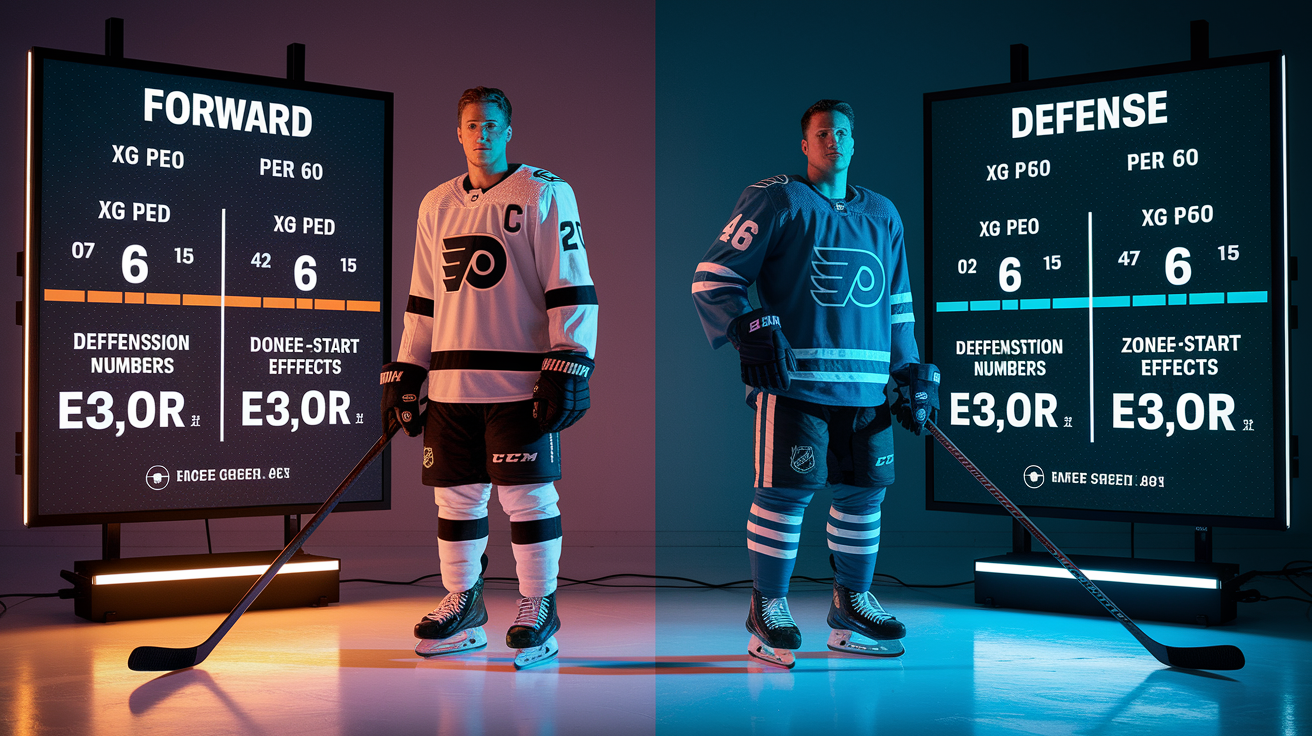
Forwards and defensemen do different things, so their metrics weight differently. Forward evaluation starts with offensive creation: xG for per 60, shot attempts, controlled entries, primary assists. Strong two-way forwards also suppress chances against and post positive xG differentials at even strength. Offensive zone faceoff wins and net-front presence show up in high-danger chance creation. Turnovers (giveaways minus takeaways) and failed exits reveal when a forward’s not pulling weight away from the puck.
Defensemen get measured on suppression first. Shots against per 60, expected goals against per 60, defensive zone exit success. Those matter more than points. The best defensemen limit high-danger chances, break up rushes, and transition cleanly under pressure. Offensive contribution still counts (controlled breakouts, entries with possession, point shot xG, power play assists), but a defenseman who can’t defend isn’t useful no matter how many points he piles up from protected deployment.
Goaltending lives in its own world. Save percentage alone hides whether a goalie faced 40 low-danger shots or 25 high-danger chances. Goals saved above expected (GSAx) compares actual goals allowed to the xG total of shots faced, isolating performance from team defense. High-danger save percentage shows how a goalie performs when it matters. Goalies also get evaluated on rebound control, puck handling on dumps, and whether they’re giving up goals on the first shot of a sequence or later chances in a scramble.
Goalie-Specific Metrics
Evaluating goalies means adjusting for shot quality, not just volume. A goalie can post .920 facing mostly perimeter shots and still be below average once you account for the easy workload. Another might sit at .910 while facing slot chances and breakaways, actually saving more than expected. Expected save percentage models weight every shot by difficulty, then compare results to what a league-average goalie would’ve allowed. GSAx and high-danger save percentage become the clearest reads on true skill, stripping out team defense noise and opponent shooting talent.
Applying Metrics to Real-World Player Evaluation

A third-line winger finishes with 12 goals and 28 points. Traditional view says depth scorer, replaceable, maybe worth league minimum. Advanced metrics say he posted 54 percent Corsi, generated 15 expected goals at even strength, faced top-six competition 60 percent of the time, and started 58 percent of shifts in the defensive zone. That’s not depth. That’s a shutdown forward with offensive upside who got unlucky on finish and will probably break out with better deployment.
Flip side: a flashy forward puts up 25 goals and 60 points playing sheltered minutes against bottom pairings. Corsi sits at 48 percent. xG for is middling, xG against is poor. Zone starts are 62 percent offensive. Quality of competition ranks bottom third among regulars. The points look great. Underlying performance says he’s getting carried by deployment, linemates, and shooting percentage. When usage gets harder, production drops.
Plenty of players with strong underlying numbers break out later once opportunity or linemates improve. Analytics spot those candidates early. A young defenseman buried on the third pair might post excellent shot suppression and clean breakouts in limited minutes. That’s your signal to give him ice time before someone else does. A fourth-liner with strong xG differential and good faceoffs is one injury away from second-line usage and a 40-point season.
Combining metrics also separates usage from talent. A player can have weak raw Corsi because his coach only deploys him for defensive zone faceoffs against the other team’s top line. Adjust for zone starts and competition quality, and his relative Corsi might be positive, meaning he’s actually winning his minutes despite the toughest circumstances. That’s who you want in a playoff series, not the guy padding stats against soft competition in easy situations.
Final Words
On the ice, watch the shifts, who wins puck battles, who creates dangerous chances, and how deployment changes results.
This post walked through the core metrics (Corsi, Fenwick, xG, zone starts, quality of competition), explained possession and chance-quality, and showed position and matchup context with real evaluation examples.
If you want to know how to assess player performance beyond points in hockey, combine those stats with tape review and role context. Do that regularly and you’ll spot reliable drivers and undervalued players—and make better decisions fast.
FAQ
Q: What are the core advanced hockey metrics beyond points?
A: The core advanced hockey metrics beyond points are Corsi (all shot attempts), Fenwick (unblocked attempts), expected goals xG (chance quality), zone starts (deployment), and quality of competition (who you face).
Q: What does Corsi measure and why does it matter?
A: The Corsi measures all shot attempts—shots on goal, misses, and blocks—and matters because higher Corsi usually indicates better puck possession, sustained offensive pressure, and more scoring opportunities over time.
Q: How is Fenwick different from Corsi?
A: The Fenwick differs from Corsi by excluding blocked shots, so Fenwick focuses on unblocked attempts and can better reflect scoring chances while slightly reducing noise from defensive blocks.
Q: What is expected goals (xG) and how is it used?
A: The expected goals xG model assigns a probability to each shot based on location, angle, and situation and is used to measure chance quality and expected scoring, not just actual goals.
Q: What are zone starts and why do they matter?
A: The zone starts show how often a player begins shifts in the offensive or defensive zone and matter because deployment skews raw stats—more offensive starts usually boost offensive numbers.
Q: What does quality of competition show?
A: The quality of competition shows which opposing players a skater faces most often and tells you whether a player’s numbers came against top lines or softer matchups, affecting interpretation.
Q: How do possession metrics and xG work together to evaluate players?
A: Possession metrics and xG work together by measuring volume and quality—Corsi/Fenwick show how much attack you drive, while xG shows whether those chances were likely to produce goals.
Q: How should analytics differ by position?
A: Analytics differ by position: forwards are judged on chance creation and possession driving, defensemen on chance suppression and transition play, and goalies on save rates adjusted for shot quality.
Q: Which goalie-specific metrics matter?
A: The goalie-specific metrics that matter are shot-quality adjusted save percentage, high-danger save rate, and goals saved above expectation—these account for chance difficulty and reveal true performance.
Q: How do analytics change player evaluation and scouting?
A: Analytics change player evaluation by combining possession, chance quality, deployment, and matchup data to spot undervalued players, explain scoring slumps, and predict likely breakouts.