

Think raw talent alone will land a Division I hockey scholarship? Think again.
Coaches start tracking players at 14 to 16, and they judge skating, hockey IQ, compete level, academics, and system fit before they offer money.
That means you need targeted training, smart exposure, and academic planning, earlier than you expect.
This post gives clear, step-by-step actions: what to train on the ice, how to build a coach-ready highlight, when to show up at showcases, and the NCAA checklist to keep you eligible.
Do the work coaches actually reward.
Step-by-Step Actions to Improve Division I Hockey Scholarship Chances
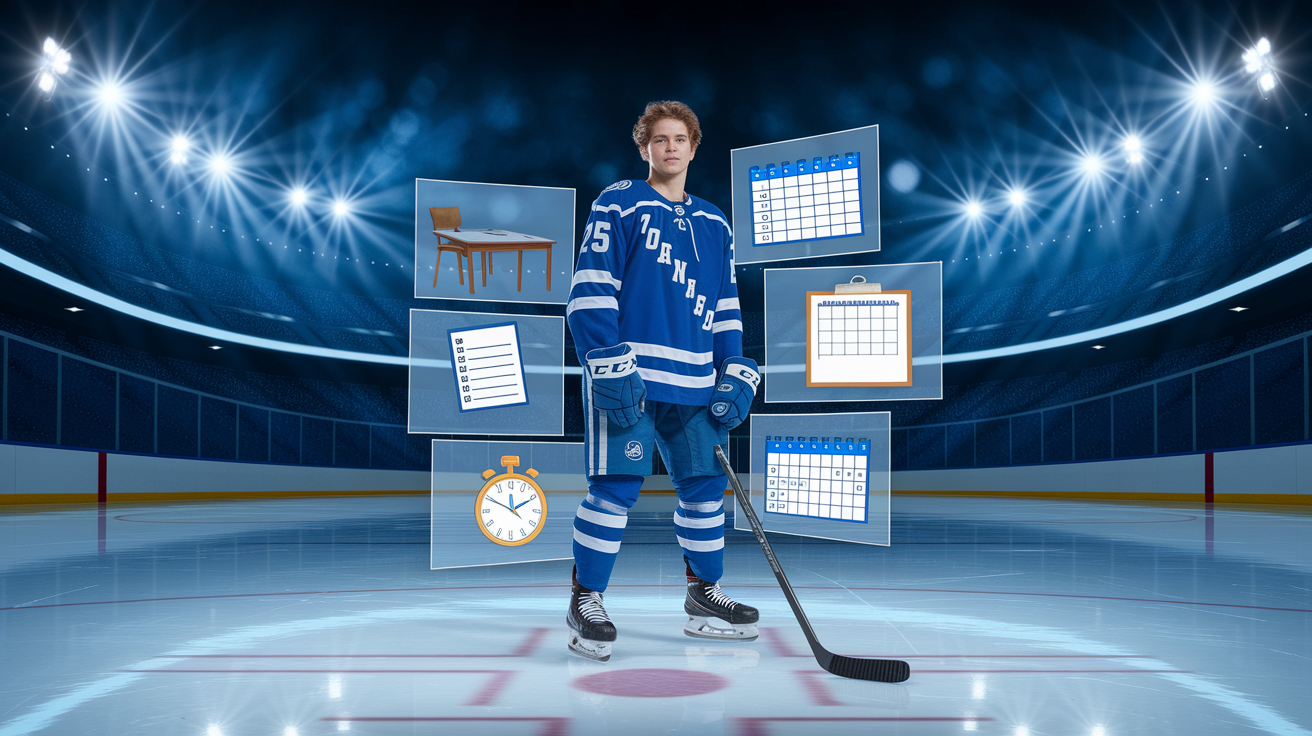
Division I hockey coaches evaluate five things before extending a scholarship offer: skating ability, hockey IQ, compete level, academic eligibility, and whether you can play the system they run. Most programs start identifying talent when players are 14 to 16 years old. You need to start preparing earlier than you think.
Your skating must be good enough that coaches don’t wonder if you can keep up. Edge control matters as much as straight-line speed. Hockey IQ is decision-making under pressure. Reading the forecheck, finding the open man before the pass, knowing when to shoot or hold. Compete level is your intensity every shift, not just the ones where coaches are watching. If any of those three areas lag behind, the scholarship becomes harder to earn no matter how good your stats look.
Academic eligibility starts with completing 16 NCAA core courses and maintaining at least a 2.3 GPA in those classes. That’s the minimum. Competitive programs prefer a 3.0 or higher and SAT scores above 1100. You must register with the NCAA Eligibility Center by junior year and track your core courses carefully with your school counselor. A failing grade in a core course can delay or eliminate your eligibility.
The typical recruiting timeline begins with visibility at age 14 or 15, serious outreach in sophomore and junior years, verbal offers during junior year, and signing in senior year. You need to attend showcases where Division I coaches are present, send highlight videos with updated stats every few months, and respond quickly when coaches reach out. The players who earn scholarships do the work before coaches ask for it.
Building the Athletic Skill Set Division I Coaches Look For

Skating is the first filter. If you can’t close gaps quickly on defense or separate on offense, the conversation ends. Coaches watch acceleration in the first three steps, top speed over the next ten, and whether you maintain balance through crossovers and pivots. A forward who gets caught flat-footed on the backcheck or a defenseman who gets beaten wide because their edges aren’t sharp enough? Those are players who don’t advance.
Hockey IQ is harder to measure on a stat sheet, but coaches see it immediately on video. Do you pass into pressure or find the soft area? Do you support the puck or float in the neutral zone? Can you read a pinching defenseman and chip the puck past him before he closes? IQ separates players who produce points because their linemates are good from players who create offense themselves.
Compete level is whether you battle through a cross-check in front of the net, finish your check on the forecheck, or backcheck hard on a line change when you’re tired. Coaches want players who work when it’s uncomfortable.
Five skill areas Division I coaches evaluate most closely:
- Skating mechanics. Acceleration, top speed, edge control, backward crossovers.
- Decision-making speed. Processing options under pressure and choosing correctly.
- Compete consistency. Effort level on every shift, especially defensive zone and forecheck.
- Puck skills. Stickhandling in traffic, shooting accuracy, passing tape-to-tape.
- Positional discipline. Staying in structure, supporting teammates, adjusting to systems.
If two of those five are weak, your odds drop significantly.
Academic Requirements for NCAA Division I Eligibility

You must complete 16 NCAA core courses before graduating high school. Core courses include four years of English, three years of math (Algebra I or higher), two years of natural or physical science (one must be a lab science), one additional year of English, math, or science, two years of social science, and four years of additional core courses. Your GPA in those 16 courses must meet the NCAA sliding scale, which starts at 2.3 and adjusts based on your SAT or ACT score.
Meet with your school counselor freshman year to confirm which classes count as NCAA core courses. Some schools list courses as core-eligible when they’re not, and you won’t find out until senior year when it’s too late to fix. If you take an online course or transfer schools, verify that the NCAA accepts those credits. Register with the NCAA Eligibility Center by the end of junior year so your transcripts are on file and any issues surface early.
Academic performance affects more than eligibility. Coaches at competitive programs receive dozens of highlight videos from players with similar stats. A 3.5 GPA and 1200 SAT can tip the decision in your favor when two players look equal on the ice. Schools also use academic scholarships to supplement athletic money, which makes strong grades a financial advantage.
Understanding the Division I Hockey Recruitment Timeline
Most Division I commits played on competitive teams by age 14 and appeared on recruiting lists by 15 or 16. That doesn’t mean every player commits at 16, but it does mean coaches are tracking prospects well before junior year of high school. If you’re a sophomore and haven’t started reaching out to programs, you’re behind but not eliminated.
NCAA rules restrict direct contact between Division I coaches and recruits until June 15 after the athlete’s sophomore year. Before that date, you can email and call coaches, but they can’t respond except in limited ways. After June 15, coaches can call once per week and begin evaluating you at tournaments and showcases. Unofficial visits (which you pay for) are allowed anytime. Official visits (which the school pays for) are allowed starting January 1 of junior year, and you’re limited to five total across all sports.
Verbal commitments often happen during junior year, especially for top prospects. A verbal commitment is a non-binding agreement that the player intends to attend a school and the coach intends to offer a scholarship. Binding commitments occur when the player signs a National Letter of Intent, which can happen as early as November of senior year. The earlier you commit, the more competition you removed yourself from. But committing too early can limit leverage if better offers emerge. Most players finalize decisions by the end of junior year or the start of senior year.
Creating a Strong Hockey Highlight Video

Coaches spend 90 seconds deciding whether to keep watching your video or move to the next one. Open with your best 20 to 30 seconds. Your fastest goal, hardest hit, cleanest breakout pass, or biggest save if you’re a goalie. The rest of the video should be 2.5 to 3.5 minutes of full shifts or isolated plays that show your position responsibilities, not just highlight-reel moments.
Include plays where you’re not touching the puck. Show your positioning in the defensive zone, your gap control, your support on the breakout, your net-front presence, your backcheck. Coaches care more about what you do between touches than the one time you sniped top shelf. If you’re a defenseman, show your first pass out of the zone under pressure. If you’re a forward, show your wall battles and how you protect the puck. Goalies should include sequences where they control rebounds and communicate with defensemen.
Six essential clips every highlight video must include:
- Full shifts showing defensive zone coverage and transition speed.
- Goals or assists with context (even-strength, power play, penalty kill).
- Physical play. Finishing checks, winning board battles, blocking shots.
- Skating speed. Separation on a breakaway or closing a gap on the backcheck.
- Hockey IQ moments. Reading a play early, making the right pass under pressure.
- Special teams. Power play positioning, penalty kill discipline.
Maximizing Exposure Through Showcases and Camps
Showcases and exposure camps put you in front of 20 to 50 college coaches in one weekend, but only if you attend the right events. The USHL Fall Classic, NAHL Showcase, and USA Hockey National Camp are high-visibility events where Division I coaches actively scout. Regional showcases hosted by prep schools or junior leagues can also work if the schools you’re targeting send staff. Attending a showcase where no Division I coaches are present wastes money and a weekend.
Check the event roster before you register. Most showcases publish a list of attending college programs. If fewer than ten Division I schools are listed, the event may not be worth the cost. Target showcases where your skill level matches the average competition. A U16 player attending a U18 showcase risks getting overwhelmed and invisible. A U18 player at a U16 event risks looking like they don’t belong at the next level.
The biggest mistake athletes make is showing up unprepared. Coaches watch warm-ups. They notice effort in the third period of a blowout. They see whether you talk to teammates or stare at your phone between periods. One great shift won’t earn a scholarship, but one lazy shift can remove you from consideration.
How to Communicate With Division I Coaches

Your first email to a coach should be short, factual, and include everything they need to evaluate you. Subject line: “2027 RW | 6’0″ 180 | 1.2 PPG USHL.” Body: two or three sentences introducing yourself, your current team and league, your key stats, a link to your highlight video, your GPA and test scores, and your contact information. Attach a one-page player profile PDF with your photo, position, graduation year, measurable stats, and tournament schedule.
Send initial emails to 15 to 25 programs where you realistically fit academically and athletically. Follow up every six to eight weeks with updated stats, new video clips, and your upcoming tournament schedule. If a coach responds, reply within 24 hours even if it’s just to confirm you received their message. Coaches track response time and effort as a measure of interest and maturity.
Personalize every email. Mention something specific about the program. Recent playoff performance, a player who was drafted, the team’s system style. Generic mass emails are obvious, and coaches ignore them. If you don’t know enough about a program to write two personalized sentences, don’t email that coach yet.
Four required elements of every coach email:
- Graduation year, position, height, weight, current team and league.
- Season stats and highlight video link (hosted on YouTube or Hudl).
- Academic summary. Core GPA, test scores, NCAA Eligibility Center ID number.
- Upcoming tournament or showcase schedule with dates and locations.
NCAA Rules Every Hockey Recruit Must Know
NCAA rules limit when and how Division I coaches can contact you. Before June 15 after your sophomore year, you can call and email coaches, but they can’t call you back or respond in detail. After June 15, coaches can call you once per week and send unlimited texts and emails. Dead periods prohibit all in-person contact. Quiet periods allow on-campus visits but no off-campus recruiting. Contact periods allow coaches to attend your games and showcases.
Unofficial visits are allowed anytime and are paid for by your family. You can tour campus, meet coaches, watch practice, and attend a game. Official visits are paid for by the school, limited to 48 hours, and include meals, lodging, and transportation. You’re allowed five official visits total across all Division I and II sports. Most recruits save official visits for their top two or three schools after receiving serious interest.
Scholarship offers aren’t binding until you sign a National Letter of Intent. A verbal commitment means you’ve agreed to attend a school and the coach has agreed to offer a scholarship, but either side can back out. Signing an NLI locks you into that school for one year, and if you change your mind, you forfeit a year of eligibility and must sit out a season unless the school grants a release. Coaches can also pull a scholarship offer if academic or legal issues arise before you enroll.
Position-Specific Guidance for Scholarship Aspirants

Forwards
Scoring matters. Division I forwards average 0.5 to 1.2 points per game in top-tier junior leagues. Coaches want goal-scorers who shoot often, protect the puck in traffic, and finish checks on the forecheck. Speed is the most important attribute. Separation speed on offense and backcheck speed on defense. If you’re not fast, you must be physical or elite in tight spaces.
Forechecking pressure and defensive zone responsibility separate good forwards from scholarship-level forwards. Coaches watch whether you track back hard, support your defensemen, and win battles along the wall. If you float in the neutral zone waiting for a breakout pass, you’re a liability. Two-way forwards who kill penalties and contribute on special teams have an advantage because they give coaches roster flexibility.
Defensemen
Gap control and first-pass efficiency are the two skills Division I coaches prioritize. Can you close on a forward without getting walked, and can you move the puck under pressure? Defensemen who panic under the forecheck or make blind passes up the middle don’t advance. Coaches also evaluate your ability to defend the rush one-on-one, box out in front of the net, and communicate with your partner.
Offensive production matters, but not as much as defensive reliability. A defenseman who puts up 30 points but gives up odd-man rushes is less valuable than one who scores 15 and plays mistake-free defense. Physicality and net-front clearance ability add value, especially for programs that play a heavier style. Mobility is critical. If you can’t skate backward with speed and pivot quickly, your ceiling is low.
Goalies
Consistency and rebound control win scholarships. Division I goalies in top junior leagues post save percentages above .915 and goals-against averages under 2.50. Coaches watch how you track the puck through screens, control your depth in the crease, and direct rebounds to safe areas. A goalie who makes highlight-reel saves but gives up soft goals loses trust quickly.
Mental consistency matters as much as physical skill. Can you reset after a bad goal, or do you spiral? Do you communicate with defensemen and take charge of the crease, or do you stay quiet? Coaches also evaluate your puck-handling ability because modern systems require goalies to act as a third defenseman on the breakout. If you can’t make a clean first pass or handle a dump-in, you limit your team’s transition game.
Final Words
You’re backchecking hard after a turnover, making the first pass that starts the next rush. That’s the lens this guide used.
It walked through the exact steps: what D1 coaches value on the ice, NCAA academic requirements, the recruiting timeline, how to build a tight highlight video, where to gain exposure, and how to contact coaches while obeying NCAA rules. We also broke down forward, defense, and goalie priorities.
Make a plan, prioritize the checklist, and keep pushing. This is how to increase chances of a Division I hockey scholarship. Progress comes shift by shift.
FAQ
Q: How hard is it to get a hockey scholarship / How hard is it to get a Division I scholarship?
A: Getting a hockey scholarship, especially Division I, is very competitive. Coaches want elite skating, hockey IQ, consistent compete level, solid academics, and exposure—start recruiting and training by age 14 to 16.
Q: What is the 3 2 1 rule in hockey?
A: The 3-2-1 rule in hockey is a forecheck and defensive structure: three players pressure the puck, two cover the middle or support, and one stays back as the last defender to stop odd-man chances.
Q: How many full-ride scholarships for D1 hockey?
A: The number of full-ride scholarships for D1 hockey depends on the program’s 18 scholarship-equivalents limit. Schools can offer up to 18 full rides, though most split those scholarships among multiple players.