

Thinking a junior league guarantees a college scholarship? Think again.
Playing in a recognized Tier I or Tier II junior league puts you directly in front of NCAA scouts.
The short answer, juniors help, but only certain juniors.
Leagues like the USHL, NAHL, and BCHL boost visibility, standardized video, and coach trust.
Play in the CHL and you likely lose NCAA eligibility.
Pick the wrong junior path and your scholarship chances shrink.
This post explains the trade-offs, the timeline, and what coaches actually watch.
Impact of Junior Hockey Participation on Scholarship Opportunities

Playing in a recognized junior hockey league seriously boosts your shot at an NCAA scholarship compared to staying in lower-level programs. But there’s a catch. It only works if you land in a league that college coaches actually watch.
The answer isn’t just “juniors help.” The real answer is that top-tier amateur junior leagues create way more scholarship visibility than high school, lower-level prep teams, or leagues that don’t regularly host NCAA scouts. Step into a Tier I or Tier II junior environment and you’re skating on the same ice where Division I and Division III coaches spend most of their scouting time. Stay out of those leagues? Your scholarship path gets a lot narrower.
Junior leagues increase scholarship likelihood through a few specific mechanisms. Your schedule puts you directly in front of coaches. Tier I and Tier II leagues run formal showcases where college staffs show up in groups. The competition level is high enough that coaches trust what they see. A standout shift in the USHL carries more weight than similar performance in a regional high school game. Stats and video from these leagues get distributed widely through recruiting platforms, so even smaller college programs that can’t travel to every rink can still evaluate you remotely. Plus your teammates and opponents are often already committed to college programs, which makes the scouting environment dense. When a coach watches one recruit, he often spots two or three others on the same sheet.
The math backs up the visibility advantage. Division I men’s hockey programs get 18 equivalency scholarships each, which they split across rosters of roughly 25 to 28 players. That means the total number of annual Division I scholarship openings nationwide is finite. Coaches concentrate their recruiting time where they know the talent level matches their needs. Most of those hours get spent in the USHL, NAHL, BCHL, and select Canadian Junior A leagues. Coaches rarely scout outside those environments unless a player’s already been flagged by a trusted source.
The mechanisms that increase your scholarship likelihood from junior hockey are:
- Consistent exposure to college scouts. Coaches attend league showcases, playoff games, and marquee regular season matchups. You get evaluated multiple times per season rather than relying on a single camp impression.
- Competition quality that coaches trust. Playing against other college bound players every night gives coaches confidence that your performance translates to the next level.
- Standardized video and statistics. Junior leagues maintain centralized stats, schedules, and video libraries that make remote evaluation easy for smaller college programs that can’t attend every event.
- Access to formal recruiting timelines. Junior leagues align with NCAA commitment windows, so your peak performance seasons (usually ages 17 to 19) happen exactly when college staffs are finalizing their recruiting classes.
- Team and league reputation. Coaches know which junior programs consistently develop college ready players. Being on a respected roster creates immediate credibility even before your first shift.
Differences Between Major Junior Hockey League Tiers
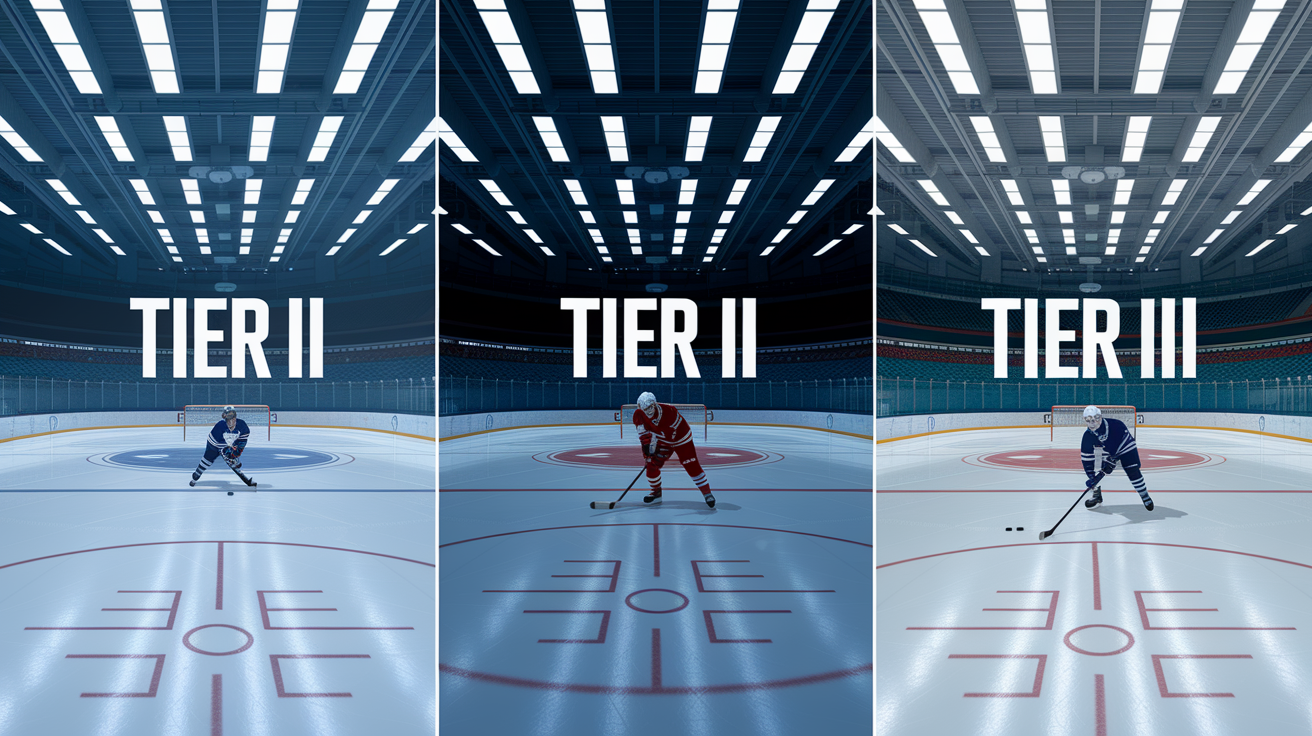
The tier structure in junior hockey directly determines how many college coaches will see you play and how seriously they’ll evaluate your performance. Tier I leagues sit at the top of the NCAA recruiting food chain. Tier II leagues offer strong exposure with more playing time. Tier III or pay-to-play leagues produce far fewer Division I scholarship players.
The line between tiers isn’t just competitive level. The line is scouting density, schedule strength, and how often college programs pull recruits from that league. Play in a Tier I league and you’re already inside the primary recruiting pipeline. Play in Tier III and you need to work much harder to get noticed. Most of your scholarship opportunities will come from Division III schools or lower tier Division I programs.
The USHL is the only Tier I junior league in the United States and the single most watched league by NCAA Division I coaches. The NAHL operates as Tier II and offers a solid development path, especially for players who need more ice time before making the jump to college. The BCHL, which recently restructured to operate as an independent league focused on the college track, has become one of the top pipelines for NCAA commitments. Particularly for Canadian players targeting U.S. schools. Tier III leagues, including the NA3HL and several regional pay-to-play circuits, offer more roster spots and proximity to home but produce a much smaller percentage of Division I scholarship athletes.
For players evaluating where to land, the tier label alone tells you roughly how many college coaches will be in the building on any given weekend.
| League | Tier Level | Annual NCAA Commitments (Approx.) | Primary Division Level |
|---|---|---|---|
| USHL | Tier I (U.S.) | 300+ to Division I | Division I (majority) |
| NAHL | Tier II (U.S.) | 250+ all levels | Division I, II, III mix |
| BCHL | Independent (college-track) | 200+ to U.S. NCAA | Division I (majority) |
| Tier III (NA3HL, regional) | Tier III / developmental | Fewer than 100 to Division I | Division III, club |
NCAA Eligibility Rules Relevant to Junior Hockey Players
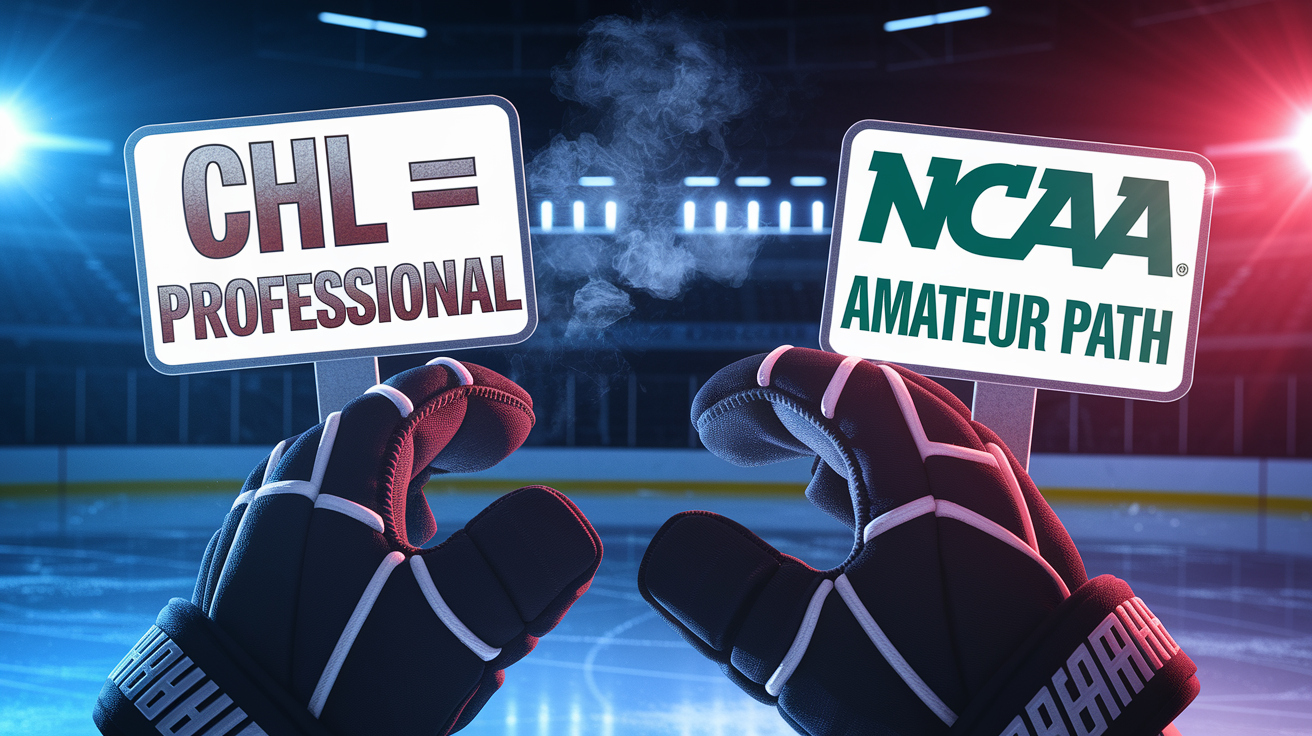
The NCAA treats some junior leagues as professional and others as amateur. That classification directly determines whether you can accept a scholarship offer after your junior career ends.
The most important eligibility line for players considering junior hockey is the distinction between the Canadian Hockey League system (CHL: WHL, OHL, QMJHL) and all other junior circuits. The CHL is classified as professional by the NCAA because players receive a stipend and benefits that exceed the NCAA’s amateur threshold. Once you play a single regular season or playoff game in the CHL, your NCAA eligibility is typically lost. If your goal is an NCAA scholarship, you must avoid the CHL entirely. Instead choose the USHL, NAHL, BCHL, or one of the other Canadian Junior A leagues that preserve amateur status.
Beyond the professional league restriction, the NCAA enforces academic and age related requirements that junior players must navigate carefully. You must register with the NCAA Eligibility Center before enrolling in college, maintain progress toward core course and GPA requirements, and avoid accepting impermissible payments or benefits while playing juniors. Many junior players compete between ages 16 and 20, and college coaches expect you to enroll by age 21 or 22 at the latest. Delay too long or don’t maintain your academic standing? You can lose years of NCAA eligibility even if you never touched professional hockey. The timeline matters as much as the league you choose.
The three main eligibility risks for junior hockey players targeting NCAA scholarships are:
- Playing in a league the NCAA considers professional. The CHL forfeits your eligibility. Always confirm league amateur status before committing to a team.
- Failing to meet NCAA academic requirements. You must complete core courses with the required GPA and submit transcripts to the Eligibility Center, even while playing full time junior hockey.
- Accepting impermissible benefits. Stipends, housing, or payments beyond basic living expenses (billeting, meals, equipment) can jeopardize your amateur status if they exceed NCAA thresholds.
How League Exposure Influences Recruiting and Scouting
The recruiting value of any junior league depends almost entirely on how often college coaches watch games in person or review video from that league. Exposure isn’t abstract. Exposure is the number of Division I, II, and III assistant coaches sitting in the press box on a Tuesday night in January. It’s the number of times your name shows up in a coach’s scouting report after a weekend showcase.
Tier I leagues create exposure by hosting formal league wide showcases that draw dozens of college staffs, scheduling games in markets near major college programs, and maintaining relationships with NCAA coaches who trust the level of play. If you’re in the USHL or BCHL, you’re being evaluated constantly. If you’re in a Tier III league, exposure depends heavily on your team’s reputation, your individual stats, and whether your coach has personal connections to college programs.
The NAHL sits in the middle of the exposure spectrum. College coaches attend NAHL showcases and playoff weekends regularly, but not at the same density as USHL events. The tradeoff is often worth it. A top line NAHL player with 60 points in a season will get noticed by Division I programs even if the scouting frequency is lower than the USHL. For many players, the NAHL offers the best combination of playing time and visibility, especially if the alternative is limited ice time on a USHL roster.
Coaches evaluate not just the league but your role. A fourth line USHL player is often less attractive than a first line NAHL player, because coaches want to see how you perform when the game is on your stick.
Exposure also depends on how well junior leagues distribute game video and statistics. The USHL and BCHL maintain comprehensive video archives and stat platforms that allow college coaches to evaluate players remotely. Smaller leagues often lack that infrastructure, which means you’re invisible unless a coach happens to be in the building.
For players in Tier III or regional leagues, the responsibility to create exposure often falls on you. You need highlight video, a clear stat line, and a coach or advisor who actively contacts college programs on your behalf. In top tier leagues, the exposure comes automatically. In lower tiers, you have to build it yourself.
Scholarship Outcomes and Commitment Statistics by League
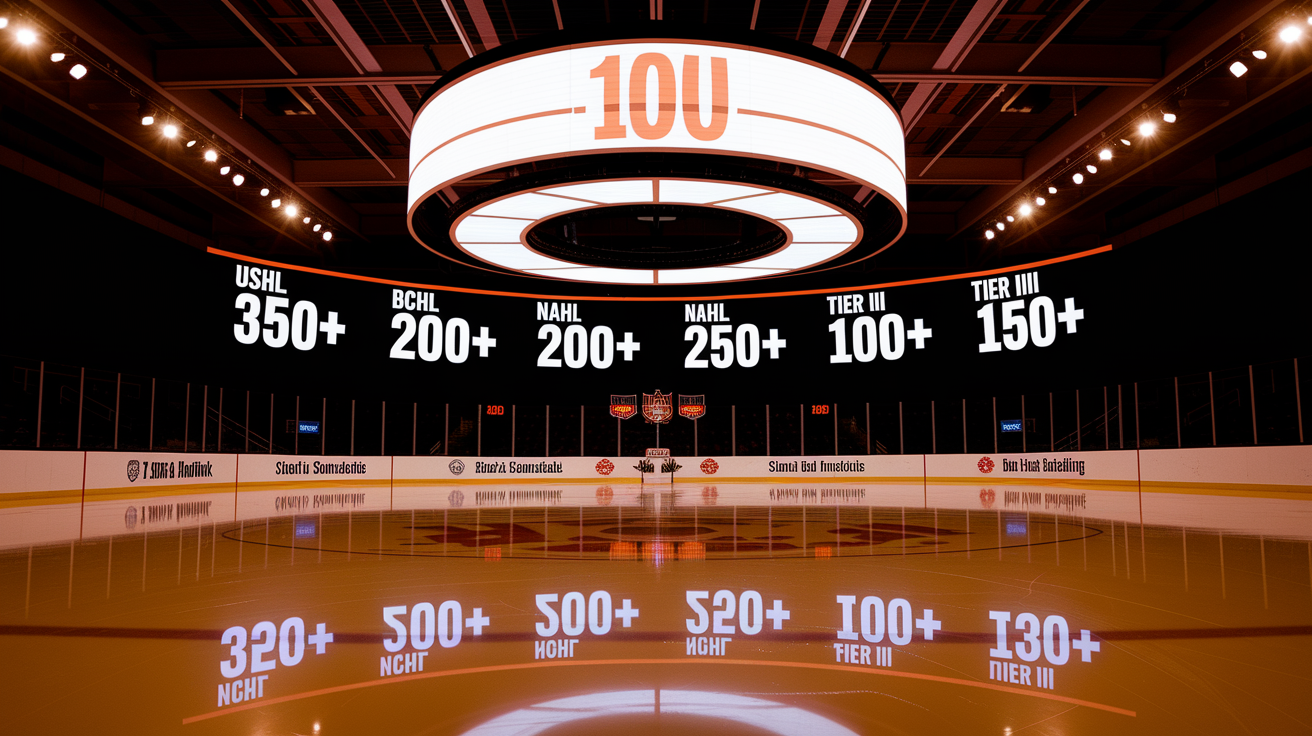
The clearest way to understand how junior leagues affect scholarship chances is to compare the number of NCAA commitments each league produces annually. The USHL consistently leads all North American junior leagues in Division I commitments, averaging over 300 per year. That number represents roughly 60 to 70 percent of all incoming Division I freshmen in any given season.
The BCHL, especially after its restructuring to focus on the college track, produces more than 200 NCAA commitments annually, with a heavy concentration in Division I programs. The NAHL sits slightly below the BCHL in total Division I commitments but spreads its placements across all three NCAA divisions, making it a strong pipeline for players targeting a range of college levels. Tier III leagues produce far fewer commitments overall, and the majority of those commitments are to Division III or club programs rather than Division I scholarships.
The distinction between full and partial scholarships matters when evaluating these outcomes. Division I programs have 18 equivalency scholarships to distribute across rosters of 25 to 28 players, so most players receive partial funding rather than full rides. The majority of USHL and BCHL players who commit to Division I programs receive partial scholarships, often ranging from 25 to 75 percent of total cost. Full scholarships are typically reserved for elite players or key recruits.
Division III schools don’t offer athletic scholarships at all, so NAHL and Tier III players who commit to Division III programs rely on academic or need based aid. The commitment numbers below reflect total commitments, not scholarship dollar amounts, so keep in mind that “commitment” doesn’t always mean “full scholarship.”
| League | Annual NCAA Commitments | Division I Commitments | Typical Scholarship Structure | Notes |
|---|---|---|---|---|
| USHL | 350+ | 300+ | Partial (25–75%); some full | Largest Division I pipeline in North America |
| BCHL | 200+ | 150+ | Partial (30–70%); some full | Strong U.S. NCAA representation |
| NAHL | 250+ | 80–100 | Partial or none (DI); academic aid (DIII) | Balanced across all NCAA divisions |
| Tier III (NA3HL, regional) | 100+ | 10–20 | Academic/need-based (DIII); limited DI | Primarily DIII and club outcomes |
| Other Canadian Junior A (AJHL, SJHL, MJHL) | 150+ | 50–80 | Partial (30–60%) | Strong regional NCAA pipelines |
Choosing the Best Junior Pathway to Maximize Scholarship Chances
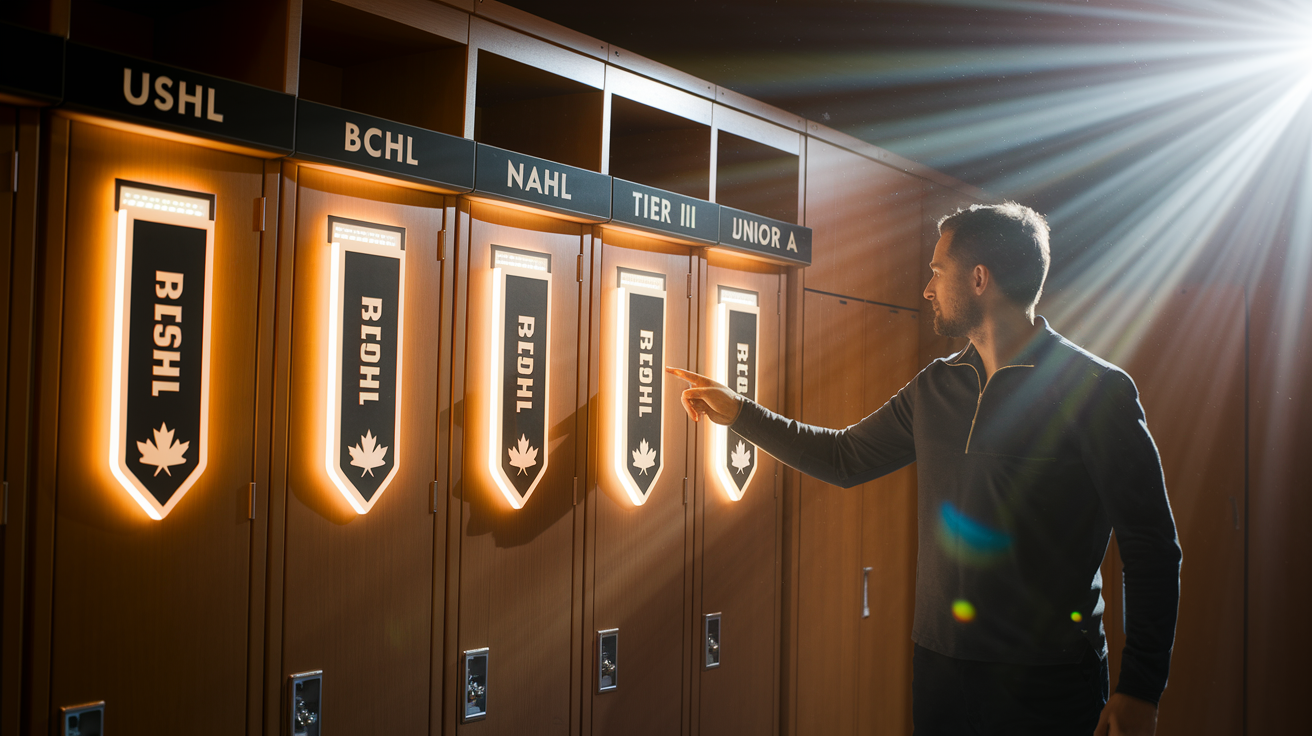
The best junior league for your scholarship chances isn’t always the highest tier league you can access. The best league is the one where you’ll play a meaningful role, get consistent ice time, and perform well enough to attract college attention.
A fourth line role in the USHL might sound prestigious, but if you’re averaging eight minutes per game and finishing the season with 12 points, you’ve likely hurt your recruiting profile compared with a top line NAHL season where you put up 50 points and logged 20 minutes per night. College coaches want to see you in situations that matter. They want to see you on the power play, taking key faceoffs, and playing in overtime. If the league tier is too high for your current development level, you won’t get those opportunities. Your scholarship chances will suffer.
Geography and schedule also matter more than most players realize. If you’re playing in a league that rarely hosts games near the college programs you’re targeting, your exposure will be limited no matter how well you play. The USHL has the advantage of hosting showcases in major hockey markets, but if you’re a West Coast player in a league that schedules most games in the Midwest, the travel burden and scouting gaps can hurt you.
The BCHL and other Canadian Junior A leagues offer strong exposure to U.S. college coaches, but you need to confirm that the teams you’re considering actually draw NCAA scouts rather than assuming the league brand alone will carry you. Some BCHL teams are scouted heavily. Others aren’t. The same variability exists in the NAHL and Tier III leagues. Team reputation and coaching connections often matter as much as the league label.
The most important decision factors when choosing a junior pathway are playing time, league scouting density, coaching quality and college connections, team location and schedule accessibility to NCAA programs, and whether the league preserves your NCAA eligibility.
Playing time determines whether coaches can evaluate your full skill set. Scouting density determines how many coaches will see you. Coaching quality and connections determine whether your coach actively promotes you to college programs or simply hopes you get noticed. Location and schedule determine logistical access for coaches who want to see you live. Eligibility determines whether all your junior development translates into a scholarship opportunity or gets wasted because you picked the wrong league.
All five factors must align, or your junior season becomes a development year without recruiting payoff.
Key decision factors to maximize scholarship chances from junior hockey:
- Playing time and role. Prioritize leagues and teams where you’ll log top line minutes and power play time, even if that means choosing a lower tier league.
- League scouting density. Confirm that NCAA coaches regularly attend games, showcases, and playoffs in the league you’re considering. Ask current players and coaches how often college staffs are in the building.
- Coaching quality and college connections. Choose teams with head coaches or advisors who have active relationships with college programs and a track record of placing players.
- Team location and schedule. Ensure the team’s schedule includes games or showcases in markets where your target college programs recruit. Remote locations reduce exposure unless the team is well known.
- NCAA eligibility preservation. Avoid the CHL if your goal is an NCAA scholarship. Verify that the league and team comply with NCAA amateur rules before signing.
Final Words
Right away. Junior leagues are the main pipeline to NCAA programs. This piece showed which tiers draw the most scouts, the eligibility rules that can bite you, and the commitment numbers that matter.
What to do next is simple. Prioritize leagues and teams that deliver exposure, quality coaching, and real playing time. Keep your amateur status and grades solid.
If you want clarity on how junior hockey leagues affect college scholarship chances, focus on visibility and development this season — those steps actually move the needle.
FAQ
Q: What is the hardest sport to get a college scholarship?
A: The hardest sport to get a college scholarship is typically those with many players but few scholarship spots, like men’s hockey, baseball, and soccer, where competition is heavy and funding is limited.
Q: What is the 5 year rule in college hockey?
A: The 5 year rule in college hockey is the NCAA five-year clock: players have five calendar years from their first full-time college enrollment to use four seasons of athletic eligibility.
Q: Can you get a full ride scholarship to JUCO?
A: You can get a full ride scholarship to JUCO; many two-year colleges offer full tuition and fees, but scholarship amounts and availability vary by school, sport, and state rules.
Q: Is it better to play juniors or college hockey?
A: Whether it’s better to play juniors or college hockey depends on goals: juniors often speed pro exposure and game reps, while college provides education, physical development, and NCAA competition—choose by fit and eligibility.