

Want readers to actually finish your player spotlights, not scroll past them?
Most hockey interviews die because they’re either shallow or messy.
This post shows how to plan, ask, and shape a player interview so it reads like a game-winning shift.
You’ll learn what to prep before you sit down, the exact question types that pull real detail, how to snag the best quotes, and when a stat actually helps the story.
Think of the spotlight as a highlight reel with context, short, vivid, and impossible to skip.
Preparing for an Effective Hockey Player Interview

Good preparation is what separates an interview people skim from one they actually remember. Before you book time with a player, grab their recent game logs, any press releases, team updates, and scroll through their social posts from the last couple weeks. You’re not trying to memorize every assist. You’re looking for patterns, shifts, something that changed. A defenseman just put up three points in two games after going ten straight without one? That’s your opening. Forward got bumped off the penalty kill or switched lines? Ask why.
If you can, watch their last five to ten games. Highlights work if full replays aren’t available. Notice body language during shifts, how they interact with linemates, moments where their effort visibly mattered. You’ll pick up details no press release will give you. Then check what local beat writers and team blogs already covered. If everyone wrote about the offensive breakout, shift your focus to defensive zone exits or what they do in practice when no one’s watching.
Pick one angle before you sit down. Maybe it’s a milestone, a position change, coming back from injury, learning a new system. Whatever it is, that becomes your anchor. It keeps your questions tight and stops the finished piece from turning into a shapeless Q&A nobody asked for.
Here’s a five-step checklist that takes less than an hour:
- Pull the stat line from their last ten games and flag anything that stands out (shooting percentage jump, penalty minutes, ice time shifts).
- Read the team’s last three game recaps and find quotes or moments involving the player.
- Check their Instagram, Twitter, or TikTok for off-ice interests, community stuff, recent personal updates.
- Watch at least one full game or a ten-minute highlight package focused on their shifts.
- Write down three story angles and choose the one that feels least picked over.
Building Strong, Insightful Interview Questions

Generic questions get you generic answers. Ask “How did it feel to score that goal?” and you’ll hear “It felt great, the boys set me up perfectly.” That quote does nothing for you. Try this instead: “Walk me through the fifteen seconds before that goal. What did you see developing, and when did you decide to shoot instead of pass?” Now the player has to reconstruct the shift. You get actual detail about reads, spacing, decisions under pressure.
Balance your question list across four areas: recent performance, personal background, team dynamics, what’s coming next. Performance questions keep the piece grounded in the current season. Personal questions (how you started playing, a coach who changed your approach, what you do between periods) turn stats into a person. Team questions let the player give credit and show some leadership. Forward-looking questions create a natural close and leave readers curious about the next game.
Here are seven question types that consistently produce usable material:
- Moment reconstruction “Describe the sequence that led to your overtime assist. What did you notice about the goalie’s positioning?”
- Tactical insight “Your coach moved you to the left wall on the power play. What’s different about reading plays from that spot?”
- Personal origin “You grew up playing on outdoor rinks in northern Ontario. How does that shape the way you handle puck battles now?”
- Team credit “Which teammate has made your transition to this league easier, and what did they teach you?”
- Adversity or adjustment “After that three-game losing streak, what changed in practice or in the room?”
- Off-ice routine “What does your pre-game routine look like? Any superstitions or habits that actually help performance?”
- Looking ahead “What part of your game are you working hardest to improve before playoffs?”
Conducting the Interview With Confidence and Control
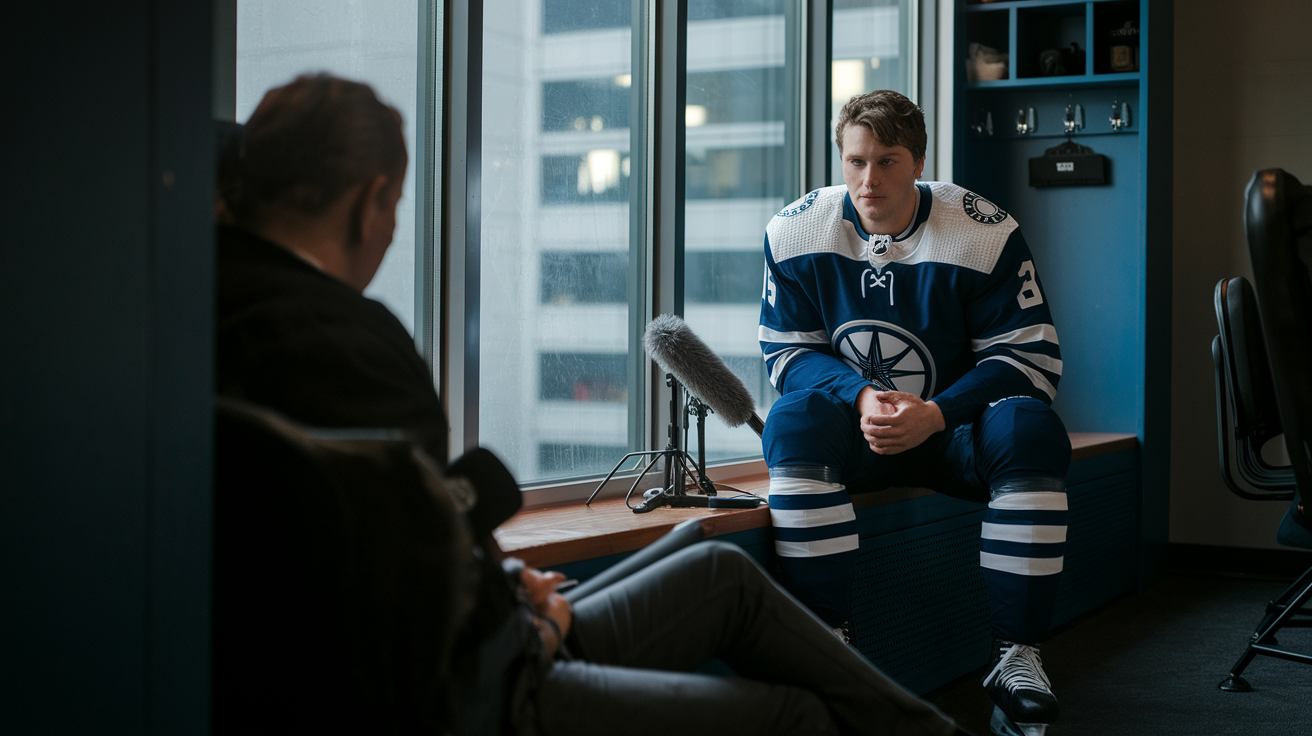
Treat the first two minutes as warm-up. Start with something easy, low stakes. The rink, the weather, last night’s result. Let the player settle in. Hockey players talk more comfortably when they feel like you understand the game. Reference a specific shift or a subtle play most fans missed, and they relax.
Pacing matters more than how many questions you ask. Ask one, listen to the full answer, then ask a short follow-up based on what they just said. Player mentions “our forecheck was clicking”? Immediately ask “What does a good forecheck look like from your position?” That follow-up often delivers the best quote of the interview because it pushes past the surface answer. Don’t stack three questions in one breath. Players will answer the easiest part and ignore the rest.
Adapt to the player’s personality and the time you’ve got. Some players give paragraph answers and need gentle steering back on topic. Others answer in ten words and need more specific prompts to open up. If you only have twelve minutes between practice and the bus, front-load your two or three most important questions. Save the rest for email follow-up if you need to. Confidence comes from knowing your material well enough to ditch your script when the conversation finds something better.
Extracting the Best Quotes and Story Elements

Not every sentence a player says belongs in your final piece. Your job afterward is pulling the lines that reveal something specific, emotional, surprising. A quote like “We need to play better as a team” is filler. A quote like “I watched video of my gap control on that third goal and realized I was cheating two feet too high all night. Coach called it out, and I fixed it the next game” is a keeper. The second version shows accountability, tactical awareness, growth.
Look for moments where the player’s language shifts from team-speak to something more personal. When a player says “honestly” or pauses before answering, they’re often about to say something real. Flag any anecdote with sensory detail. What the rink smelled like, how the ice felt during a specific shift, the exact words a linemate said between periods. Those fragments separate a forgettable Q&A from a piece readers actually remember.
Here’s what makes a quote worth featuring:
Specificity. The player names a drill, a read, a moment, a person instead of speaking in generalities.
Emotion or stakes. The quote conveys pressure, doubt, excitement, relief in a way that connects to the reader’s own experience.
Insight into process. It explains how a play developed, how preparation paid off, or how the player thinks during live action.
Credit or humility. The player acknowledges a teammate, coach, or mistake in a way that shows leadership or self-awareness.
Structuring a Player Spotlight for Maximum Impact

A strong spotlight follows a clear arc. Start with a hook that drops the reader into a defining moment (a goal, a save, a hit, a conversation in the locker room), then step back to provide context about who the player is and how they got here. From there, weave in recent performance details and personal insights before closing with a forward-looking note that gives readers a reason to watch the next game.
Break the piece into digestible sections using subheads or natural paragraph breaks every three to four paragraphs. If the spotlight runs longer than 800 words, use a pull-quote to give the eye a rest and highlight the best line from the interview. Readers should be able to skim the piece in ninety seconds and still walk away with a clear sense of the player’s story and current role.
You don’t need to follow the interview order. If the player’s best quote came at minute eighteen, move it up. If a stat provides context for an anecdote, place the number right before the story.
| Section of Spotlight Article | Purpose | Recommended Length |
|---|---|---|
| Opening hook | Drop reader into a defining moment or compelling scene | 50–80 words |
| Background and context | Establish who the player is, position, recent role, and key storyline | 100–150 words |
| Recent performance and insight | Blend stats, quotes, and tactical observations to show current form | 250–400 words |
| Closing and forward look | End with a memorable quote or preview of upcoming games/goals | 50–80 words |
Weaving Stats Into a Personal Story

Numbers matter when they explain why a moment felt significant or how a player’s role evolved. Saying “Smith has eight goals in his last twelve games” tells the reader something happened. Saying “Smith has eight goals in his last twelve games after the coach moved him to the net-front role on the power play, where his screen and tip work opened up shooting lanes for the defense” tells the reader why it happened and what it means going forward. Context turns a stat into part of the narrative instead of a random data point.
Use stats sparingly. Only when they deepen understanding or validate a claim the player made. If a forward mentions working on faceoff consistency, include his faceoff win percentage over the last month and compare it to his season average. If a goalie talks about staying calm under pressure, reference save percentage in third periods or one-goal games. The stat should feel like evidence that supports the story, not a separate section you paste in because you think spotlights need numbers. When a number helps the reader see the game more clearly, include it. When it doesn’t, leave it out.
Common Pitfalls in Player Spotlight Interviews

Weak spotlights happen when preparation, question quality, or narrative focus breaks down. The most common mistake is relying on questions every player has answered a hundred times (“What does this win mean to the team?” or “How do you stay focused?”) and then wondering why the answers sound generic. Another frequent error is burying the best material at the end because you followed the interview order instead of reorganizing for impact. If the player’s most interesting quote came late in the conversation, move it up.
Avoid these five pitfalls:
- Asking only performance questions. Stats and game results matter, but personal background and off-ice routines give the piece texture and make the player relatable.
- Ignoring follow-up opportunities. When a player hints at something interesting, ask them to expand. One-question-one-answer interviews feel stiff and transactional.
- Overloading the piece with statistics. Readers came for the human story. Use numbers to support the narrative, not replace it.
- Failing to choose a clear angle. A spotlight that tries to cover everything (career history, recent stats, team dynamics, personal life) ends up covering nothing well. Pick one central thread.
- Publishing without a strong closing. The last paragraph should leave the reader with a memorable image, quote, or reason to care about the player’s next game. Ending with “We’ll see how the season goes” wastes the final moment.
Final Words
in the action, this guide walked you through prep, quick research on recent games, and picking a clear angle. It then showed how to craft open-ended hockey interview questions and run the session confidently.
We covered pulling strong quotes, shaping a spotlight with a simple narrative arc, and using stats to boost the story without drowning it. We flagged common pitfalls to avoid.
Use this checklist next time you sit with a player. It’s a practical map for how to write a compelling player spotlight interview for hockey blogs. You’ll get cleaner copy and better stories.
FAQ
Q: How to write a blog based on an interview?
A: To write a blog based on an interview, pick a clear narrative angle, transcribe standout quotes, frame key moments with context and stats, and finish with a takeaway or what to watch next.
Q: What are the 4 basic skills in hockey?
A: The four basic skills in hockey are skating, stickhandling (puck control), passing, and shooting. Practice them in game-like reps to improve edges, first pass, and shot selection.
Q: What do you call a girl who loves hockey players?
A: A girl who loves hockey players is usually called a hockey fan; if she’s romantically involved you might hear “girlfriend,” or “hockey mom” for a parent supporting players.
Q: What are good interview questions for athletes?
A: Good interview questions for athletes are open-ended and mix performance, preparation, turning points, team role, off-ice life, goals, and a quick rapid-fire question to show personality.