

Think a hot goal streak can erase a weak GPA?
Not even close.
Academic rules, core-course counts, the NCAA sliding scale, and Eligibility Center clearance shape who gets official offers and scholarship conversations.
This post lays out the must-hit GPA thresholds, the 16 required core courses, how test scores trade with GPA, and the timeline to register and submit transcripts.
Read this to know what to fix now, not during a frantic senior season.
Coaches notice earlier than you think.
Core Academic Standards Every Hockey Recruit Must Meet

NCAA Division I requires you to finish at least 16 NCAA-approved core courses and hold a minimum core-course GPA of 2.3. Division II requires the same 16 courses with a minimum core-course GPA of 2.2. These core courses must come from your high school’s approved list. Electives like gym, driver’s ed, or personal finance don’t count, even if they show up on your transcript.
The 16 required core courses break down like this:
4 years of English
3 years of math (Algebra I or higher)
2 years of natural or physical science (must include at least one lab)
2 years of social science
1 additional year of English, math, or science
4 additional years of approved courses (foreign language, philosophy, religion, or other academic electives)
SAT or ACT scores also affect eligibility through the NCAA’s sliding scale, which links your core-course GPA to your test score. A higher GPA allows a lower test score and vice versa. You send test scores to the NCAA Eligibility Center using code 9999. Many schools have adopted test-optional admission policies, but coaches often still review scores during recruiting evaluations, academic pre-reads, and scholarship decisions. Skipping the test because a school is “test-optional” can limit your recruiting leverage and hurt your chances at merit aid.
Meeting the NCAA minimum doesn’t mean you’re competitive for scholarships. Most recruited hockey players show cumulative GPAs around 3.3 or higher. If you’re targeting academically selective programs or Ivy League schools, expect coaches to look for GPAs near 3.7 or above. The NCAA floor exists to certify eligibility, not to predict which recruits will actually receive offers.
NCAA Eligibility Center Requirements for Hockey Recruits
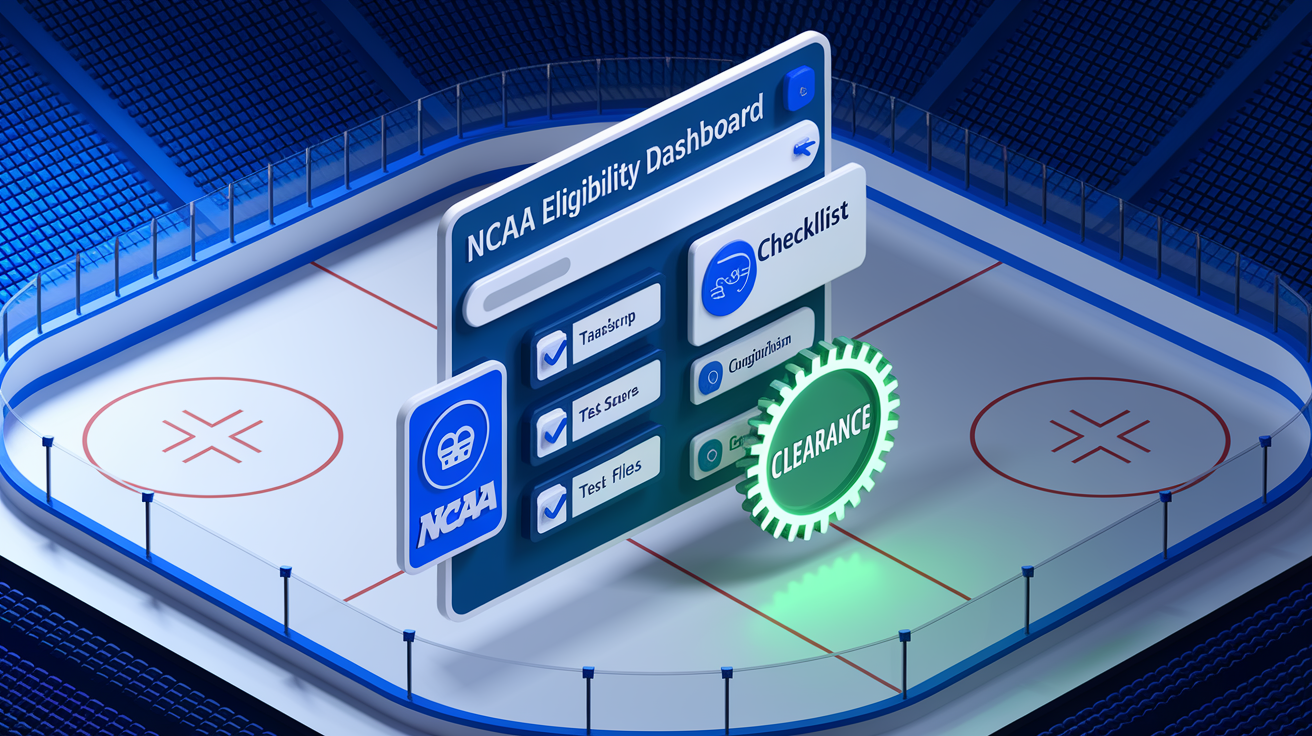
Division I and Division II hockey recruits must register with the NCAA Eligibility Center to be cleared for official visits, scholarship offers, and competition. The Eligibility Center verifies that your high school courses meet NCAA standards, that your grades and test scores satisfy the sliding scale, and that you’ve remained an amateur. Without a cleared status, coaches can’t extend official offers. Your recruiting process stops.
Registration opens as early as freshman year, but the practical window is sophomore year or early junior year. Waiting until senior fall creates problems. Late registration can delay your certification by months, block official visits during your senior season, and push back scholarship conversations when rosters are filling fast. If transcripts or test scores arrive late or if your school’s course list hasn’t been verified by the Eligibility Center, your file sits incomplete while other recruits move forward.
Eligibility Center Timeline and Process
The Eligibility Center matches your transcript against your school’s list of approved core courses. If your school has never submitted its list or if the list is outdated, your courses may not be recognized even if they should count. You need to confirm that your high school has an active, verified course list on file with the NCAA before you submit your transcript. Many families assume counselors handle this automatically. They don’t always. Athletes who register early have time to catch and fix mismatches. Athletes who wait until senior year often discover problems too late to repair.
Required submissions include:
Official high school transcripts sent directly from your school (not by you or your parents)
SAT or ACT scores sent using NCAA code 9999
Verification that every course on your transcript matches your school’s approved core-course list
Amateurism certification, completed during senior year
GPA and Test Score Expectations for Hockey Scholarship Competitiveness

Clearing the NCAA minimum and earning a scholarship are two different benchmarks. A 2.3 GPA satisfies Division I eligibility but won’t make you a strong academic candidate at most programs recruiting seriously. Real scholarship conversations start around a 3.0, and most athletes who sign are closer to 3.3 or higher. At academically selective Division III schools and Ivy League programs, coaches typically look for 3.7 or above, since those schools don’t lower admission standards for athletes.
The sliding scale allows lower test scores if your GPA is higher, but that doesn’t mean ignoring the SAT or ACT is a good strategy. Even at test-optional schools, coaches use scores to assess academic fit, compare recruits in tie-breaker situations, and identify merit aid opportunities. Retaking the test once or twice to improve your score can shift the math in your favor, especially if your GPA sits near the middle of the recruiting pool.
| GPA Range | Typical Outcome | Notes |
|---|---|---|
| Below 2.3 (DI) / 2.2 (DII) | Ineligible for NCAA competition | Must pursue credit recovery or other eligibility pathways |
| 2.3–3.0 | Clears NCAA floor but not competitive at most programs | Partial scholarships rare; limited to programs with lower academic targets |
| 3.0–3.5 | Competitive range for many DI/DII scholarship offers | Strong athletic performance required; test scores still matter |
| 3.5–4.0+ | Opens doors to selective DIII, Ivy, and top academic DI programs | Merit aid and need-based aid more accessible; coaches prioritize academic fits |
Division-Level Academic Rules and Differences for Hockey Scholarships

Division I and Division II both use NCAA core-course and GPA minimums (2.3 for DI, 2.2 for DII) and both require Eligibility Center registration. Division III doesn’t offer athletic scholarships and doesn’t enforce the same NCAA academic floor. Instead, DIII schools set their own admission standards, which are often significantly higher than NCAA minimums. Many strong DIII hockey programs recruit athletes who would academically qualify for DI but choose the academic rigor and campus culture of a selective liberal arts school.
Ivy League programs fall under Division I but can’t award athletic scholarships. They compete under the same NCAA eligibility rules but layer on institutional admission requirements that routinely exceed a 3.7 GPA and require strong test scores. Financial aid at Ivy schools is entirely need-based, so families complete the FAFSA and CSS Profile rather than negotiating athletic scholarship percentages. The coach’s influence in admissions is real but limited. Academic credentials must clear the school’s admissions office independently.
NAIA schools follow separate eligibility standards and aren’t covered by the NCAA Eligibility Center. If you’re considering NAIA hockey programs, you register through the NAIA Eligibility Center and meet different GPA, test score, and course requirements. The NAIA minimum is typically a 2.0 GPA combined with a minimum test score or class rank threshold, but each school also applies its own admission policies on top of that baseline.
Comparing Admission vs Athletic Eligibility
Being eligible to compete doesn’t mean you’ll be admitted. The NCAA certifies that you meet the floor to play, but each college decides independently whether you meet their admission standards. Selective Division III schools and Ivy programs recruit athletes who would sail past NCAA minimums because those schools evaluate the entire applicant. Rigor of courses, essays, recommendations, extracurriculars. Not just the core-course GPA. If your grades and scores don’t align with the school’s admitted-student profile, the coach can’t make exceptions. Plan your high school course load and GPA strategy knowing that the finish line is admission, not just eligibility.
Academic Planning Timeline for Prospective Hockey Scholarship Athletes

The best time to register with the NCAA Eligibility Center is during sophomore year, or at the latest early in junior year. Early registration lets you verify that your school’s course list is up to date and that the classes you’re taking will count as core courses. Waiting until senior year compresses the timeline and removes your margin for error if transcripts are delayed, test scores don’t arrive on time, or a course you thought was approved turns out not to be.
Here’s a practical step-by-step timeline:
Freshman and sophomore years: Meet with your counselor to confirm you’re enrolled in NCAA-approved core courses. Register with the Eligibility Center by the end of sophomore year.
End of sophomore year: Request that your high school send an official transcript to the Eligibility Center. Verify that the courses listed match the school’s approved list.
Junior year: Take or retake the SAT or ACT. Send scores to the Eligibility Center using code 9999. Request another updated transcript at the end of junior year to reflect completed courses and grades.
Summer before senior year: Double-check your core-course count and GPA. If you’re short on required courses or your GPA is below target, explore summer school or online credit recovery options before senior year starts.
Senior year: Complete the amateurism questionnaire in your Eligibility Center account. Send a final official transcript after you graduate, confirming all 16 core courses and your final core-course GPA.
Late registration is one of the most common mistakes families make. If you register in November of senior year and your school has never submitted its course list to the NCAA, you may not be cleared in time for official visits during your senior season. Coaches move fast when filling rosters. A delayed certification can cost you the scholarship opportunity you worked years to earn.
Maintaining Academic Eligibility After Earning a Hockey Scholarship
Once you arrive on campus, the academic requirements shift from high school core courses to college-level standards. NCAA rules require full-time enrollment (typically 12 credit hours per semester) and you must make continuous progress toward your degree. Each year you must complete a minimum percentage of the credits required for graduation and maintain a GPA that meets both NCAA and institutional standards.
If you fall below the required GPA or fail to complete enough credit hours, you enter academic probation. During probation you may be restricted from competition, practice, or travel until you return to good standing. Some programs will reduce or pull scholarship funding if academic problems persist. The NCAA’s Academic Progress Rate (APR) also penalizes teams whose players fail academically, so coaches monitor grades closely and provide academic support resources (tutors, study halls, academic advisors), but the responsibility to attend class and pass courses is yours.
Progress-toward-degree rules tighten each year. By the end of your second year you must have completed 40 percent of your degree requirements, 60 percent by the end of year three, and 80 percent by year four. Missing these benchmarks can make you ineligible for your senior season even if your GPA is fine. Athletes who change majors late, drop courses frequently, or take light loads to protect GPA often hit progress-toward-degree problems that cost them eligibility when it matters most.
Academic Recovery Options for Hockey Recruits Falling Behind

If your core-course GPA is below the NCAA minimum or you haven’t completed all 16 required courses, you have options to repair your academic file before graduation. Retaking a course you failed or earned a D in allows you to replace the grade in your core-course GPA calculation. The NCAA uses the higher grade, not an average of both attempts, so a single strong retake can materially change your eligibility math.
Summer school and NCAA-approved online courses let you add missing core classes or swap out an unapproved elective for a core course that counts. Not all online programs are NCAA-approved, so verify any course through the Eligibility Center before enrolling. Some families assume that any accredited online high school will work. Many don’t meet NCAA standards, and credits earned there won’t count toward your 16-course requirement.
Recovery strategies include:
Retaking a failed or low-grade core course to replace the original grade in your GPA calculation
Enrolling in summer school to complete a missing lab science, fourth year of English, or third year of math
Using an NCAA-approved online provider to add a core course if your high school schedule can’t fit it
Replacing an elective that doesn’t count (like health or personal finance) with an approved academic course during your senior year
Many recruits don’t realize that their core-course GPA is calculated separately from their cumulative GPA. You might have a 3.2 overall but only a 2.8 in your 16 core courses if you stacked your schedule with easier electives. Identifying that gap early and targeting the right courses to retake or add can move you from ineligible to competitive in a single semester.
International and Transfer Student Academic Requirements for Hockey Scholarships

International recruits can earn NCAA hockey scholarships, but the academic certification process is more complex. You must provide official transcripts from every secondary school you attended, and if those transcripts aren’t in English you must submit certified translations. The NCAA also requires a credential evaluation that converts your international grades and courses into a U.S. equivalency. This evaluation determines your core-course GPA and whether your coursework satisfies the 16-course requirement.
Most international athletes are also required to submit SAT or ACT scores, even if the college itself is test-optional for admission. English-language proficiency may be assessed separately through TOEFL or IELTS scores, depending on the school’s admission policies. The credential evaluation and translation process can take weeks or months, so international players should begin the Eligibility Center registration and transcript submission process as early as possible (ideally by the end of their second-to-last year of secondary school).
Transfer students follow different rules. If you played at a four-year NCAA school and want to transfer, you must meet the NCAA’s transfer eligibility requirements, which include being academically eligible at your previous school, meeting progress-toward-degree standards, and obtaining a release or following the transfer portal process. If you’re transferring from a junior college (JUCO), you must complete a certain number of transferable credits and achieve a minimum GPA to be immediately eligible at a Division I or Division II program. Each school also enforces its own transfer admission standards, which may be stricter than NCAA rules. A transfer recruit must clear both the NCAA and the new school’s registrar before a coach can offer a roster spot or scholarship.
Final Words
You’re lining up your high school plan: picking core courses, registering with the NCAA Eligibility Center, and sending transcripts and test scores.
This post walked the 16 core-course rule, DI/DII GPA minimums (2.3/2.2), the sliding scale for SAT/ACT, realistic recruit GPAs, timelines, retention rules, and recovery options.
Follow the timeline: register by sophomore year, verify courses early, and use approved summer or repeat classes if needed. Meet the academic requirements for hockey scholarships and keep more doors open, you’ve got this.
FAQ
Q: How hard is it to get a hockey scholarship?
A: Getting a hockey scholarship is competitive. Roster spots are limited, so coaches need high-level play, exposure, and solid academics—most successful recruits show about a 3.3 GPA or higher and strong game tape.
Q: What GPA do you have to have to get a sports scholarship?
A: The GPA needed to get a sports scholarship starts with NCAA minimums: Division I 2.3 core-course GPA and Division II 2.2. Competitive scholarship candidates usually hold closer to a 3.0–3.5 GPA.
Q: What is the 3 2 1 rule in hockey?
A: The 3-2-1 rule in hockey is a positional forecheck/defensive scheme: three players pressure deep, two provide support higher in the zone, and one stays back to protect the point and prevent breakaways.
Q: What GPA gets you a full-ride scholarship?
A: A GPA that gets you a full-ride varies: academic full rides often expect about a 3.7+ GPA; athletic full rides depend more on sport and program—full hockey scholarships are rare and rely on elite talent.