

Clearing the ball is often the wrong play after a turnover.
You get two to four seconds to re-form or the opponent finds space and attacks.
A quick zone reset is the faster, smarter choice: drop the back line, compress width, assign the nearest player to press, and use short voice cues to sync everyone.
This guide walks through the exact movements, communication words, and drills coaches and players should practice so your team regains shape fast and keeps possession instead of giving it away.
Quick Reset Protocol for Regaining Team Shape and Possession

The moment your team loses defensive shape, you’ve got 2 to 4 seconds to re-establish structure before the opponent capitalizes. A quick zone reset is the transition from broken defensive organization back into a compact, possession-ready formation. The goal isn’t to clear the ball. It’s to reorganize spatially so you can win it back and keep it.
Your back line needs to drop and pinch toward the ball immediately. The two nearest center backs shift to cut off central passing lanes. Fullbacks tuck inside to compress horizontal width to about 35 to 40 yards. Your defensive midfielder steps into the seam between the back line and the next wave of opponents, reading whether to press the ball or mark the most dangerous forward option. Wide players track back on diagonal recovery runs, aiming to arrive goal-side of their marks within three to four seconds.
Communication cues must be automatic. Assign one center back and the holding midfielder to call “reset,” “compact,” or directional instructions like “shift left” the instant shape is lost. These verbal triggers help all eleven players synchronize movement without hesitation. When your team hears “reset,” everyone knows to prioritize zonal responsibilities over chasing individual opponents.
Here’s the rapid spacing correction sequence:
- Recognize the trigger. Poor body shape on the receiver, a loose first touch, or a backpass signals the moment to initiate the reset.
- Drop and compress. The back line retreats 5 to 10 yards and narrows width. Midfielders step into covering lanes between lines.
- Assign ball pressure. The nearest player to the ball applies controlled pressure to force a predictable pass or delay forward progress.
- Establish support angles. Two teammates position themselves at 45 degree angles behind the presser, ready to intercept or step if the ball is played wide.
- Communicate the next action. Once compact, the holding midfielder or a center back calls “press now” or “hold” to coordinate the next defensive or possession step.
Core Drills for Quick Zone Reset Mastery

Structured drills compress the learning cycle from weeks into days. By isolating the exact moments when shape collapses and practicing the reset under controlled pressure, players build muscle memory for spacing, communication, and ball recovery. You’re rehearsing directional recovery and compact positioning until the movements become automatic.
Each drill below trains a specific reset pattern. Start with unopposed walk-throughs, then add passive resistance, and finally introduce full speed opposition. Players internalize zonal responsibilities so they can execute resets instinctively during live play.
5v3 Reset Box. A 30 by 20 yard grid with five attackers working against three defenders. Attackers lose the ball on purpose every 15 seconds. Defenders immediately reset into a compact triangle, apply pressure to the ball, and try to win it back within four seconds. If they succeed, they hold possession for six passes before restarting.
Transition Funnel. Set up a 40 by 30 yard area with two mini goals on one end and a full goal on the other. When the defending team regains the ball in the funnel, they must reorganize into a 3-2 shape within three seconds, then build out through the mini goals. The attacking team counter-presses to disrupt the reset.
Compact-Recover-Play Out. A thirds-based drill where six defenders face eight attackers in the middle third. When possession turns over, the six must drop into the defensive third, compress horizontally to 30 yards, and use a 2v1 build pattern to play the ball back into the middle third safely. Repeat for six cycles.
Dual-Zone Pressure Reset. Divide a half field into two horizontal zones. When the ball enters the lower zone, four midfielders must reset by dropping five yards, shifting laterally to cover the ball-side lane, and sending one presser. The remaining three hold a covering triangle. Rotate pressing responsibilities every turnover.
Situational Variations for Different Game Phases

Resetting after a midfield turnover requires the fastest response. If your team loses the ball in the center circle, your defensive midfielder and nearest center back must immediately step up to delay the counterattack while wide midfielders sprint back on diagonal lines. Force the opponent sideways or backward, buying your back line two to three seconds to compress and re-establish a clean line of confrontation. Once the opponent’s first forward pass is cut off, the reset is complete and your team can begin to build possession from a stable base.
When outnumbered, the reset shifts from full compression to intelligent zonal coverage. If you find yourself defending 4v6 in transition, your back line should retreat to the edge of the penalty area and form a narrow block of about 25 yards wide. The two nearest midfielders drop into the gaps between defenders, creating a temporary 6v6 until reinforcements arrive. Don’t press the ball aggressively in this scenario. Instead, show the opponent toward the sideline and wait for your shape to fill in. The reset is slower but more controlled.
Against opponents who play direct or launch balls wide immediately after winning possession, your reset must prioritize horizontal shifting over vertical compression. Fullbacks stay wider, around 5 to 8 yards from the touchline, to meet wide runners early. Center backs shift ball-side but don’t pinch as tightly. The holding midfielder steps laterally to cover the back post diagonal. Communication changes to “shift ball-side” or “cover far post,” signaling that the reset is about preventing crosses and second balls rather than central compactness. Once the wide threat is neutralized, the team can re-narrow and look to win the ball in a less dangerous area.
Communication Systems That Support Fast Resets
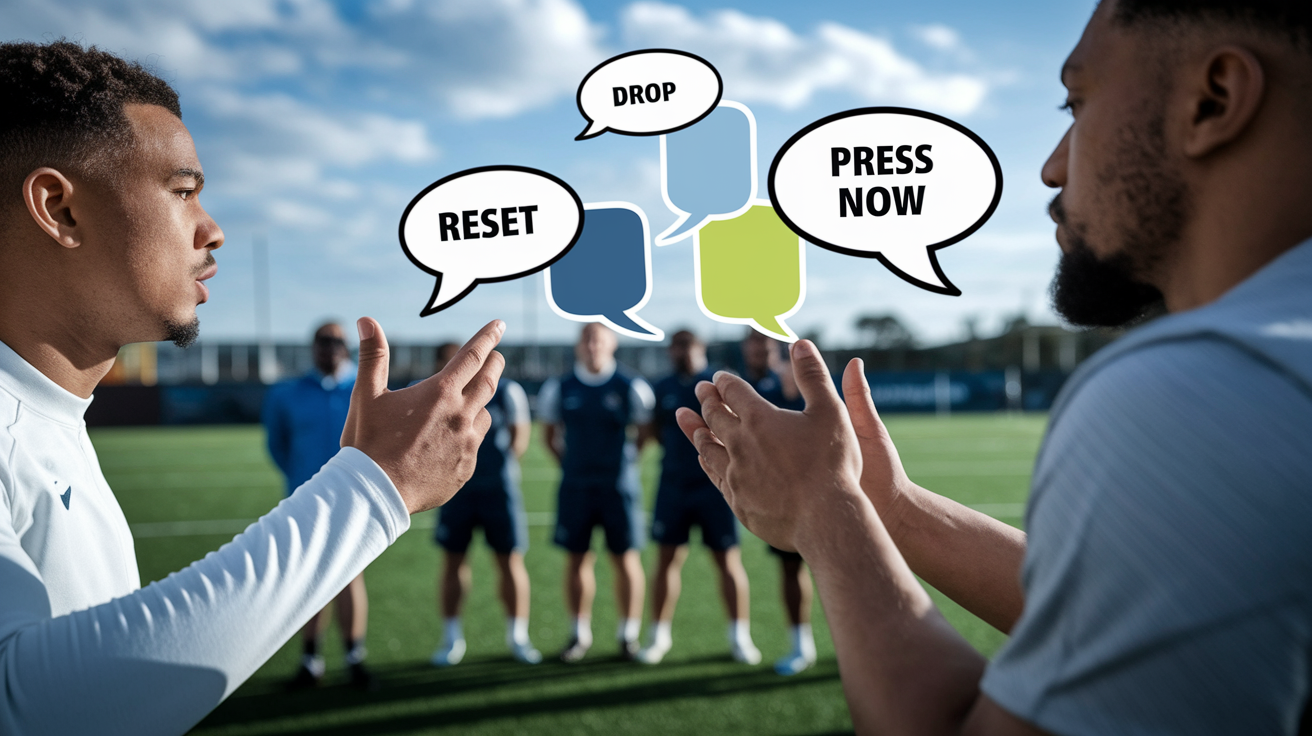
Patterned cue words eliminate guesswork. Assign fixed meanings to short calls. “Man on” warns a teammate under immediate pressure. “Time” signals space to turn. “Drop” tells the back line to retreat five yards. “Switch” instructs the team to shift the point of pressure to the opposite flank. “Thirds” reminds players to respect zonal boundaries. “Press now” initiates coordinated pressure on the ball. Each word has one job, and every player knows what to do when they hear it.
Gestures work when verbal calls are drowned out by crowd noise or distance. A raised fist can mean “compact now.” Two hands pushing down signal “drop the line.” Pointing left or right directs lateral shifts. An open palm held up means “hold your position, don’t step.” Train these signals in every session so they become second nature.
Every unit needs a designated communication leader. Back line, midfield, forwards. Typically, a center back runs the back line, calling shifts and drops. The holding midfielder organizes midfield spacing and decides when to press or delay. A forward or winger can manage the first line of pressure, signaling when to step and when to drop off. When each leader knows their responsibility, the reset happens faster and with fewer mistakes. Silence on the field means broken shape. Constant, clear communication means your team resets before the opponent can exploit the gap.
Progressive Training Tiers to Reinforce Reset Patterns
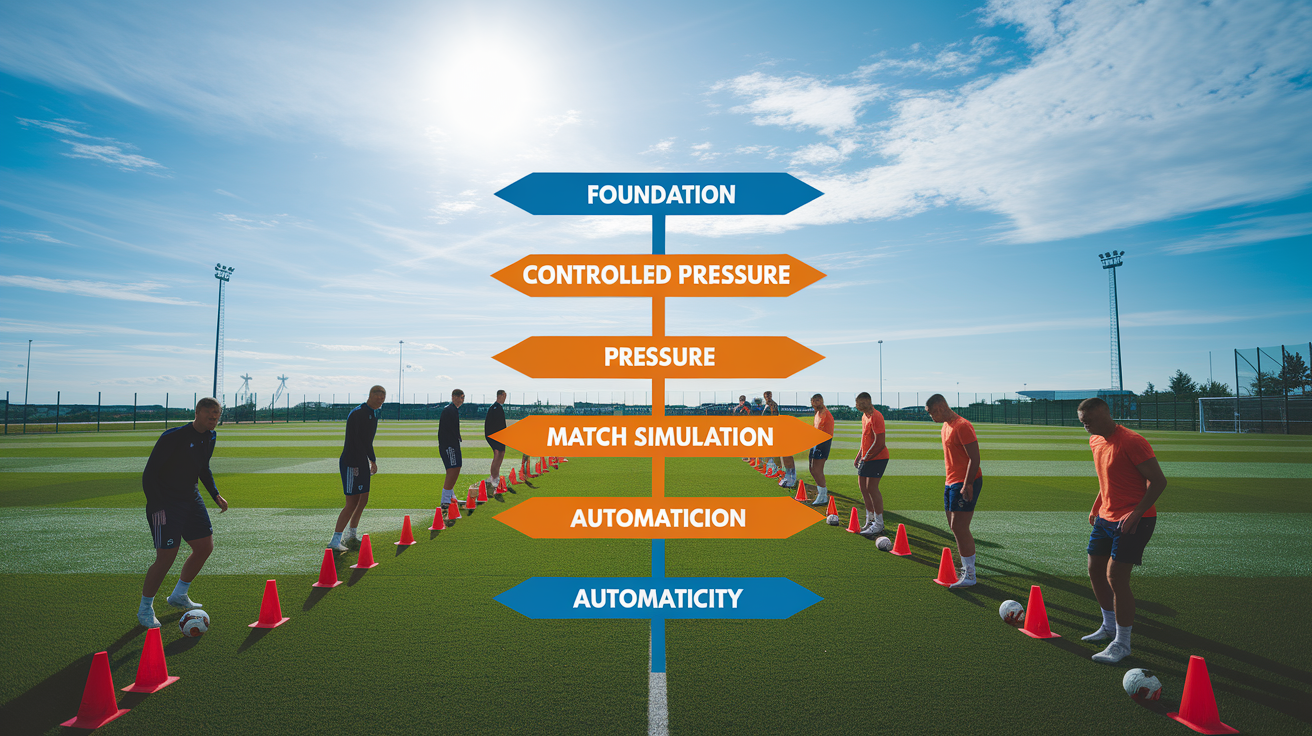
Start with low pressure technical resets where players walk through positioning without opposition. Use mannequins or cones to represent opponents and rehearse drop depths, lateral shifts, and passing lane coverage. The focus is on spacing accuracy and verbal cues. Players should be able to name their role and execute the movement without thinking.
Once spacing is clean, add passive pressure and live ball movement. Introduce a small number of opponents who apply light resistance but don’t press aggressively. Now players must read the ball, communicate, and adjust their reset in real time. Gradually increase opponent intensity until the drill mirrors full match pressure. By the final stage, players execute resets at game speed with no hesitation.
| Stage | Focus | Duration |
|---|---|---|
| Foundation | Unopposed walk-throughs; spacing and verbal cues only | 2–3 weeks |
| Controlled Pressure | Passive opponents; light ball contest; shape under mild disruption | 3–4 weeks |
| Match Simulation | Full speed resets; live turnovers; game-realistic chaos | 4–6 weeks |
| Automaticity | Resets executed instinctively in scrimmages and matches | Ongoing |
Final Words
You’re under pressure, shape’s gone, and the reset clock is ticking. This piece walked through a Quick Reset Protocol, practical drills, situational tweaks, communication cues, and a training progression to lock it in.
Work the five core actions: spacing, first-pass options, cue words, coordinated pressure, and sequencing in game-like reps.
Use quick zone reset techniques to retain possession and turn turnover moments into control. Keep drilling—your team will recover quicker and play with calmer possession.
FAQ
Q: What is the 4 3 3 possession formation?
A: The 4-3-3 possession formation is a back four, three midfielders, and three forwards set up to keep the ball through short passing, flank overloads, and central midfield control.
Q: Why is 4 2 3 1 so popular now?
A: The 4-2-3-1 is popular because it balances defensive protection with attacking creativity, using two pivots to screen the back line and three advanced midfielders to link play and create chances.
Q: How does 4 2 2 2 work?
A: The 4-2-2-2 works by pairing two holding midfielders with two attacking mids and two forwards, creating compact vertical lines, quick transitions, and central overloads for short passing.
Q: What should a team do immediately after losing possession?
A: A team should immediately regroup by pressuring the ball, forcing a predictable pass, and compacting its shape within two to four seconds while using clear cues like “reset” and “compact” to organize recovery.