

Carrying the puck over the blue line isn’t always the smartest play.
This post breaks down the three entry options—carry, pass, dump—and shows when each creates real scoring chances.
You’ll learn to read gaps, use third-man support, and time passes so you keep possession.
That matters, because a possession entry is three to four times more likely to produce a shot within ten seconds, so you’ll finish knowing which entry fits the ice, the opponent’s structure, and your lineup.
Core Offensive Zone Entry Methods and When to Use Them
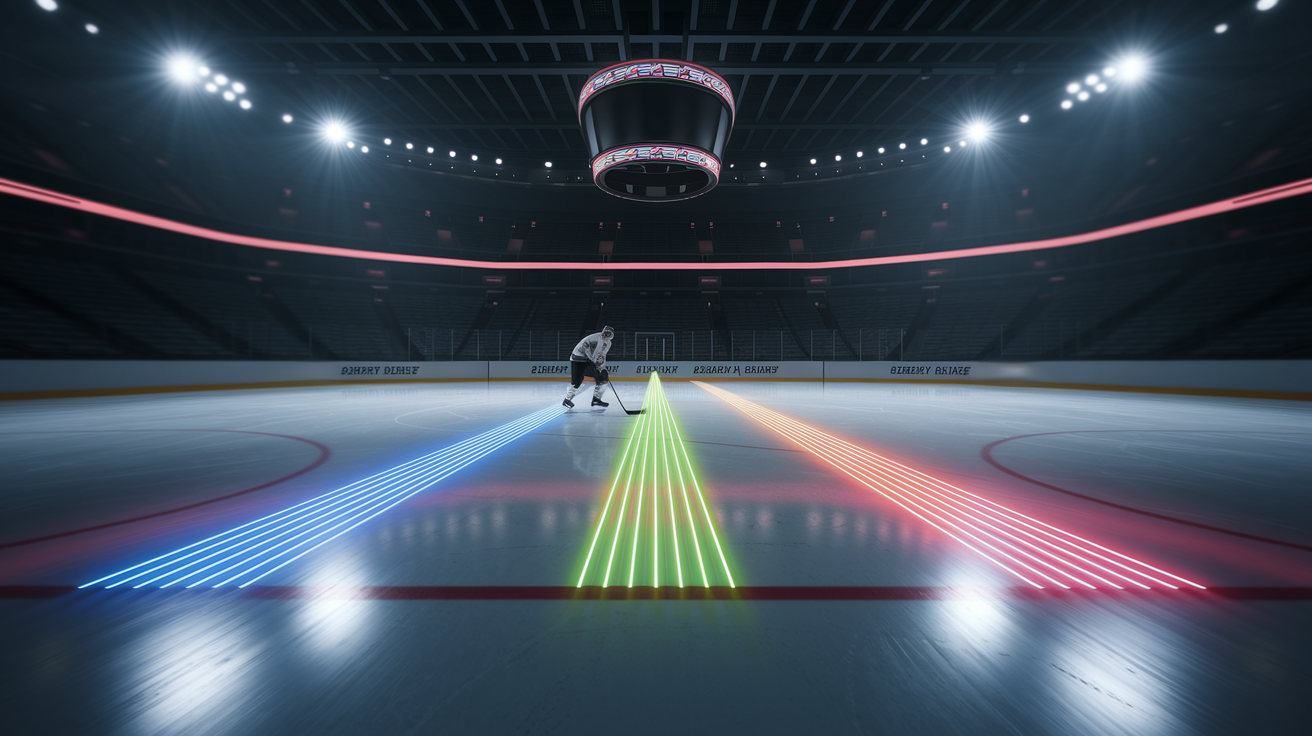
Every offensive zone entry comes down to three options: you carry it in, you pass it in, or you dump it. Controlled carries mean a player skates the puck over the blue line with possession and keeps his options open. Pass-based entries use timed passes (lateral, lead, or stretch) to beat defenders before you cross. Dump-and-chase entries are rims or chips meant to win races and set up forechecks when speed’s gone or the gap closes. The tradeoff? Possession certainty versus risk. Controlled and pass entries give you better possession rates but need cleaner reads and more support. Dump-ins trade immediate possession for lower turnover risk and a chance to reset when things stall.
Success rates tell the story. Controlled entries keep possession around 50 to 65 percent of the time. Pass-ins, when they connect, hold possession 55 to 70 percent. Dump-and-chase entries? Only about 20 to 35 percent. What matters more is this: entries that keep possession are roughly three to four times more likely to generate a shot within ten seconds. That multiplier alone shapes what kind of offense you can run.
Pick your entry by reading what’s in front of you. Loose gap control, soft blue-line pressure, or a power play where you need playmaking lanes? Use controlled carries. Against passive 1-4 or 1-2-2 neutral traps that clog the middle, pass-ins stretch defenders and create odd-man chances. When you’re facing aggressive forechecking, tight gaps, or protecting a lead late, dump-and-chase lets you change lines, tire defenders, and avoid high-risk turnovers at your own blue line. On special teams, power plays want controlled and pass entries to maximize possession time. Penalty kills rely on structured rims and clears to relieve pressure and flip ice.
Controlled Entry Techniques for Creating High-Percentage Offensive Zone Attacks

Controlled entries depend on three things: speed through the neutral zone, tight puck control under pressure, and reading defender gap spacing. Speed gives you time to decide before the gap closes. Puck control (strong edgework, crossovers, body positioning) lets you protect the puck from stick checks and body contact as you cross. Gap reading tells you whether to attack middle, use the half-wall corridor, or pull up and pass. If the defender backs off, drive wide or down the middle and force him to commit. If he steps up early, you’ve got time to delay, pass, or chip behind him. The carrier needs his head up through the blue line so he can spot the next play: shoot, pass to the net-front, or cycle low.
Controlled entries work best when your teammates give you multiple outlets. A winger on the far side creates a cross-ice passing lane. A trailing center or defenseman (the third man) gives you a drop-pass or delay option. A net-front presence pulls one defender’s eyes off the puck carrier. When all three support positions are there, the defense has to choose between taking away the carrier or covering the outlets. That hesitation opens lanes. Use controlled carries when you’ve got a line change and the opposing forwards are sagging back, when you’re on the power play and need controlled setups, or anytime the gap between the blue line and the defending forwards is more than two sticks.
Core controlled-entry execution cues:
- Middle-lane drive: attack the seam between the two defending forwards to split coverage and force both to commit.
- Half-wall carry: use the boards to protect one side of your body, keep speed and look for a quick pass to the slot or a rim to the far corner.
- Delay at the line: slow down just before the blue line to let support catch up, then accelerate into open space or drop-pass.
- Body positioning: carry the puck on your outside hip (away from the defender) and shield it with your shoulder and stick.
- Head-up crossovers: use crossovers to maintain speed through turns while scanning for the open man or shooting lane.
Passing-Based Offensive Zone Entry Patterns for Beating Defensive Formations
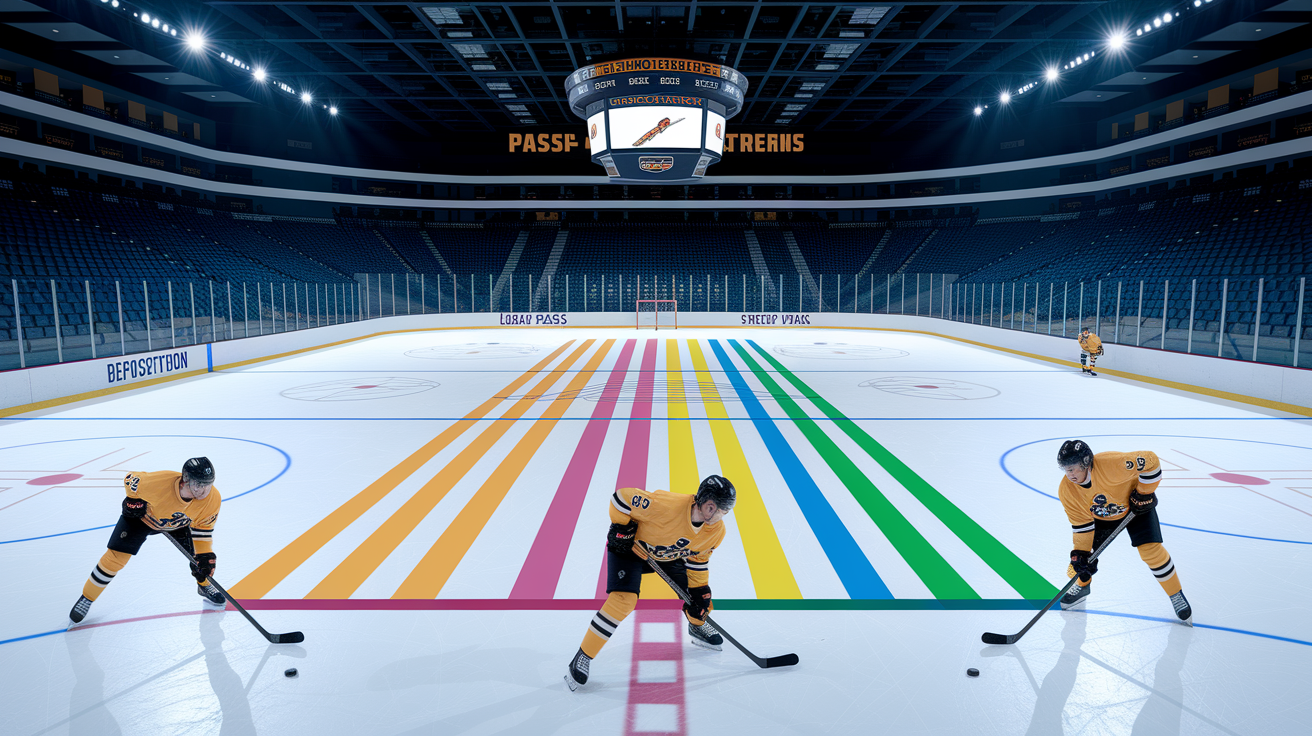
Pass-in entries beat structured defensive systems by moving the puck faster than skaters can adjust. The three most common pass types are lateral passes (across the ice to an open winger), lead passes (to a teammate’s stick in stride ahead of the defense), and stretch passes (long outlet to a forward behind the trap). All three need precise timing. The passer reads when the receiver will have a step on his check, weights the pass so it hits the stick in full stride, and delivers it into space the defender can’t cover. When done cleanly, pass-in entries keep possession 55 to 70 percent of the time and often create odd-man situations because defenders are still recovering from the neutral-zone setup they were holding.
Pass entries work well against passive systems that prioritize gap control and clog the middle. A 1-4-0 trap leaves one forechecker high and four defenders across the blue line in a wall. The counter? Quick lateral pass behind the wall to exploit the wide lanes, or a stretch pass over the top if the lone forechecker overcommits. Against a 1-2-2 with two high forwards, use a cross-ice pass to pull the middle defender out of position, then hit the third man (trailer) through the vacated lane. The key is patience. Hold the puck in the neutral zone long enough to let the defense commit to their structure, then pass into the open seam before they can recover. If your first option is covered, pull up and reset rather than forcing a low-percentage pass that leads to a turnover at their blue line.
Third-Man Support Timing
The third-man role (usually the trailing forward or late-joining defenseman) turns a two-option entry into a multi-threat attack. The third man enters the zone slightly behind and offset from the puck carrier, creating a passing lane defenders can’t cover without abandoning net-front or weak-side responsibilities. Timing is everything. Too early and he congests the entry, making it easier for defenders to pressure multiple attackers at once. Too late and the puck carrier’s already committed to a shot or cycle, wasting the extra option. The sweet spot? One to two seconds after the puck crosses the blue line. Late enough that defenders have committed to the first two attackers, early enough that the third man can receive a pass in open ice and either shoot, carry to the net, or continue the cycle. Coaches should teach third-man timing by marking entry zones with cones during practice and running timed repetitions until players internalize the rhythm. The third man should also communicate verbally (“third man high,” “trailer weak side”) so the puck carrier knows the outlet’s available without having to look back.
Dump-and-Chase and Chip Entries as Tactical Offensive Zone Solutions Under Pressure
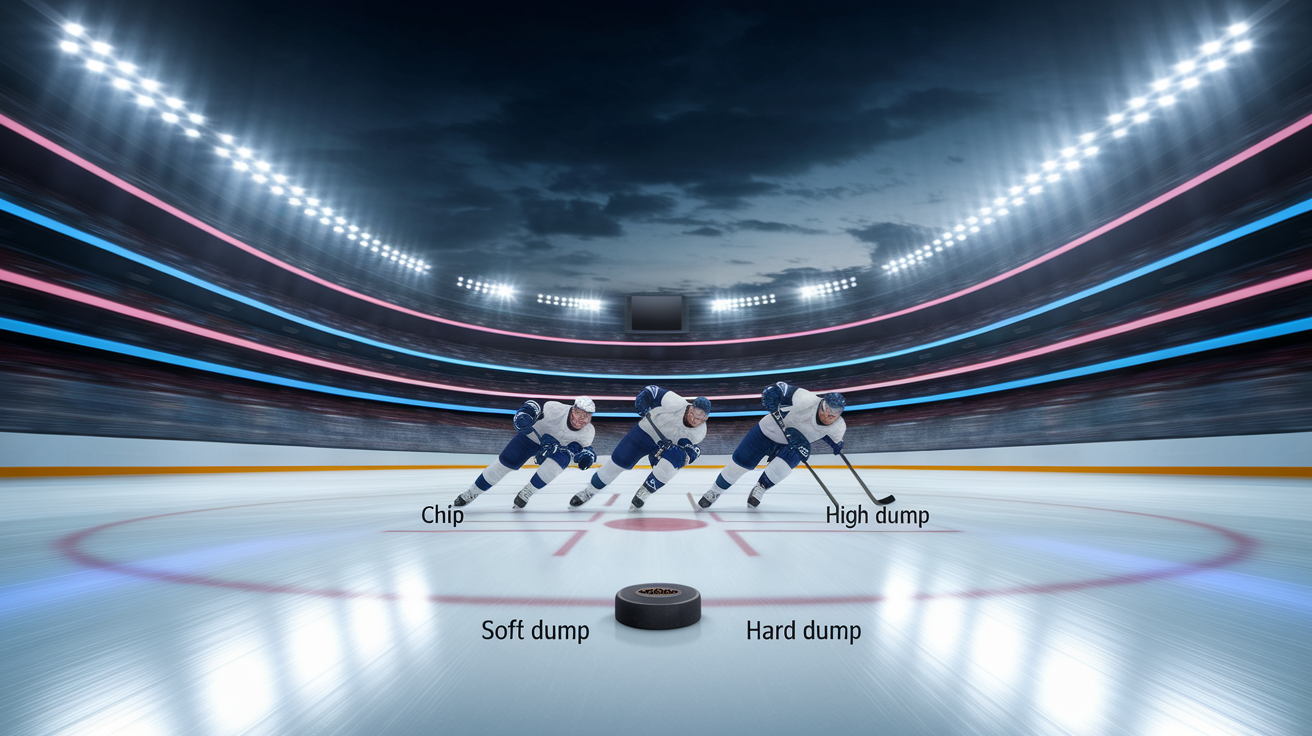
Teams pick dump-and-chase entries when controlled possession is either too risky or tactically unnecessary. If the neutral-zone gap is tight and the puck carrier has no speed advantage, trying to force a controlled entry often ends in a turnover at the blue line. If you’re protecting a lead and want to burn time while changing lines, a rim or soft dump moves the puck into the offensive zone without exposing your tired forwards to a counterattack. If the opposing team’s running an aggressive 1-3-1 forecheck that traps the middle and forces turnovers, a hard rim to the far corner lets you bypass the pressure and set up a 50/50 puck battle instead. Dump-and-chase entries keep possession only 20 to 35 percent of the time, but they eliminate the risk of giveaways in the neutral zone and let you dictate where the next battle happens.
Retrieval success comes down to forecheck angles and how quickly your forwards arrive at the puck. The first forechecker (F1) takes the most direct line to the dump location (usually the corner or behind the net) and forces the defending defenseman to make a play under pressure. The second forechecker (F2) reads whether the defenseman will rim the puck, pass it, or try to skate it out, then takes away the most dangerous option. The third forward (F3) stays high to prevent breakout passes up the middle and provides an outlet if F1 or F2 wins the puck. If your team retrieves the dump more than 60 percent of the time, the entry becomes a viable possession tool rather than just a reset. Below 50 percent? You’re giving the puck away for free and should adjust to more controlled or pass-based entries.
| Entry Type | Best Used When |
|---|---|
| Chip (high glass) | Heavy neutral-zone pressure; need to flip ice quickly and change lines |
| Soft dump (low rim) | Controlled retrieval situation; F1 has inside angle on defender |
| Rim (boards to far corner) | Bypassing aggressive forecheck or 1-3-1 trap; set up cycle game |
| Hard dump (center ice to corner) | Speed mismatch; force tired defenders to turn and race for puck |
Offensive Zone Entry Tactics Against Common Defensive Systems
Reading the defensive structure in the neutral zone tells you which entry will work. Look at the positioning of the two high forwards and the three defenders at the blue line. If the forwards are stacked in the middle (1-4-0) and the defense is playing a passive gap, the wings will be open. If the forwards are pressuring hard up ice (1-2-2 with aggressive gaps), the middle seam often opens behind them when they commit. If the defense is collapsing into a box around the slot (common on penalty kills), quick east-west passes pull them out of position and create shooting lanes from the half-wall. The first three seconds after you gain the puck in the neutral zone are your decision window. Identify the structure, pick your entry type, and communicate the play to your support players.
Against a 1-2-2 forecheck, use a quick pass behind the two high forwards to exploit the gap between them and the blue-line defenders. The puck carrier can also pull the middle forward out of position with a lateral move, then pass through the vacated lane to the third man. Against a 1-4-0 trap, stretch passes over the top or wide-lane carries force the lone forechecker to choose between taking the puck or covering the outlet. Either choice opens a lane. If the trap sits back and clogs the blue line, use a delay entry or drop pass to let your support catch up, then attack with numbers and multiple passing options. Against aggressive man-to-man pressure, use lateral passes to pull defenders out of their lanes, then dump the puck into the corner they just vacated so your forecheckers have a better retrieval angle.
Special-teams entries need specific adjustments. On the power play, go with controlled carries and pass-ins because you’ve got a man advantage and need to maximize possession time to set up your structure. The extra skater gives you a numerical outlet on every entry, so use it. Controlled entries on the PP should approach 70 percent success if your spacing is correct. On the penalty kill, use structured rims and chips to relieve pressure and flip the ice without risking turnovers in your own end. PK entries aren’t about possession. They’re about safely moving the puck 200 feet and forcing the opposing team to regroup. A successful PK entry gets the puck deep, changes your tired killers, and burns ten to fifteen seconds off the penalty clock.
Metrics and Analytics for Evaluating Offensive Zone Entry Success
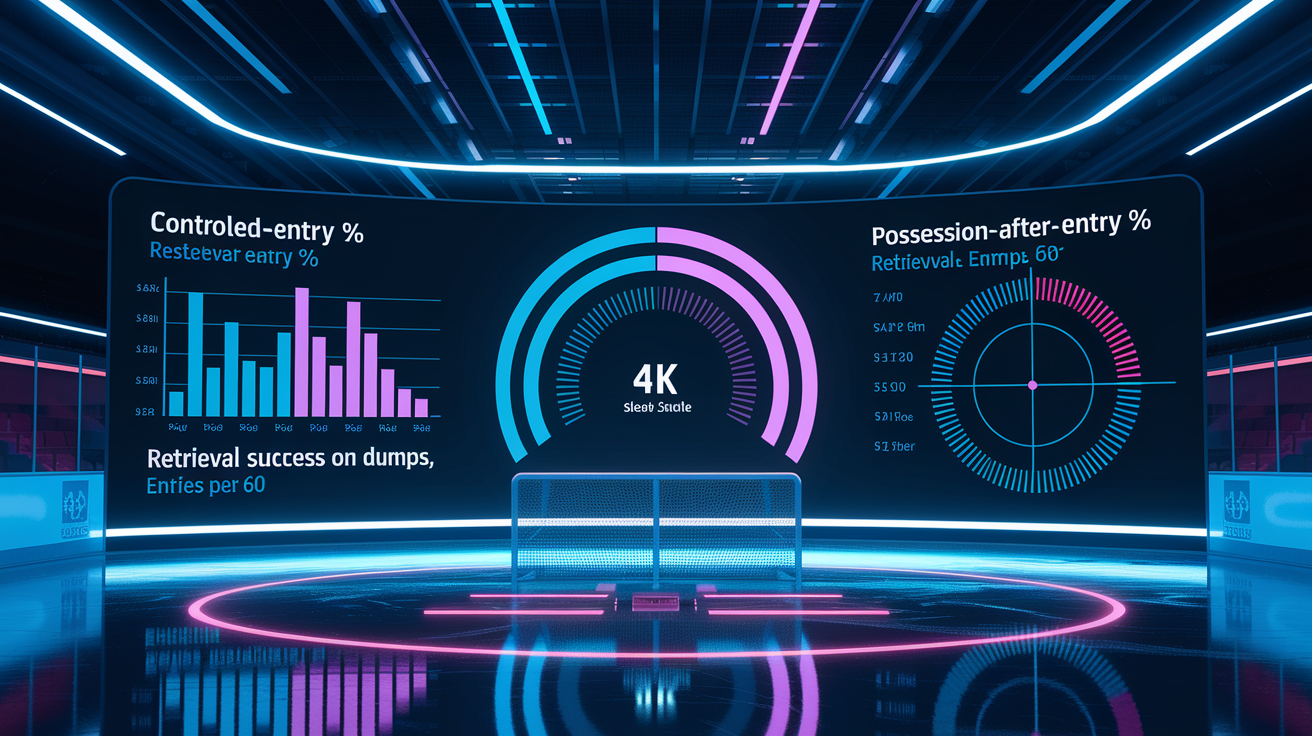
Track four primary metrics to measure entry effectiveness: controlled-entry percentage, possession-after-entry percentage, retrieval success on dump-ins, and total entries per 60 minutes. Controlled-entry percentage is the number of times your team carries or passes the puck into the zone with possession divided by total entry attempts. Target above 55 percent. Possession-after-entry percentage measures how often any entry type (including dumps) leads to sustained offensive-zone time. Target above 40 percent across all entries. Retrieval success on dump-ins tracks how often your forecheckers win the puck after a rim or chip. Aim for above 60 percent to justify using dump entries tactically. Entries per 60 is a volume stat that tells you how often your team’s attacking. Most competitive teams generate 30 to 45 entries per 60 minutes of play, and higher totals usually correlate with more offensive-zone time and scoring chances.
The single most important finding from entry analytics? The shot-multiplier effect. Entries that retain possession are roughly three to four times more likely to produce a shot within ten seconds compared to dump-ins that don’t result in immediate retrieval. That gap explains why teams emphasizing controlled and pass-based entries tend to generate five to twelve percent more high-danger scoring chances from the slot and net-front areas. If you increase your controlled-entry rate by ten percentage points over a season, you’ll see a measurable rise in shots per game, expected goals, and actual goals scored.
Key entry metrics to track:
- Controlled-entry % (target >55%): successful carry-ins and pass-ins divided by total attempts
- Possession-after-entry % (target >40%): entries leading to sustained zone time (>5 seconds) across all types
- Retrieval success on dumps (target >60%): successful forechecks after dump/chip entries
- Entries per 60 (target 30–45): total offensive-zone entry attempts per 60 minutes of play
- Shot rate from retained entries: shots generated within 10 seconds of possession-based entries (benchmark ~3–4× higher than dump-ins)
Practice Drills to Develop Reliable Offensive Zone Entry Strategies

Start with individual skill work before adding team reads and defensive pressure. Players need to handle the puck at top speed, protect it through contact, and execute tight turns at the blue line before they can read gaps or make split-second passing decisions. Weeks one and two of any entry-focused training block should prioritize edgework, puck protection, and neutral-zone acceleration drills. Use simple one-on-zero and one-on-one repetitions where players carry the puck from the red line to the offensive blue line, practicing crossovers, delays, and body positioning without worrying about support players or complex reads. Six to eight reps per side, one minute rest between sets, builds muscle memory without fatigue that breaks down technique.
Once individual skills are solid, layer in team concepts and defensive pressure. The corridor drill teaches controlled carries through specific lanes: set up three lines at center ice, mark three entry corridors (middle, half-wall left, half-wall right) with cones, and rotate players through each lane with a coach or passive defender at the blue line. Run three sets of six reps per side, progressing from no pressure to active gap control. The pass-in timing drill uses two lines in the neutral zone and one line of defenders. The passer carries to a marked release point, then delivers a lead pass to a teammate hitting the blue line in stride while a third-man support player trails. Four sets of eight reps, with emphasis on pass weight and arrival timing. The dump-and-chase retrieval drill simulates game retrieval by having one forward rim the puck around the boards from the top of the circle, then racing a defender to the corner. Run five sets of ten reps with an eight-second shot clock to add urgency. Full-team entry sequences combine all three entry types in a continuous flow: forwards rotate through controlled carries, pass-ins, and dump retrievals in three circuits of five reps each, working at game pace while a coach records video for immediate feedback.
Structure your weekly progression to build from fundamentals to game situations. Weeks one and two focus on individual skills (speed, puck control, edgework). Weeks three and four introduce pattern-based team repetitions (corridor work, timing drills, support positioning). Week five runs full-speed scrimmages with entry metrics tracked in real time. Count successful entries by type, measure possession-after-entry, and review video clips during breaks to reinforce correct reads. By the end of five weeks, players should be able to execute all three entry types under pressure and choose the right method based on gap, structure, and support.
Six drill examples with parameters:
- Edgework and tight-turn drill: red line to blue line, crossovers into tight turn at boards, 6 reps each side, focus on maintaining puck control through direction changes
- Corridor carry (1-on-1 progression): three lanes marked by cones, passive then active defender at blue line, 3 sets × 6 reps per side
- Pass-in timing drill: two neutral-zone lines plus defenders, timed lead pass to seam, third-man support, 4 sets × 8 reps
- Dump-and-chase retrieval: rim from top of circle, race to corner against defender, 5 sets × 10 reps, 8-second shot clock
- Full-team entry sequences: rotate all three entry types (carry, pass, dump) in continuous flow, 3 circuits × 5 reps, game pace, video review
- Small-area entry games: half-ice 3-on-3 or 4-on-4, mandate entry type per shift (all controlled, all pass-in, all dump), track success rate, provide immediate feedback
For a detailed breakdown of corridor concepts and support-positioning drills, refer to 3 Middle-Zone Entry Concepts for video examples and additional coaching cues.
Coaching Cues and Player Roles During Offensive Zone Entry Execution

Coaches need to give simple, repeatable verbal cues that players can process at game speed. “Read the gap” tells the puck carrier to look at the distance between himself and the nearest defender before deciding to carry, pass, or dump. “Third man late” reminds the trailing forward or defenseman to time his arrival one to two seconds after the puck crosses the line. “Wide support” tells the weak-side winger to stay high and wide to create a cross-ice passing lane. “Forecheck angles” reminds F1 and F2 to take direct lines to the dump location and take away the defenseman’s best options. These cues should be drilled in practice until they’re automatic, so players can execute them without hesitation during live play. Predictable rotations (F1 always attacks the puck, F2 reads the rim or pass, F3 stays high) reduce decision-making load and improve possession-after-entry rates because everyone knows their role before the puck’s touched.
Player roles vary by entry type. On controlled carries, the puck carrier needs to read gap and protect the puck, the weak-side winger creates width for a cross-ice outlet, and the third man times his arrival to provide a drop-pass or trailer option. On pass-in entries, the passer reads when the receiver will have a step, the receiver attacks the blue line in full stride, and the third man fills the weak side or drives the net. On dump-and-chase entries, F1 takes the direct angle to the puck, F2 reads the defenseman’s play and takes away the best option, and F3 provides high support and prevents breakout passes. Defined roles eliminate confusion, speed up decision-making, and let players focus on execution rather than wondering what their teammates will do next.
Final Words
In the action we broke down the three entry methods—controlled carries, pass‑in patterns, and dump‑and‑chase—and the possession‑risk tradeoffs.
We compared success ranges: controlled entries hold possession about 50–65%, pass‑in entries when completed ~55–70%, and dump‑ins ~20–35%. Entries that retain possession are 3–4× more likely to create a shot in 10 seconds.
Pick controlled carries with space or on the power play, use pass‑ins vs passive traps, and dump when under heavy pressure. Practice drills, track metrics, and coach clear roles—offensive zone entry strategies turn shifts into shots.
FAQ
Q: How to enter the offensive zone?
A: Entering the offensive zone uses three main methods: controlled carry-in, pass-in, or dump-and-chase. Choose based on pressure and personnel, with carry to keep possession, pass to beat traps, dump under heavy pressure.
Q: Where to put the weakest player in hockey?
A: Placing the weakest player on the wing or fourth line reduces risk; use them on the wall for simple support plays, board battles, and defensive responsibility while building confidence and basic reads.
Q: Where should a winger be in the offensive zone?
A: A winger should be on the half-wall to support the first pass or down low to screen, rebound, and cycle. Match position to your team’s entry plan and the puck’s location.
Q: What is a common strategy for offense in hockey?
A: A common offensive strategy is to prioritize controlled entries and sustained possession, use quick passes and support to create odd-man chances, and attack the net — retaining possession is 3-4x more likely to produce a shot within 10 seconds.