

Think offside is just a raised flag and a delay? Think again.
A split-second position mistake can wipe out a goal, hand the defense an indirect free kick, or let play continue if the attacker never gets involved.
This guide explains what actually becomes an offside offense, how referees and VAR signal and manage the stoppage, and the key difference between passive and active involvement so players, parents, and coaches know what to watch for.
Read on to stop guessing and start avoiding the calls that kill chances.
Definition and Immediate Consequences of an Offside Offense

You’re offside when any part of your head, body, or feet that can legally play the ball sits closer to the opponent’s goal line than both the ball and the second-last opponent. Arms don’t count. That second-last opponent is usually the keeper plus one defender, so if you’re level with that second player when your teammate plays the ball, you’re onside. Timing matters more than anything else. Offside gets judged at the exact moment the ball leaves your teammate’s foot, not when you receive it.
Being in an offside position isn’t illegal by itself. It becomes an offense only when you get involved in one of three ways: touching or playing the ball from a teammate’s pass, interfering with an opponent by blocking their view or challenging for the ball, or gaining an advantage from a rebound or deflection off the post, bar, or another player.
Once the ref confirms an offside offense, the whistle blows. The defending team gets an indirect free kick from the spot where you interfered. The ref raises one arm straight up and holds it there until someone kicks the ball and it touches another player. Opponents have to back off at least 10 yards unless they’re already standing on their own goal line. If the offense happened inside the goal area, the kick gets taken from the nearest point on the goal area line.
How Referees Signal and Enforce Offside Decisions

When the assistant ref spots offside, the flag goes straight up at shoulder height. It stays there until the center ref sees it or play stops. Sometimes the assistant will lower it if the offside player doesn’t get involved and the defense grabs possession.
The center ref makes the final call. After seeing the flag, they decide whether to blow the whistle right away or let play continue if the defending team has a clear advantage. If they agree with the call, the whistle sounds, they point to where the free kick happens, and one arm shoots up vertically.
Everything moves fast from there. Play stops, the ball gets placed, opponents step back 10 yards or line up on the goal line, and the defending team restarts. That raised arm stays up until the kick is taken and the ball touches someone else. If the ball goes straight into the goal without touching anyone, it doesn’t count. The other team gets a free kick instead.
VAR Involvement in Offside Calls

VAR uses calibrated lines on freeze-frame images captured right when the ball is played. Cameras around the field track where players are, and software maps body parts onto a grid lined up with the pitch. Semi-automated offside tech, which showed up at the 2022 World Cup, adds sensor data to speed things up and nail down exact limb positions in 3D. If VAR catches a clear mistake (like flagging someone who was actually onside, or missing someone who was clearly off), it tells the ref to review or correct the call.
VAR intervention adds a quick pause while the video assistant checks footage and passes findings to the ref. Most reviews wrap up in 60 to 90 seconds. The ref might walk over to the monitor to confirm subjective stuff like whether a player interfered with an opponent, or VAR might just say the position was misjudged. Once the decision’s final, play restarts with the right call. Either the free kick stands, moves, or gets cancelled and the attack continues. The stoppage and restart stay the same as non-VAR matches. Only the decision-making changes.
Distinguishing Passive vs. Active Involvement

Standing offside but not participating doesn’t get you penalized. That’s passive offside. You could be behind the defense, but if the ball goes to a different teammate or the opponent intercepts before you touch it or influence anyone, the ref waves play on.
Five actions turn an offside position into an active offense:
- Receiving the ball straight from a teammate’s pass
- Touching or playing a ball that came from a teammate
- Blocking the keeper’s view when the ball’s heading toward goal
- Making a move or gesture that fools or distracts a defender
- Playing a rebound off the post, bar, or an opponent after being offside when a teammate played it
Refs watch what you do when the ball arrives in your area. Sprint toward it and pull a defender away? That’s interference. Stand still five yards off and let another teammate score? Usually passive. Distance and context drive the call. An attacker standing offside near goal but not in the keeper’s sight and not touching the ball can stay there until they engage.
Frequent Misconceptions and Illustrative Scenarios
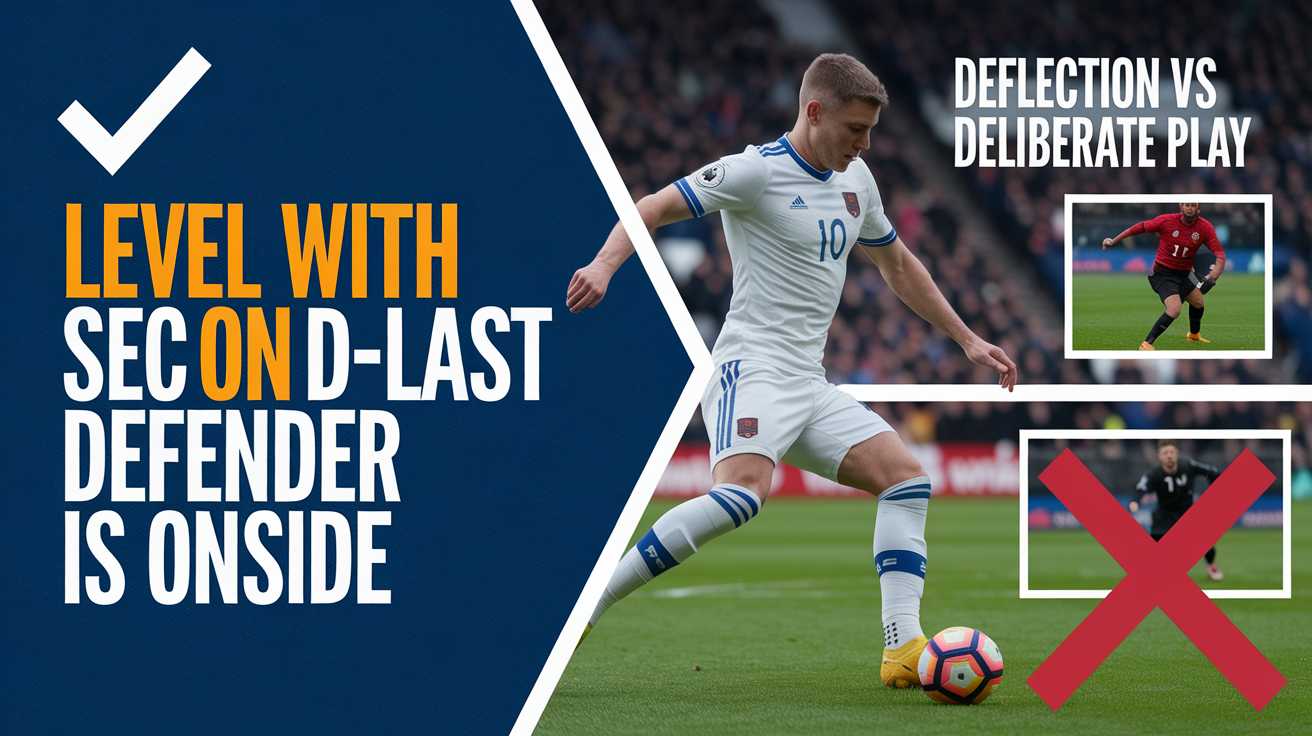
Lots of people think being level with the second-last defender is offside. It’s not. Level is onside. If any part of your head, body, or feet lines up with that second-last opponent when the ball’s played, you’re legal. Assistant refs give attackers the benefit of the doubt on tight calls, so marginal decisions often go your way.
Another mix-up involves deflections versus deliberate play. If the ball bounces off a defender or the keeper makes a save that sends it to you while you’re offside, you can still get flagged because the phase hasn’t reset. But if a defender deliberately plays the ball (a controlled pass or clearance, even a bad one), that resets offside. An attacker who was previously off can legally take the ball without penalty. Intent and control make the difference, not just contact.
Two scenarios show this. First: an attacker stands two meters past the last defender when a teammate launches a long pass. The ball clips a defender’s knee and lands at the attacker’s feet. Offside, because the deflection wasn’t deliberate. Second: a defender under zero pressure chests the ball back toward their keeper, but it falls short. An attacker who was originally offside when the first pass went out runs in and grabs it. No offense. That deliberate chest pass reset the phase, putting the attacker onside when they collected the loose ball.
Final Words
When the flag goes up and the whistle blows, you should know why play stopped. We defined offside position, what turns a position into an offside offense, and the restart: an indirect free kick from the spot.
We covered how assistant referees and the referee signal decisions, how VAR checks positioning, and how to spot passive versus active involvement. That helps you read calls and clear up common myths like rebounds.
Keep this checklist in mind at the rink. You’ll see penalties and stoppages related to offside explained in real time, and that makes watching and coaching clearer.
FAQ
Q: What is the penalty for offside?
A: The penalty for offside is an indirect free kick awarded to the opposing team, taken from the place where the offside player became involved in play after the referee stops play and signals.
Q: How to explain the offside rule in simple terms?
A: The offside rule in simple terms is a player is offside if closer to the opponent’s goal than the second-last defender when a teammate plays the ball, and then becomes involved in play.
Q: What are three situations where offsides cannot be called?
A: Offsides cannot be called on a goal kick, a corner kick, or a throw-in, because those restarts remove the offside restriction under the Laws of the Game.
Q: Does offside apply in the penalty box?
A: Offside does apply in the penalty box. Location doesn’t matter. If a player is in an offside position and becomes involved, the referee stops play and awards an indirect free kick from the spot of the offense.