

What if your power play is just handing goals to the other team?
A power play is the extra skater after a penalty, usually five attackers vs four.
Positioning is what turns that spare skater into real scoring chances.
This post breaks down the formations that actually score: the 1-3-1, the umbrella, and the overload.
You’ll get who goes where, why each lane matters, and simple reads and drills to train it.
If you want more goals on the man advantage, start here.
What Is a Power Play? Quick Explanation and Why Positioning Matters
A power play happens when one team gets more skaters on the ice because the opponent took a penalty. Most of the time, that’s five attackers against four defenders. The extra player opens up space, but only if the attacking group spreads out and moves the puck with intent. If everyone bunches together or just stands around, the penalty killers can compress the ice and shut down lanes pretty much the same way they would at even strength.
Formations matter because they control where players set up, how puck support works, and which shooting lanes appear first. A good setup forces defenders to cover multiple threats at the same time. When a point player holds the puck, there’s a half-wall option ready for a quick outlet, a bumper sitting in the high slot for a seam pass, and someone near the net tying up a defender by the crease. Each spot has a role. When everyone fills their lane, the defense has to pick which threat to take away. That decision is what creates the opening.
Formations also help teams get the puck back when a pass gets broken up or a shot is blocked. If players are spread evenly, someone’s always there to support, grab it, or reset. Tight spacing might feel like you’re being aggressive, but it actually makes it easier for penalty killers to read passes and jump lanes. Wide, disciplined positioning is what turns that extra skater into actual scoring chances.
Core Structure and Roles Within Power Play Formations

Every formation uses the same basic roles, just arranged in different spots. Knowing what each position is supposed to do makes it easier to see why certain setups work against certain defensive looks.
Point (Quarterback): Stands at or just inside the blue line, usually in the middle. Controls the top of the zone, starts puck movement, and looks for shooting lanes or cross-ice passes. The point player has to read pressure and move the puck fast when defenders step up.
Half-Wall Players: Set up along the hash marks or a bit lower, roughly ten to twenty feet from the boards. They retrieve pucks, feed the point or bumper, and create plays off the wall. These players need solid passing vision and the ability to protect the puck under pressure.
Bumper (High Slot): Sits between the faceoff dots, six to ten feet above the crease. Acts as a pivot for quick passes and a shooting threat from the middle. The bumper finds seams when defenders collapse or cheat toward the boards.
Net-Front Presence: Works within a few feet of the goal. Screens the goalie, tips shots, battles for rebounds, and ties up at least one defender. This player doesn’t always touch the puck, but creates chaos that opens lanes for everyone else.
These roles connect through constant movement and puck circulation. When the point holds, the half-wall players shift to open passing angles. When the half-wall receives, the bumper relocates to find a seam. When the bumper gets it, the net-front player adjusts to screen or tip. Everyone’s job depends on what the puck carrier sees and how defenders rotate. A formation is just a starting map. The real work happens in how players read each other and fill the next open spot.
The 1-3-1 Formation
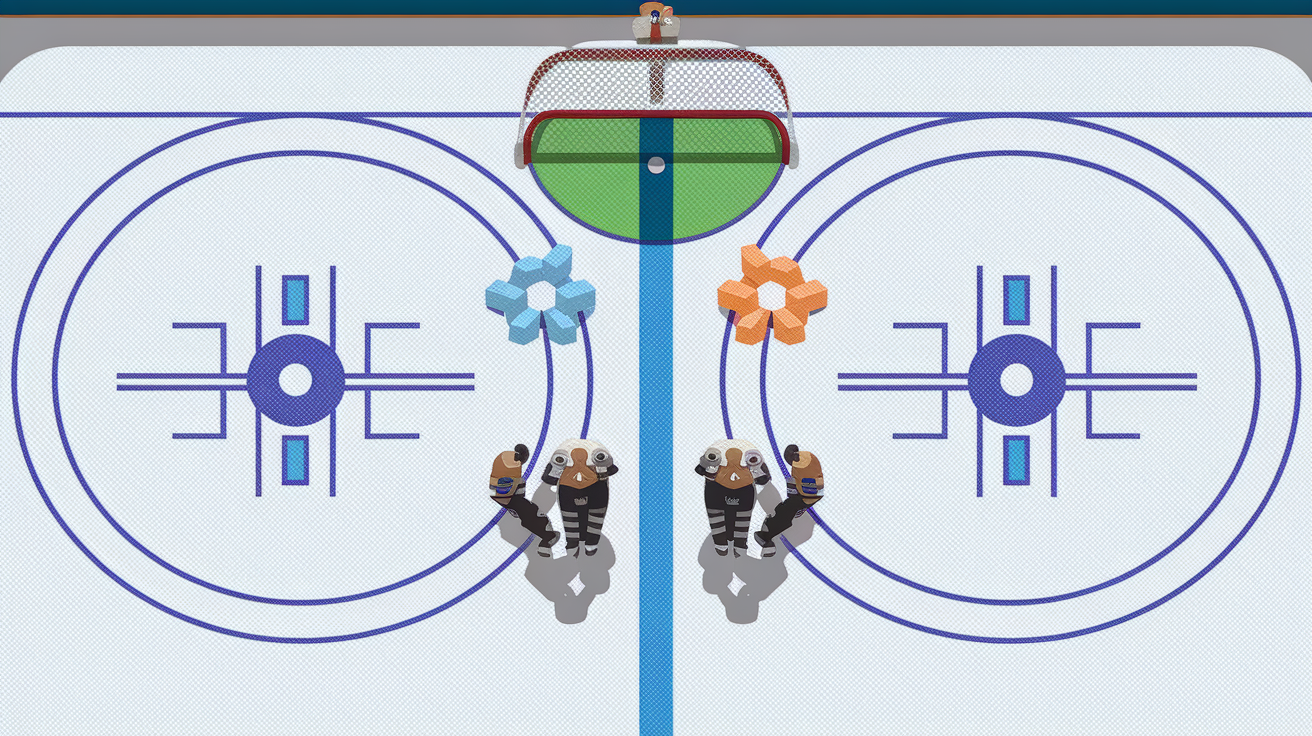
The 1-3-1 spreads attackers across the width of the offensive zone, creating multiple passing options and forcing penalty killers to cover a lot of ice. It’s built around a single point player, three forwards positioned across the middle (including a bumper in the high slot), and one net-front presence. Plenty of NHL teams use this as their base because it balances perimeter shooting with high-danger slot chances.
Positional Layout
The point player (P1) anchors the top, standing at or just behind the blue line in the center. Two half-wall forwards (P2 and P3) set up on opposite sides, roughly six to twelve feet off the boards and ten to twenty feet down from the blue line. The bumper (P4) sits in the high slot, between the hash marks about six to ten feet above the crease. The net-front player (P5) works within three to six feet of the goal, usually on the strong side of the puck or directly in the goalie’s sight line.
This layout stretches the penalty kill lengthwise and side to side. Cross-ice passing lanes run twenty-five to forty feet, which is long enough to pull defenders out of position when the puck moves quickly. The bumper sits in the middle, ready to receive seam passes from the point or either half-wall. Because P4 can shoot or pass, defenders can’t fully commit to blocking the boards without leaving the slot open.
Movement Patterns and Common Plays
The point player starts most sequences. P1 looks for a shooting lane through traffic or moves the puck to a half-wall to get the cycle going. If P1 passes to P2, the opposite half-wall (P3) shifts slightly lower to open a cross-ice one-timer lane. At the same time, the bumper (P4) relocates toward the pass to stay available for a quick seam feed. P5 adjusts to screen or prepare for a deflection.
One of the best plays is the high-low seam pass. P1 holds at the point, pulls a defender’s attention, then feeds P4 in the slot. P4 can shoot right away or drop a quick pass to P5 for a finish from close range. If the seam is closed, P1 moves the puck to a half-wall and the sequence resets. Another common option is the cross-ice one-timer: P2 receives from P1, then fires a tape-to-tape pass to P3 for a quick release. The timing window is tight, usually one to two seconds, because goalies adjust fast once the puck crosses the ice.
When defenders pressure the point or collapse on the half-walls, the 1-3-1 can shift into an overload by moving P3 lower or behind the net to create a numerical advantage on one side. This flexibility is one reason the formation works against multiple penalty-kill systems. The structure gives clear starting points, but players have to read pressure and rotate to the next open lane within two to four seconds.
The Umbrella Formation
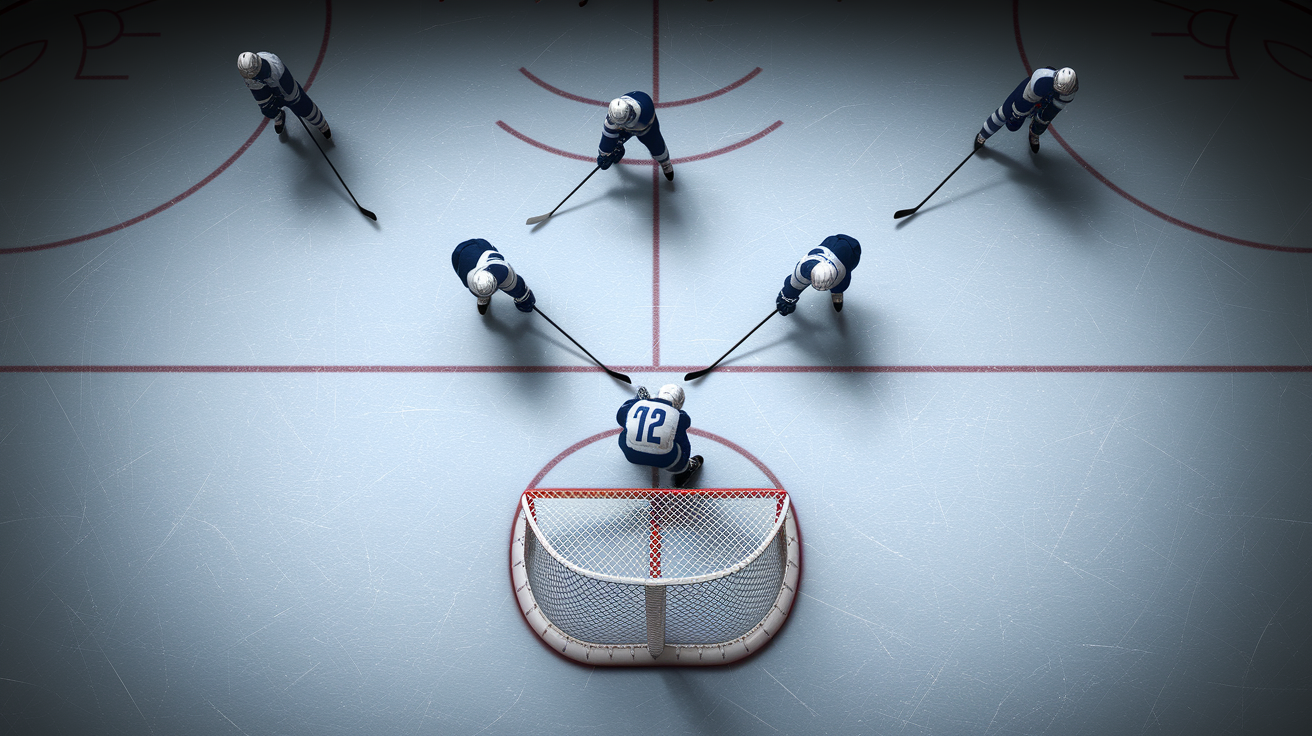
The umbrella loads three players high in the offensive zone and two players low, creating a shape that funnels shooting lanes toward the net. Teams use it when they’ve got strong point shooters or want to generate rebound chances from heavy traffic in front.
Positional Structure
One player sits at the point, centered just inside or at the blue line. Two more forwards position themselves at the tops of the faceoff circles, creating a wide arc across the top of the zone. These three players form the “umbrella.” Down low, one forward works the half-wall or goal line extended, while the other camps in front of the net to screen and battle for rebounds.
The spacing forces penalty killers to cover a wide area up high while also protecting the net-front zone. If defenders collapse to take away the bumper or net-front player, the three high players have clean shooting lanes. If defenders step up to pressure the point or circle shooters, the low players gain space to cycle or slip into high-danger areas. The umbrella is less about quick seam passes and more about creating volume from the outside with traffic in front.
Tactical Application
The point player controls the pace, looking for a direct shot through a screen or a pass to one of the circle players for a one-timer. When the puck moves to the circle, the opposite-side player often shifts slightly to open a better shooting angle. The net-front forward adjusts to block the goalie’s vision and tie up a defender’s stick.
If the first shot is blocked or the passing lane is closed, the low forward on the half-wall grabs the puck and works it back up to the point or across to the opposite circle. This creates a second wave of pressure. The umbrella works on repetition: shot, retrieve, reset, shoot again, until the defense breaks down or the goalie gives up a rebound.
Teams go with the umbrella when they have two or more defensemen or forwards with hard, accurate shots from the point or circles, when the opponent’s penalty kill sags deep and leaves the perimeter open, or when rebound chances are a strength and the net-front player can win battles consistently.
The umbrella is straightforward to execute and doesn’t need complex rotations, which makes it a solid choice when the power-play unit needs simplicity under pressure or late in a game.
The Overload Formation
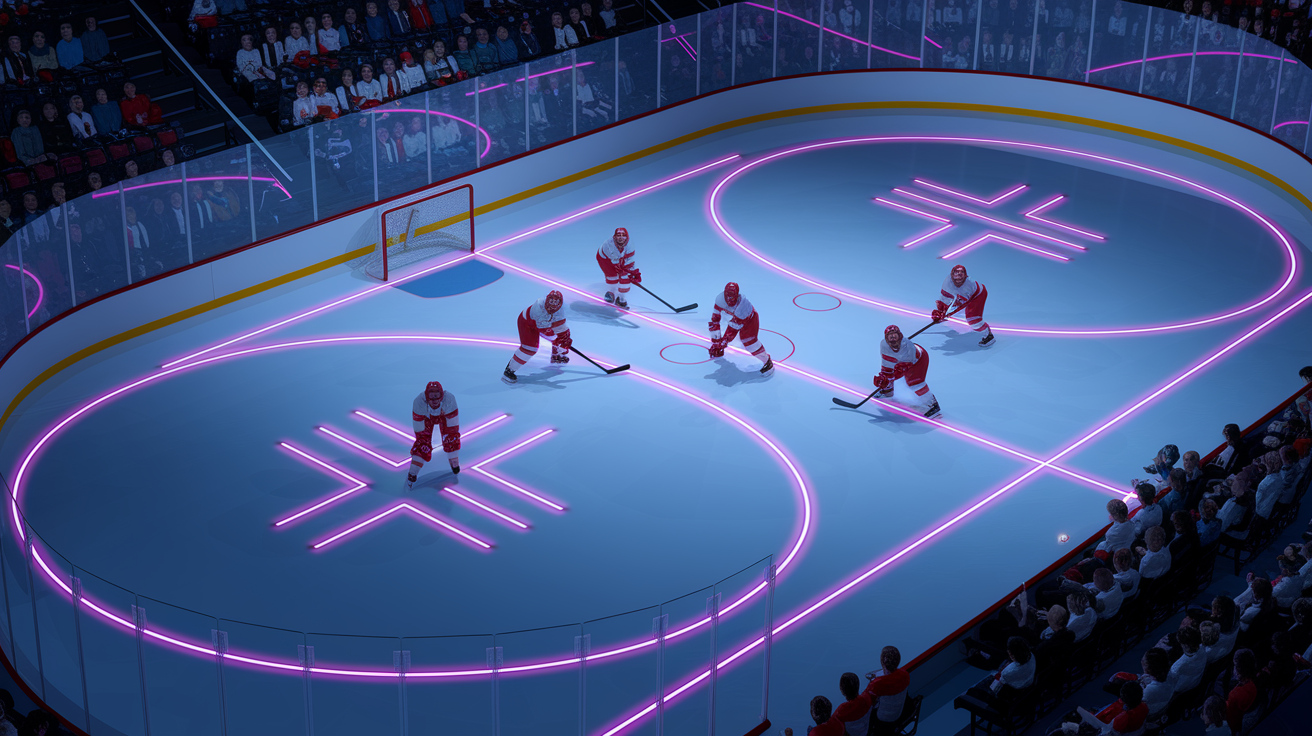
The overload clusters attackers on one side of the ice to create passing triangles, force defensive collapses, and open weak-side shooting lanes. It works when teams can control the puck low and move it quickly enough to take advantage of the gaps that form when defenders shift to cover the strong side.
Spatial Setup
The overload starts with three players concentrated on one side of the offensive zone. One forward works the half-wall, another sits in or near the corner or below the goal line, and a third forward takes the high slot or bumper position on the strong side. The fourth forward stays near the net or drifts to the weak side, and one defenseman holds the point, usually shaded slightly toward the strong side to support the overload.
This triangle on the strong side creates quick passing options and forces at least two penalty killers to commit to that area. When defenders collapse to cover the low player and half-wall, the weak-side defenseman or forward often finds himself open for a cross-ice one-timer or a clean look from the point. The overload works by pulling defenders into a small space, then making them pay for overcommitting.
Primary Attacking Sequences
The most common sequence starts with the puck below the goal line or in the corner. The low forward grabs it and looks for a short pass to the half-wall player. From there, the half-wall forward can feed the bumper in the slot, pass back down low to restart the cycle, or fire a quick cross-ice pass to the weak-side option. If defenders pinch on the half-wall, the low forward can slip behind the net and create a backdoor chance.
Another solid play is the low-to-high pass. The corner player sends the puck up to the half-wall or directly to the point, and the point player either shoots through traffic or passes to the weak-side shooter for a one-timer. Timing matters. If the puck movement slows, defenders reset and the overload loses its numerical advantage.
Short-side attacks are also part of the overload setup. When the low forward works the puck along the goal line on the strong side, the half-wall player can crash the net for a quick finish or the bumper can drop low to receive a centering pass. These plays happen fast, usually within three to five seconds of the initial puck retrieval, and they force defenders to make quick reads. If they hesitate, the slot opens up.
Comparing Major Power Play Formations

Each formation targets different parts of the ice and takes advantage of specific defensive weaknesses. Picking the right one depends on personnel, opponent tendencies, and where the puck enters the zone.
| Formation | Key Strength | Best Situational Use |
|---|---|---|
| 1-3-1 | Balanced threat from perimeter and slot; strong seam-pass options | Against penalty kills that sag deep or struggle with lateral puck movement |
| Umbrella | High shooting volume from the outside with net-front traffic | When you’ve got multiple strong shooters and the opponent leaves the perimeter open |
| Overload | Creates passing triangles and forces defensive collapses on one side | When defenders overcommit to puck-side coverage or when cycling low works |
The 1-3-1 is the most flexible. It can shift into an umbrella by adjusting the bumper higher or into an overload by moving a half-wall player lower. Teams that run a 1-3-1 as their base can adapt mid-cycle without swapping players. The umbrella is simpler and more direct, which makes it easier to run under pressure or when the penalty-kill unit is aggressive. The overload takes the most puck skill and tight-space passing, but it creates the highest-danger chances when done right. Most teams carry at least two of these setups and switch based on how the penalty kill responds in the first ten to fifteen seconds.
Situational Usage and Opponent-Specific Adjustments
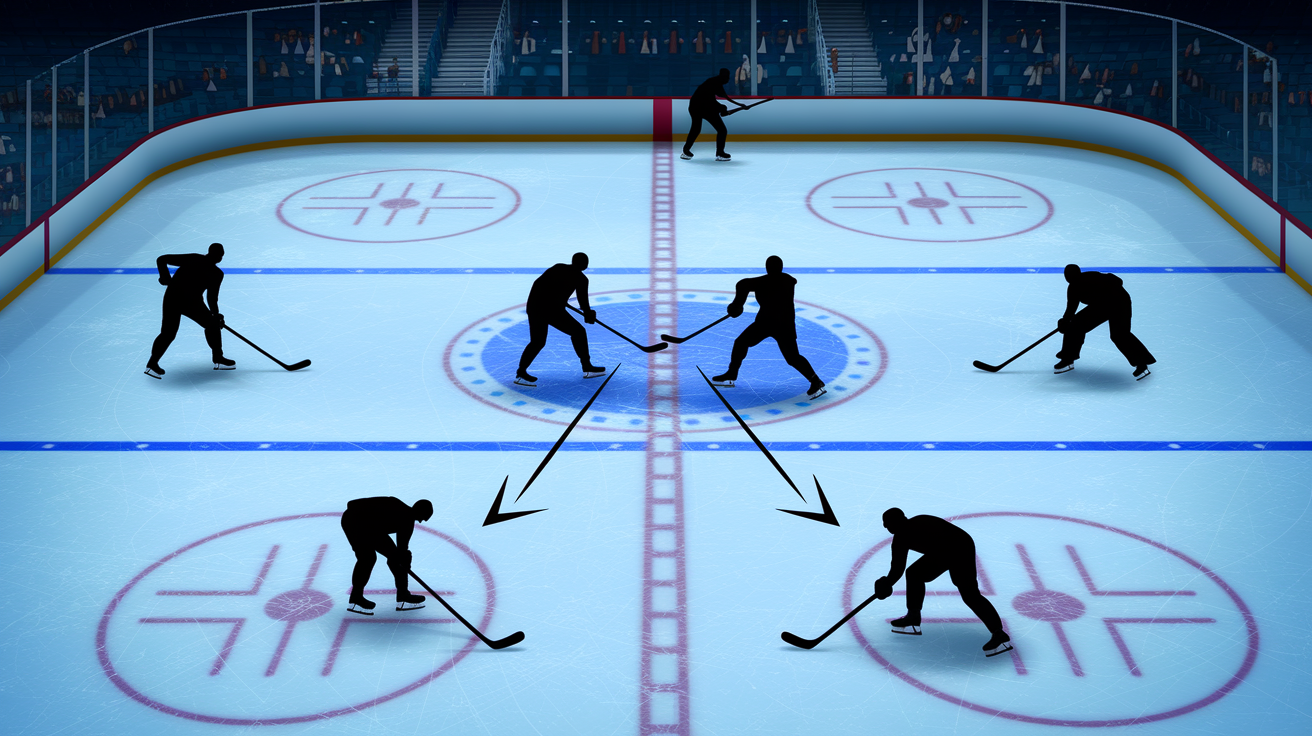
Power-play formations aren’t fixed. Teams switch based on how the penalty kill pressures the puck, where defenders set up, and which passing lanes they take away. Reading the opponent’s setup in the first few seconds of zone entry often tells you which formation will work best.
Penalty kills usually use one of four structures: diamond, box, wedge, or aggressive trap. A diamond collapses one defender low near the net and spreads the other three across the points and half-walls. Against a diamond, the 1-3-1 works well because the bumper can find space between the low defender and the three high killers. If the power play moves the puck quickly, the diamond can’t rotate fast enough to cover both the slot and the weak side.
A box penalty kill puts two defenders high and two low, creating even coverage across the zone. The umbrella works here because it forces the box to choose between pressuring the point shooters or collapsing on the net-front player. If the box stays compact, the perimeter opens up. If it steps up, the low players gain space to cycle and create second chances. The overload can also work against a box by packing attackers on one side and forcing the two low defenders to cover three passing options.
The wedge or “diamond-plus-one” sends one forechecker to pressure the point while the other three defenders form a triangle lower in the zone. Against a wedge, the overload is often the best pick. Moving the puck below the goal line takes the forechecker out of the play and forces the triangle to rotate. If the low defenders commit to the corner, the weak-side shooter opens up. If they hold position, the strong-side triangle can work quick passes for a short-side shot.
Teams that scout opponents closely adjust mid-game. If a penalty kill starts in a box but collapses into a diamond after the first pass, the power play can shift from an umbrella to a 1-3-1 by moving the bumper into the slot and spreading the half-walls wider. If defenders are stepping up hard on the point, the overload can drop a forward behind the net to relieve pressure and create a 3-on-2 below the circles. These adjustments happen in real time, usually signaled by a quick stick tap or verbal call from the point player.
Examples From Professional Teams
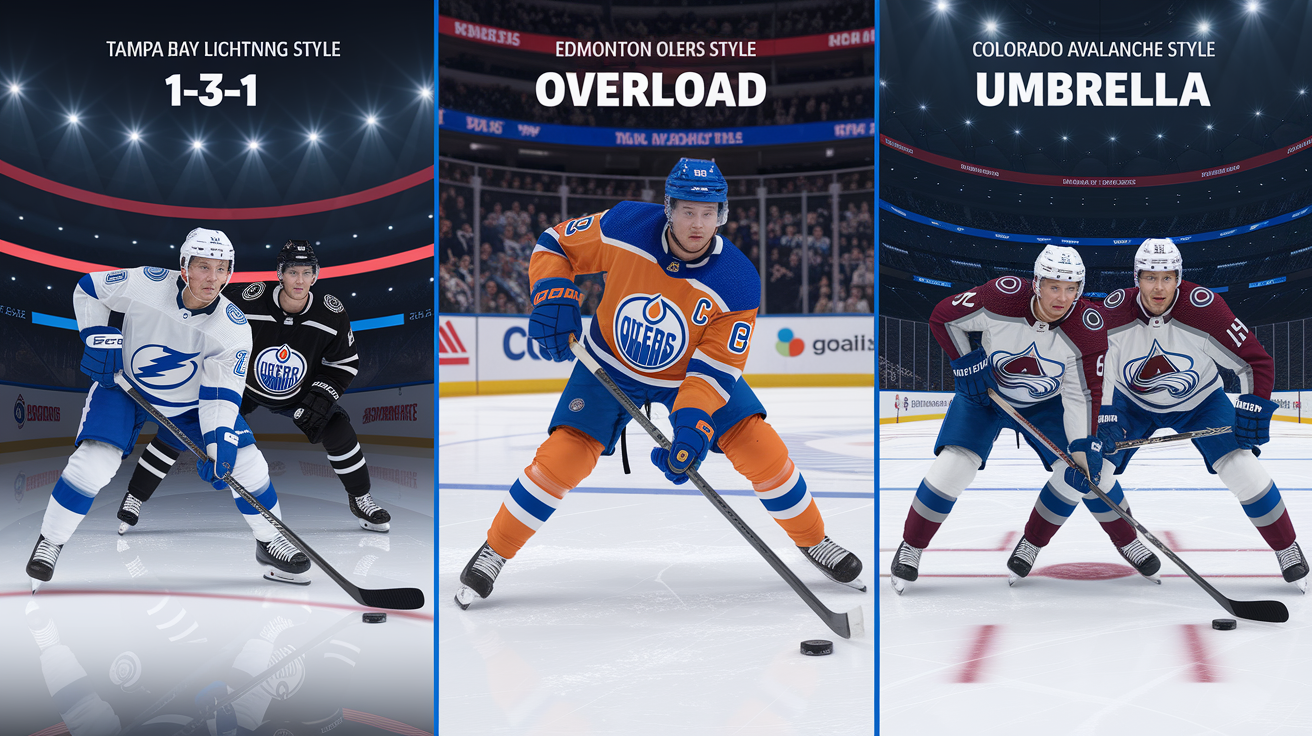
NHL teams show clear models of how personnel drives formation choice. Tampa Bay’s power play, especially during their Stanley Cup runs, leaned heavily on a 1-3-1 with Victor Hedman at the point, Nikita Kucherov and Steven Stamkos on the half-walls, and Brayden Point as the bumper. The structure worked because all four players could shoot and pass at a high level, forcing penalty kills to respect every option. Point’s ability to find seams and finish from the slot made the bumper position a constant threat, and Hedman’s skating at the point let Tampa reset quickly when pressure arrived.
Edmonton built their power play around Connor McDavid and Leon Draisaitl, often using an overload on the strong side with McDavid working the half-wall and Draisaitl in the bumper or low slot. The overload let McDavid control the puck in tight spaces and create passing lanes most players can’t see. When defenders committed to stopping McDavid, Draisaitl slipped into open ice for one-timers or backdoor finishes. Edmonton’s formation worked because their two best players could beat defenders one-on-one, which made the numerical advantage feel even bigger.
Colorado used an umbrella a lot with Cale Makar at the point and multiple shooting options at the circles. Makar’s ability to walk the blue line and change shooting angles turned the umbrella into something dynamic rather than static. The Avalanche loaded the net-front area with size and skill, creating rebound chances when Makar’s point shot got through. Their umbrella succeeded because they had the personnel to shoot from distance and the net-front presence to finish second chances. The formation matched their strengths: speed, shooting accuracy, and the ability to generate volume.
Final Words
In the action, this post showed why power plays hinge on spacing, puck movement, and clear roles, point, half-wall, bumper, and net-front.
We broke down three go-to looks: the 1-3-1 for seams, the umbrella for point shots, and the overload for high-pressure cycling, plus when to switch based on the penalty-kill.
Practice the rotations, know your job, and watch pro examples to see it live. Mastering power play offensive zone formations makes the difference between shots that miss and shots that score. Keep working it. You’re building real scoring chances.
FAQ
Q: What is a power play and why does positioning matter?
A: The power play is when a team has a man advantage after a penalty, and positioning matters because proper spacing, support, and lanes create higher-percentage shots, quicker puck movement, and easier rebounds.
Q: What are the core roles on a power play and what does each do?
A: Core power play roles are the point quarterback, half-wall playmakers, bumper in the slot, and net-front screener; each supports puck circulation, opens shot lanes, tips shots, or screens the goalie for rebounds.
Q: How does the 1-3-1 formation work on a power play?
A: The 1-3-1 formation spreads players horizontally with one point, three across the middle, and one bumper in the slot; it forces cross-seam passes, creates slot shots, and balances threats from both flanks.
Q: When is the umbrella formation most effective?
A: The umbrella formation is most effective when you want heavy point shooting: three high attackers open shooting lanes, funnel pucks to the point, and generate traffic for rebounds and deflections.
Q: When should a coach use the overload formation and what are its risks?
A: The overload formation is best when a coach wants to concentrate pressure on one side, create quick triangles, and force defensive collapses; risks include weak-side seams and vulnerability to quick outlet passes.
Q: How do you choose between 1-3-1, umbrella, and overload during a game?
A: You choose between 1-3-1, umbrella, and overload by reading penalty-kill shape, your shooters’ strengths, and the goaltender’s weakness: switch to umbrella for point shots, overload versus passive boxes, or 1-3-1 for balance.
Q: How should power plays adjust to common penalty-kill looks like the diamond, box, and wedge?
A: Power plays should adjust to diamond, box, and wedge by targeting weak spots: use quick cross-seam passes against boxes, overload or cycle against diamonds, and hop to high shooting setups against wedges.
Q: Why is the net-front player important on a power play?
A: The net-front player is important because they screen the goalie, tip shots, collect rebounds, and pull defenders out of lanes, creating higher-percentage slot chances and follow-up opportunities.
Q: How do pro teams like Tampa Bay, Edmonton, and Colorado use power play formations?
A: Pro teams like Tampa Bay, Edmonton, and Colorado use formations to match personnel: Tampa favors umbrella point shooting, Edmonton blends 1-3-1 with speed, Colorado overloads to exploit strong-side skill and net-front presence.