

Question: Are you still dumping the puck and praying your forecheckers lose the race?
Stop.
Controlled breakouts win more shifts.
This post breaks down simple systems like D-to-D, reverse, wheel and hinge, and the reads, timing, and player roles that turn a retrieval into a clean, high-quality zone entry (that’s getting into the offensive zone with the puck).
You’ll get practical checks coaches and players can use on the bench and drills to practice so your team keeps possession, carries speed over the blue line, and creates real scoring chances.
Core Principles of Controlled Breakouts

A controlled breakout is your team moving the puck together from the defensive zone, through neutral ice, and into the offensive zone without giving it away. The difference between this and dumping it out? Simple. Who’s holding the puck at center ice and who gets to decide what happens next. When your defenseman grabs it clean and hits a forward skating into open space, you keep possession and carry speed over the blue line. That turns into better entries, cleaner looks at the net, fewer turnovers.
Controlled breakouts need a few things to work. The puck has to get picked up fast and under control. Every second it’s sitting loose behind your net gives forecheckers time to close down your options. Your support structure needs layers: one guy gets the puck, two or three teammates give him outlets, and someone stays deep as the safety option. Timing beats speed here. If your forwards leave too early, the pass won’t connect. Too late and the forecheck shuts the lane. Every breakout works by creating a lane, either by pulling defenders out of position or by hitting space they’ve already left open. And communication ties it all together. The D-man with the puck calls the play so everyone moves at the same time.
Here’s what every controlled breakout depends on:
- Possession first. Protect the puck when you grab it. Make the pass that keeps control, not the one that just looks fast.
- Layered support. Two outlets minimum, plus a safety valve. Different depths so the passer has options.
- Timing precision. Forwards and D-men start their routes together, cued by the call or what they see.
- Lane creation. Pull forecheckers away from your target or use space they’ve already given up.
- Communication. Calls like “reverse,” “wheel,” “stretch” get everyone moving as one unit.
These aren’t coaching theory. They’re the on-ice framework that decides whether you get a clean entry with speed or a neutral zone turnover. Every pattern you’ll see here is built on this: quick retrieval, layered support, synchronized timing, smart lane selection, clear communication. Get these five right and the individual patterns get easier to read and run.
Standard Breakout Structure and Player Responsibilities

Every controlled breakout starts with a structure players can adjust when the forecheck changes. Five roles. Each one owns a zone of ice and a timing window. When everyone holds position until the play gets called, you’ve got options. One player drifts and the whole thing falls apart. You either turn it over or dump it out under pressure.
The puck-side defenseman, D1, retrieves. D1’s job is to get there first, scan for pressure, and make the first call: carry, pass, or get help. D1 controls the clock. The weak-side defenseman, D2, sits behind the net or near the opposite post. D2’s ready if D1 gets pressured or if the forecheck floods the strong side. D2 is your safety valve and the pivot for several breakout options.
The center holds low support, usually near the bottom of the circles or a bit deeper. The center needs to be available for a quick outlet if D1 has to move the puck right away. The center also reads whether it’s going D-to-D, reverse, or up the strong side, and adjusts. If it goes to D2, the center shifts across. If D1 carries, the center supports through the middle as the second wave.
The strong-side winger, same side as D1, moves to the boards near the top of the circle. That creates a target for a direct pass up the wall. The winger’s spot opens the strong-side lane and forces the forechecking winger to choose: pressure D1 or cover the outlet. The weak-side winger starts across from D2, ready to go if the puck moves D-to-D or if the play shifts to a stretch or cross-ice option. Both wingers have to read the call and start their routes when the center does, or you lose your layered support and you’re down to one option.
D-to-D Breakout Pattern

The D-to-D shifts forecheck pressure by moving the puck behind the net from D1 to D2, then pushing up the weak side right away. This works best when the forecheck floods the strong side. Two or three forecheckers collapse on D1, leaving the other side wide open. The second D1 sees that pressure, the call is “over” or “D-to-D,” and D2 gets ready to receive and attack up the open lane.
The pass from D1 to D2 should be direct and hard, tape to tape through the crease if you can. A bank pass off the boards works if pressure’s heavy, but direct is faster and cleaner. The key timing piece is that D2 can’t drift toward D1 before getting the puck. That pulls D2 into the pressure zone and lets the forecheck recover and close both sides. D2 has to hold behind the net, take the pass, then skate or pass up the weak-side lane where the center and weak-side winger are supporting.
Once D2 has it, the center shifts low and across for middle support, and the weak-side winger moves to the boards as the main outlet. The strong-side winger starts moving toward the middle or gets ready to trail as the third wave. Good timing on the D-to-D creates a 3-on-2 or 2-on-1 in the neutral zone because the forecheckers are still recovering from the strong-side flood. That advantage turns straight into a controlled entry with speed and multiple passing options at the offensive blue line.
Reverse Breakout Pattern
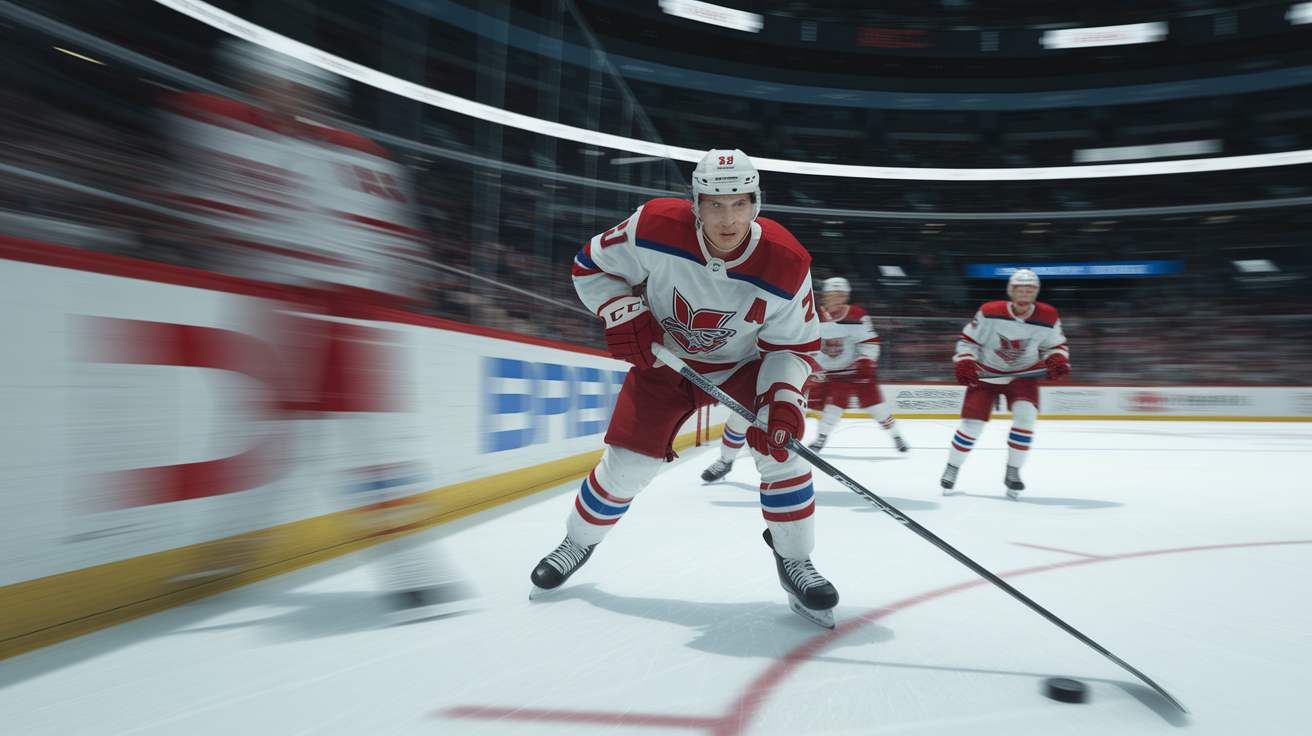
The reverse is a counter-move for when a forechecker’s chasing D1 hard behind the net or pinning D1 against the boards. Instead of passing through the crease to D2, D1 banks it hard off the boards the other way, sending it behind the chasing forechecker to D2, who’s positioned a bit higher and ready for the rim. The reverse breaks the forecheck’s angle and creates separation right away because the forechecker committed one direction and can’t recover fast.
The call is “reverse,” and D1 has to hit the bank pass with pace. Too soft and the forechecker picks it off. Too hard and it bounces past D2 into the neutral zone. D2 reads the call and sits slightly higher than in a standard D-to-D, usually near the hashmarks or just outside the circle, waiting for the rimmed puck. The center starts supporting D1 low, then cuts through the slot once the reverse activates, becoming an instant outlet for D2. The strong-side winger moves inside briefly then comes back to the boards after the puck reverses, and the weak-side winger gets ready to support D2 up the wall or across the middle.
The reverse is Plan B. Not your first choice, but it works when the forecheck overcommits or when D1 loses a step and needs to reset possession fast. The coaching point is timing: D1 should spot pressure early, call “reverse,” and hit the bank before getting pinned. D2 has to trust the call and move into position without waiting. Clean execution creates a controlled exit with D2 carrying speed up the weak side, often leading to a 2-on-1 or odd-man rush because the forecheckers are still recovering from their first pressure angle.
Wheel Breakout Pattern

The wheel gets called when D1 retrieves the puck with space and speed, letting the defenseman carry it around the back of the net and up the strong side without immediate pressure. The wheel uses the net as a natural screen, and D2 positions near the front of the crease as a pick to tie up or slow any forechecker trying to close on D1. The result is a high-speed controlled exit with D1 as the main puck carrier, supported by forwards moving up ice in layers.
The wheel gets triggered by four things:
- D1 has a clear path to the puck without a forechecker right on top.
- The strong-side lane is open or only lightly pressured.
- D1 has skating speed and confidence to carry through traffic.
- The forecheck is set up so D1 can use the net and D2’s body to create separation.
Once D1 starts the wheel, the center gives low support through the middle, the strong-side winger moves to the boards as the main outlet, and the weak-side winger trails or shifts across depending on how things develop. D2 holds near the crease until D1 clears the net, then moves up ice as the second wave or safety support. The wheel is one of the fastest ways to get controlled zone entries because it turns a D-zone retrieval into immediate neutral zone speed without needing multiple passes.
The coaching point for the wheel is D1’s read: if pressure closes too fast, bail on the wheel and call “reverse” or “over” instead. The worst thing you can do is commit to the wheel when a forechecker’s already tight. That’s a turnover at the top of the circle with no support behind. Get it right and the wheel creates a 3-on-2 rush with D1 leading and forwards filling lanes at speed. That’s one of the best zone entry setups you can get.
Hinge Breakout Pattern

The hinge is a possession reset for when the main breakout lanes are closed and the puck needs to move backward to create new angles and options. The hinge uses a deeper safety valve, often D2 or the center, to receive the puck under no pressure, giving time to scan and make a second decision. You see this when the forecheck is aggressive and well structured, killing quick up-ice passes but not applying enough back pressure to force a dump.
D1 grabs the puck and sees that the strong-side lane and the D-to-D lane are both covered. Instead of forcing a pass, D1 skates laterally or a bit backward toward the safety valve, who’s positioned lower and closer to the goal line, creating a short, safe pass option. Once the safety valve gets the puck, the whole forward group adjusts: the center might drop deeper for an outlet, or the wingers reset their routes to match the new puck position. The hinge buys time and resets pressure angles without giving up possession.
The key is that the hinge is proactive, not reactive. The safety valve has to position early, and D1 has to spot the need for a hinge before getting forced into a bad pass. Once the hinge is done and the puck’s under control, the breakout can restart with any of the standard patterns. Wheel, D-to-D, reverse, whatever the forecheck gives you. The hinge works really well against teams that press hard in the D-zone but lack discipline in their back-pressure coverage. That lets the hinged puck carrier find open ice and start a controlled entry with fresh speed and structure.
Stretch Breakout Pattern
The stretch extends the ice vertically, sending a forward deep into the neutral zone or even across the offensive blue line before the puck gets released. The stretch forces the other team’s defense to retreat and respect the threat of a long pass, creating big open pockets in the neutral zone for controlled entries. The stretch is best against aggressive forechecks that commit multiple players deep, leaving almost no back coverage.
The stretch happens in four steps:
- D1 retrieves and scans for pressure while the weak-side winger or center starts skating hard up the far side.
- The stretching forward times the route so they’re at full speed when D1’s ready to release.
- D1 delivers a long, flat pass up the boards or through the middle, leading the forward into open ice.
- The other forwards and D-men fill support lanes as the second and third waves, creating a layered attack.
The stretch is high reward but needs precise timing and a strong, accurate pass from D1. If the stretch forward leaves too early, they’re offside. Too late and the pass becomes a contested 50-50. The cue for the stretching forward is to read D1’s body position and stick placement. When D1 has control and is ready to pass, start the route.
The stretch works especially well on the power play or against teams using a 2-1-2 forecheck, where the two high forecheckers commit hard and leave space behind. Clean execution creates a 1-on-1 or 2-on-1 at the offensive blue line with speed. That’s one of the highest percentage controlled entry setups. The risk is that a missed stretch pass often results in an icing or an odd-man rush back the other way, so you need to practice stretch timing a lot before using it in games.
Timing Mechanics and Synchronization

Good breakouts depend on all five players moving at the same time, triggered by one cue, usually the puck retrieval or the call from D1 or D2. If the forwards leave early, the passes show up late or into space the forwards already vacated. If the forwards leave late, the forecheck closes the passing lanes before the outlets are in position. Synchronization is the single biggest technical piece that separates controlled breakouts from turnovers or dump-outs.
The timing window starts the moment D1 touches the puck. Right then, the center, both wingers, and D2 should all begin their routes. The center moves to low support. The strong-side winger moves to the boards. The weak-side winger reads the play type and adjusts. D2 positions for a potential D-to-D or safety valve. All of this happens at once, not one after another. If any player waits to see where the puck goes before moving, the support structure collapses and D1’s left with one option: dump it out.
The coaching piece for timing is visual and verbal triggers. A lot of teams use a simple call system: “wheel,” “over,” “reverse,” “stretch.” The call happens as soon as D1 sees the pressure and picks the breakout type. The moment the call’s made, everyone goes. In practice, coaches should blow the whistle randomly during breakout drills and freeze players to check positioning and timing. If the forwards are standing still or out of sync, reset the drill. The goal is to build a habit where the whole unit moves as one, reading the same cues and responding in the same half-second window. That’s what lets you break out clean under heavy pressure and what creates the speed and support structure you need for quality zone entries.
Reading Forecheck Pressure and Adjusting Breakouts

Different forecheck structures create different pressure patterns, and spotting the forecheck type fast lets your team pick the best breakout. A 1-2-2 forecheck puts moderate pressure with one high forward and two support layers. A 2-1-2 forecheck sends two forecheckers deep, creating heavy pressure but leaving more space behind. A 1-3-1 spreads forecheckers across the ice, cutting direct passing lanes but reducing immediate back pressure. Reading these structures in the first two seconds of puck retrieval tells you whether to wheel, reverse, or stretch.
| Forecheck Type | Best Breakout Option |
|---|---|
| 1‑2‑2 (moderate pressure, middle support) | Wheel or D‑to‑D |
| 2‑1‑2 (heavy deep pressure, weak back coverage) | Stretch or Reverse |
| 1‑3‑1 (spread pressure, limited lanes) | Hinge or D‑to‑D |
The 1-2-2 forecheck is the most common at higher levels. It puts consistent pressure but rarely floods one side completely, so the wheel and D-to-D options stay open. The wheel works when the first forechecker’s a bit late or out of position, letting D1 use speed and the net as a screen. The D-to-D works when the forecheck commits to the strong side, leaving the weak side open for D2 to push up.
The 2-1-2 forecheck is aggressive and high risk for the forechecking team. Two forwards commit deep, trying to force a turnover or a rim. This sets up the stretch breakout: back coverage is thin, and a well-timed long pass can break the forecheck entirely. If the stretch isn’t there, the reverse becomes your next option because it uses the forecheckers’ aggression against them, banking the puck behind their chase and resetting possession with D2.
The 1-3-1 forecheck spreads three forecheckers across the neutral zone, clogging passing lanes and making the breakout go through multiple layers. Against this, the hinge is often your best choice because it resets the puck to a deeper spot, forcing the 1-3-1 to collapse or back off. Once the hinge’s done, the breakout can restart with better angles. The D-to-D also works because it shifts the puck laterally, pulling the spread forecheckers out of position and opening a new lane up the weak side. The key is patience. Forcing a direct pass into a 1-3-1 usually ends in a neutral zone turnover.
Coaching Cues for High-Quality Zone Entries

Coaches can use simple, repeatable cues to reinforce timing, spacing, and reads during breakouts and zone entries. These cues should be quick, specific, and tied to actions players can do right away. The goal is to cut hesitation and improve execution under pressure.
- “Look before you get there”. Scan for outlets and pressure before touching the puck, not after.
- “Feet moving, head up”. Never take a pass standing still. Always be moving to keep speed and options.
- “Give a target”. Forwards have to show their stick blade clearly so the passer knows where to put it.
- “Quick release, no hesitation”. Once you decide, execute the pass or carry right away. Hesitation invites pressure.
- “Fill lanes, don’t chase”. Forwards should move into open lanes instead of chasing the puck carrier. Keep support structure.
These cues work best when you repeat them in practice and reinforce them during video review. Players start to internalize the language, and the cues become automatic triggers for correct positioning and timing.
The coaching focus should always come back to the same idea: controlled breakouts and quality zone entries are built on synchronized movement, clear communication, and smart reads of forecheck pressure. When players trust the system and run their roles with precision, the breakout becomes a weapon instead of a source of turnovers and dump-outs. Small adjustments in timing and positioning create big differences in possession and shot generation once the puck crosses the offensive blue line.
Diagram Set: Visualizing Each Breakout Pattern
Each breakout pattern should be backed by a clear overhead diagram showing player positioning, puck movement, skating routes, and timing cues. The following diagrams matter for teaching and reinforcing the systems covered here:
- D-to-D Breakout Diagram. Show D1 passing behind the net to D2, weak-side winger moving to the boards, center shifting across, strong-side winger trailing.
- Reverse Breakout Diagram. Show D1 banking the puck off the boards behind the forechecker, D2 positioned higher to receive, center cutting through the slot, wingers adjusting routes.
- Wheel Breakout Diagram. Show D1 skating around the net with speed, D2 acting as a pick near the crease, strong-side winger on the boards, center giving middle support.
- Hinge Breakout Diagram. Show D1 passing backward to a safety valve (D2 or center), support layers resetting, new passing lanes opening after the hinge.
- Stretch Breakout Diagram. Show the stretching forward (weak-side winger or center) skating deep, D1 delivering a long pass, remaining forwards filling second and third wave lanes.
- Standard Support Structure Diagram. Show the baseline breakout shape with D1, D2, center, strong-side winger, and weak-side winger in their default spots before the play gets called.
Video Example Breakdown
Video analysis is the best way to teach breakout recognition and execution because it shows real-time pressure, player movement, and reads in ways static diagrams can’t. Coaches should build a library of short clips, 10 to 20 seconds each, that isolate specific breakout types and show both good execution and common mistakes. Focus on three areas: retrieval under pressure, pattern execution, and the zone entry quality that results.
Retrieval clips should show how fast D1 gets to the puck, scans for outlets, and makes the first decision. Look for examples where D1 hesitates and the forecheck closes, versus examples where D1 moves decisively and creates separation. Pattern execution clips should isolate one breakout type (wheel, reverse, stretch, or D-to-D) and show the synchronized movement of all five players. Pause at key moments to show timing: when did the forwards start their routes, when did D1 release the puck, and how did the support layers adjust as the play developed.
Zone entry clips should connect the breakout to the result: controlled carry across the blue line, clean pass to a forward with speed, or a breakdown that forces a dump or turnover. The goal is to show players the direct link between breakout execution and offensive zone possession. Quality entries almost always follow clean, synchronized breakouts with good spacing and smart pressure reads. Poor entries usually follow rushed decisions, bad timing, or isolated puck carriers with no support. Video makes that connection visible and reinforces why you practice breakout systems with discipline and precision.
Final Words
In the action, this guide laid out the must-have principles: support triangles, early puck retrieval, timing, and lane creation that keep possession through the neutral zone.
We then ran through the standard shape and the main patterns — D-to-D, reverse, wheel, hinge, and stretch — so you know when each one fits.
Timing, forecheck reads, coaching cues, diagrams, and video examples tie it together so players make smarter choices on the fly.
Use these ideas to tighten your controlled breakout hockey and create more high-quality zone entries.
FAQ
Q: How do you break out of your zone in hockey? What is the basic breakout play in hockey?
A: Breaking out of your zone uses a basic breakout: defense retrieves the puck, plays a short D-to-D or D-to-wing to the strong-side forward, support layers rise together, and timed skate-and-pass preserves possession through the neutral zone.
Q: Where do you put your weakest player in hockey?
A: You should place your weakest player on the wing, usually the strong-side wall, give simple, clear tasks, and pair them with a supportive teammate; avoid center or isolated defensive roles.
Q: What is the 1 2 2 neutral zone in hockey?
A: The 1-2-2 neutral zone is a forecheck/trap alignment where one forward pressures, two clog the middle, and two stay back, aiming to force wide plays, slow entries, and create turnovers in the neutral zone.