

What if your power play is losing more chances because players stand too close, not because they can’t shoot?
Spacing and movement are what force the penalty kill into bad choices.
Keep perimeter players 10 to 15 feet apart, stagger your points, and move the puck fast, and lanes open.
This post gives clear, rink-ready habits: exact spacing, tempo windows, and rotation triggers for umbrella, 1-3-1, and overload looks.
Read on to learn the plays and drills that turn set-ups into real goals.
Core Principles Behind Effective Power Play Movement and Spacing
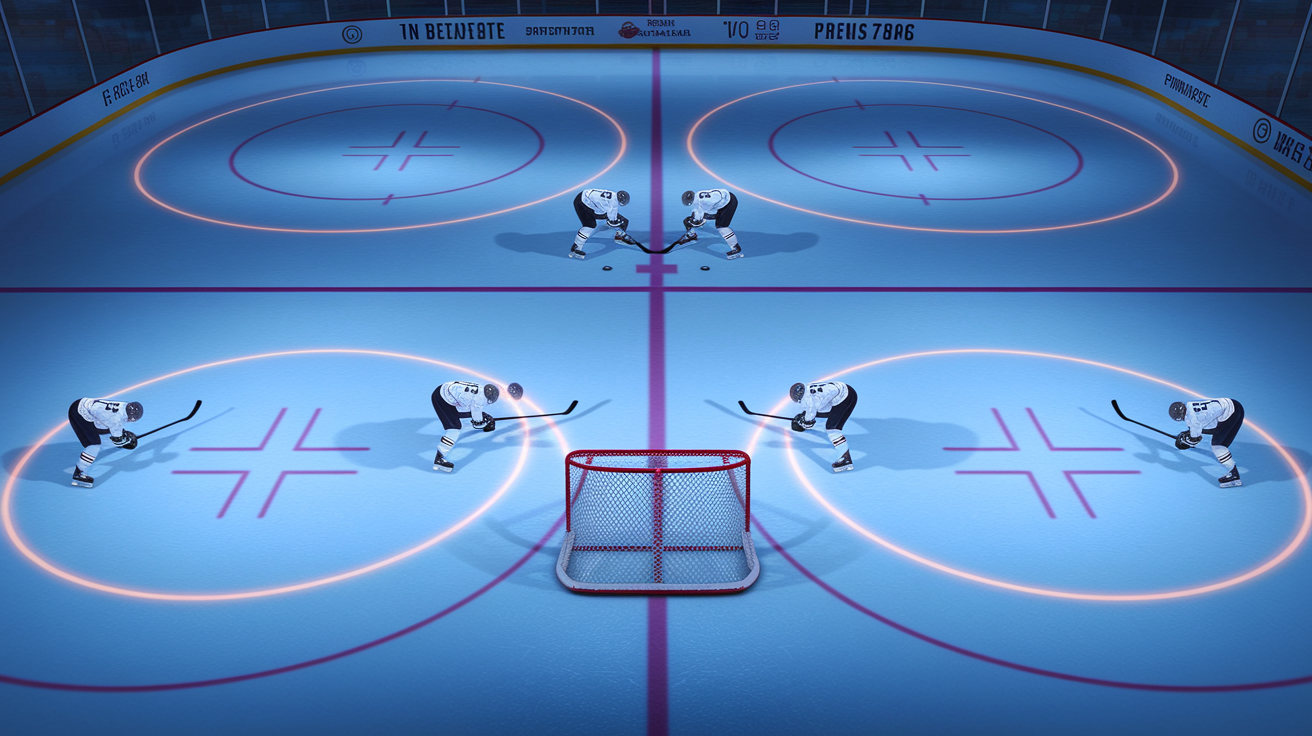
A power play works because you’ve got five attackers versus four defenders. The whole idea is to force the penalty kill into impossible decisions. Move the puck, stretch their coverage, and create shooting lanes they can’t close. You’re using four main attack positions (two points, two half-boards) plus someone parked at the net, and the goal is simple: make one defender choose between covering two players or leaving a lane wide open.
Spacing is what makes those choices impossible. Keep 10 to 15 feet between your perimeter guys so one penalty killer can’t collapse on two lanes at once. Stagger your points vertically by 5 to 8 feet. If they’re lined up side by side, the penalty kill can step into the middle and shut down both one-timer options. Put your net-front guy 3 to 6 feet from the crease. Close enough to screen, tip, and jump on rebounds, but not so tight a defender can just tie him up without leaving something else open.
Pass tempo turns spacing into pressure. Move the puck across the perimeter in 1 to 2 seconds per touch to shift the box faster than skaters can rotate. When you’re shooting from the point, you want the catch-and-release window under 1 to 2 seconds. That forces the penalty kill to respect the threat every single time the puck touches a shooter’s stick. If no clean lane opens, rotate positions every 6 to 8 seconds. When you want to catch defenders flat-footed, shorten that to 3 to 5 seconds after a seam pass or a scramble in front.
Spacing rules that create high-quality chances:
- 10 to 15 feet between perimeter players to stretch the penalty kill.
- Net-front presence 3 to 6 feet from the crease for screens, tips, rebounds.
- Stagger points vertically by 5 to 8 feet so you’ve got independent one-timer lanes.
- Execute passes at 1 to 2 second tempo to shift coverage faster than they can rotate.
- Rotate positions every 6 to 8 seconds, or every 3 to 5 seconds when you’re exploiting hesitation.
Power Play Formation Structures That Shape Movement and Spacing

Each formation solves the 5-on-4 puzzle differently. Umbrella, 1-3-1, overload. They distribute your five attackers across the ice in unique ways, and understanding the positioning behind each one helps you match personnel to structure and exploit how the penalty kill sets up.
Choosing a formation is choosing where to put your bodies. Umbrella stacks shooters high and wide, the 1-3-1 loads the middle with a bumper, and overload packs one side to manufacture weak-side seams. Each demands different spacing and different rotation cues.
Umbrella Setup
The umbrella runs three players high (center point plus two flanking shooters or half-wall wings) and two low (half-boards or net-front). Your center point sits near the top of the circles. The two flanking shooters station 10 to 12 feet wide and 5 to 8 feet lower, forming a curve that creates multiple one-timer angles. Your low players occupy the goal line extended and the net-front, forcing the penalty kill to choose between collapsing on the screen or respecting the point shot. Movement in the umbrella is lateral. Swing the puck point to point or point to half-board to drag the box sideways, then fire a one-timer or slip a cross-slot pass through the seam that rotation creates. This works best when you’ve got two strong point shooters with opposite handedness who can release in under 1.5 seconds. The Edmonton Oilers ran this with Paul Coffey on the left point and a right-shot bomber on the other side, forcing penalty kills to honor both lanes every touch.
1-3-1 Structure
The 1-3-1 puts one player at the top (point), three across the middle lane (two half-boards plus a bumper in the high slot), and one net-front. Spacing here is about vertical layering and middle-lane control. The bumper sits 15 to 18 feet from the net in the center slot, acting as a pivot and quick-release shooter. Your two half-board players stay wide at the dots, maintaining that 10 to 15 foot lateral spacing to stretch the penalty kill. Net-front presence anchors 3 to 6 feet from the crease. This formation’s power is in the bumper reading which seam opens first and making a 1 to 2 second decision. Movement rotates through the middle: bumper can drop low or swing to the half-board, half-board player can rotate up to the point, or the point can step into the high slot and convert the look into an umbrella shot. Track rotation every 6 to 8 seconds to keep the penalty kill guessing.
Overload Alignment
The overload puts three or four players on the strong side (typically two along the wall, one in the low slot, and one at the net-front or half-board) and leaves one weak-side distributor high and wide. Vertical spacing is key. Stack players at different heights, one at the goal line, one at the top of the circle, one in between, so passing lanes run at multiple angles and the penalty kill can’t cover all three with a simple box shift. The overload works by forcing the penalty kill to collapse toward the puck-side concentration, which opens a cross-ice seam to the weak-side shooter for a one-timer or a quick return feed into the vacated slot. Movement starts with a strong-side cycle (two or three quick passes to pull defenders), then a snap pass across to the weak side in under 2 seconds before the penalty kill can rotate. When the weak-side shooter catches and releases immediately, the penalty kill is still sliding and the shooting lane is clean. Think of it as a 4-on-3 strong side, then a 1-on-0 weak side if the pass is fast enough.
Zone Entry and Set-Up Movement Patterns for Optimal Spacing
Clean zone entries set spacing before the penalty kill can get organized. A controlled entry, where the puck carrier or a pass receiver enters with possession, succeeds 70 to 90% of the time when practiced and eliminates the scramble that follows a contested dump-in. The moment you gain the zone, you need to occupy your formation’s anchor positions within 2 to 3 seconds: establish the point, locate the bumper or half-boards, and put someone 3 to 6 feet from the crease. Speed of setup determines whether the penalty kill can pressure your first touch or has to respect all five threats right away.
Entry width matters as much as speed. Entering wide (near the boards rather than up the middle) stretches the penalty-kill fore-checker horizontally and creates a safer first pass to the point or opposite half-board. If the entry gets pressured and you lose the angle, a quick chip to the half-board (where a teammate is already positioned) or a controlled dump to a low man who retrieves in 1 to 2 seconds keeps possession and avoids the neutral-zone turnover that kills momentum. The difference between a 25-second power play and a 5-second scramble is often whether the first three seconds after entry are clean or chaotic.
Three entry options matched to spacing priorities:
- Controlled carry: Skate in with possession, draw the fore-checker, and pass to the point or half-board to set spacing immediately. Use when you’ve got speed through the neutral zone.
- Chip to half-board: Soft chip along the wall to a stationary target, establish the half-board position first, then swing to the point. Use when the entry lane is tight but the wall is open.
- Dump and retrieve: Hard rim or soft chip to the low corner, retrieve within 1 to 2 seconds, and cycle up to half-board. Use when forechecking pressure is heavy and a clean carry isn’t available.
Rotation, Timing, and Movement Sequences That Open Lanes
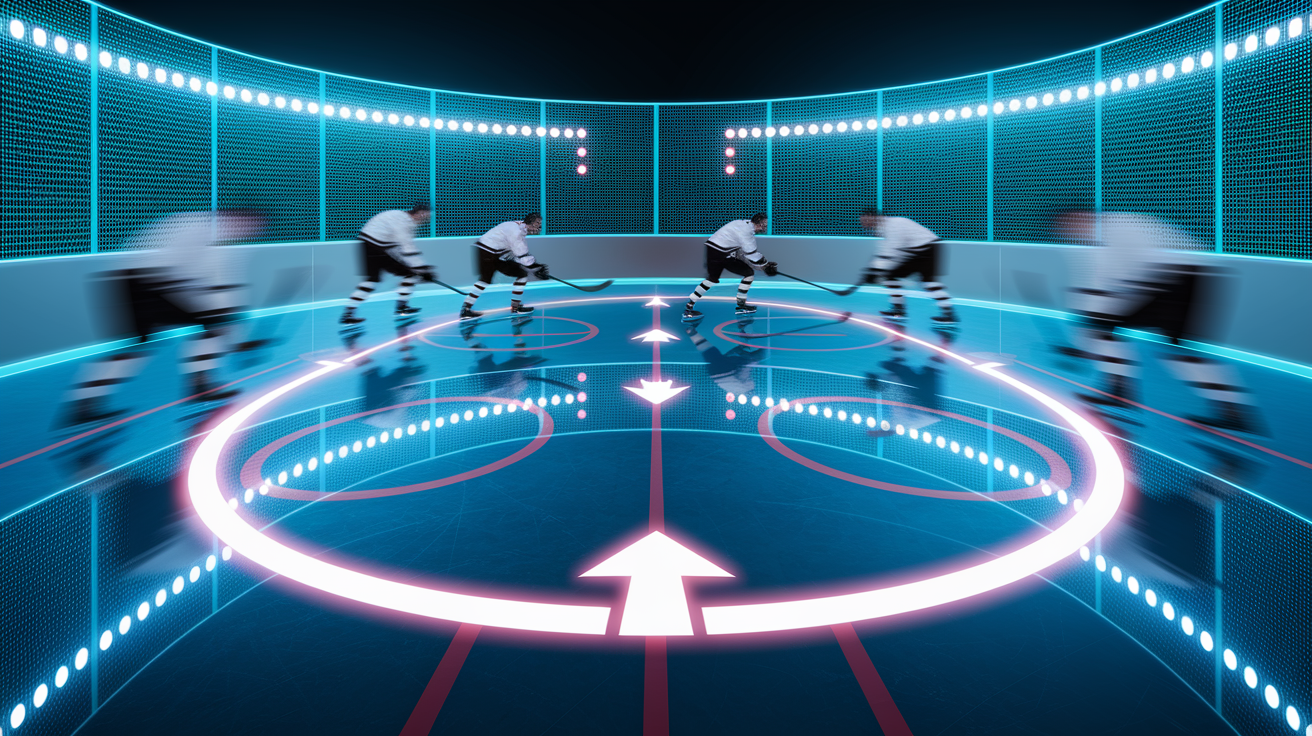
Rotation timing manipulates the penalty kill’s structure by forcing defenders to choose between staying home and chasing movement. Standard rotation cadence is 6 to 8 seconds. If no clear shooting lane appears after two or three perimeter passes, trigger a positional swap. Point drops to bumper, bumper swings to half-board, half-board rotates up. This broad rotation pulls penalty killers out of their box or diamond and creates a 2 to 3 second window where coverage is in transition and a seam pass or one-timer can slip through. Shorter rotation windows (3 to 5 seconds) work when you want to catch a defender flat-footed after a net-front scramble or a quick puck reversal.
Pass tempo is the engine. Move the puck at 1 to 2 seconds per touch across the perimeter to shift the penalty-kill box faster than skaters can rotate their feet. A slow, deliberate cycle gives defenders time to adjust. A quick two-touch sequence (half-board to point to opposite half-board in under 3 seconds) forces the box to slide, and the third defender in the rotation is often a half-step late closing the seam. Point one-timers demand sub-1.5 second release windows from catch to shot. Any longer and the penalty kill can step into the lane or commit to a block.
Rotation triggers tell you when to swap positions instead of cycling the puck. If the penalty kill overcommits to the half-board (two defenders pressuring the wall), rotate the half-board player to the point and immediately swing the puck there for a shooting lane before the penalty kill can recover. If the net-front presence draws two defenders into a scrum, rotate the bumper or a half-board player to the vacated high slot for a quick feed and release. If a seam pass gets tipped or blocked but the puck stays in the zone, reset spacing and initiate a fresh rotation within 3 seconds to prevent the penalty kill from re-establishing their structure. Track these windows during video review. Most goals come within 2 to 5 seconds after a rotation or a quick reversal catches the penalty kill in transition.
Four rotation triggers that create immediate scoring chances:
- Penalty kill overcommits to one side: Rotate the pressured player out and swing the puck to the vacated zone within 2 seconds.
- Net-front scramble: When two defenders engage your screen, rotate a perimeter player into the open high slot for a feed and quick release.
- Blocked seam pass with zone retention: Reset spacing and rotate positions within 3 to 5 seconds to exploit the penalty kill’s recovery lag.
- Point pressure: When a penalty killer steps to the point, the point player can drop to bumper and a half-board rotates up to take the next one-timer.
Off-Puck Movement and Net-Front Spacing Techniques

Net-front presence turns perimeter movement into goals by creating screens, deflections, and rebound opportunities inside the home-plate area. Position your net-front player 3 to 6 feet from the crease. Close enough to obstruct the goalie’s sight lines and get a stick on pucks, but far enough that the defender can’t simply pin you to the post without leaving a passing lane open. Staggered screens (where the net-front player shifts laterally by a step every 2 to 3 seconds) generate moving obstacles that make it harder for the goalie to track the puck through traffic. Deflection and rebound work accounts for 20 to 25% of power play training reps because those ugly goals (tips, scrambles, second chances) convert at a higher rate than clean perimeter shots when the net-front spacing is dialed in.
Off-puck drift and cuts manufacture weak-side seams and backdoor opportunities. A half-board player who drifts toward the middle while the puck cycles strong side pulls a penalty-kill defender with them, opening space for a cross-ice pass or a weak-side one-timer. A bumper who fakes a cut to the net and then pops back to the high slot creates a moment of hesitation. Just enough for a quick feed and release. Low-slot dodges (quick lateral steps to evade a defender’s stick or body) keep passing lanes alive when the penalty kill tries to collapse. All of these movements happen without the puck, and they only work when spacing is maintained. If players bunch within 5 feet of each other, the penalty kill can cover two threats with one defender and the off-puck movement becomes wasted energy.
| Technique | Spacing Target | Purpose |
|---|---|---|
| Screen | 3 to 6 feet from crease, stick blade on ice | Obstruct goalie sight lines and create tip opportunities on point shots |
| Deflection | 4 to 8 feet from crease, angled toward shooter | Redirect shots into areas the goalie has already committed away from |
| Low-slot dodge | Quick 2-foot lateral step in slot | Evade defender’s stick to keep seam-pass lanes open and maintain soft-area positioning |
| Backdoor cut | Weak-side post, 1 to 3 feet from crease | Exploit cross-ice pass when penalty kill collapses strong side, create tap-in opportunity |
Puck Circulation, Cycling Patterns, and Seam-Pass Creation
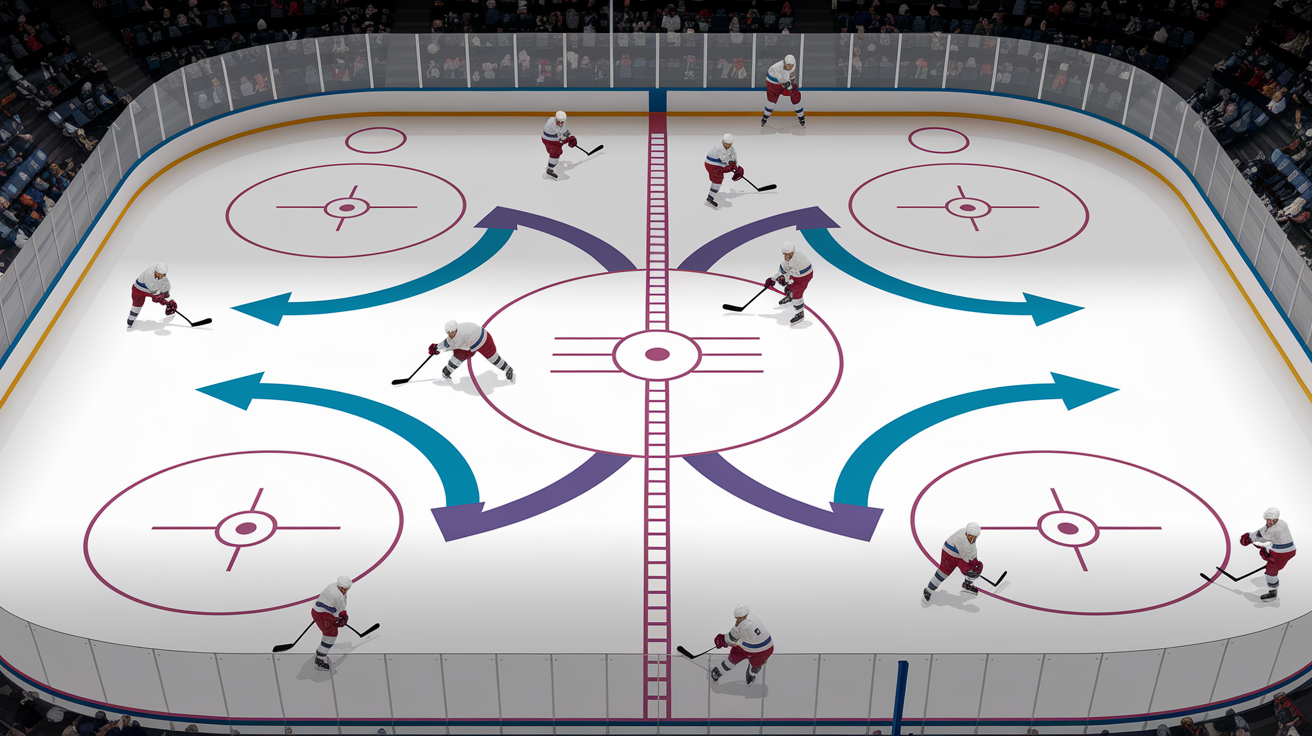
Lateral puck circulation at 1 to 2 seconds per pass is the simplest way to shift a penalty-kill box and open seams. A quick three-pass chain (half-board to point to opposite half-board) executed in under 4 seconds forces the penalty kill to rotate their diamond or box, and the third or fourth defender in that rotation is often a half-step late closing the shooting lane. One or two-touch passing keeps the puck moving faster than skaters can adjust their feet, and it prevents the penalty kill from settling into a static structure. When the puck sits on one player’s stick for more than 2 seconds, the penalty kill has time to collapse passing lanes and step into shooting windows.
Cycling patterns create vertical and horizontal puck movement that pulls defenders out of position. A low-to-high cycle (corner to half-board to point) draws a penalty killer low, then sends the puck back up before the defender can recover. A reverse cycle (point to half-board to bumper to opposite half-board) forces the penalty kill to rotate in one direction, then immediately reverse. The seam usually opens during that direction change. Weak-side conversions in overload structures exploit the lag between the puck moving and the penalty kill sliding. If you cycle strong side for 2 to 4 passes and then snap a cross-ice pass to the weak-side shooter in under 2 seconds, the penalty kill is still sliding toward the puck’s old location when the shot releases. D-to-D passes (point to point) drag the penalty-kill forwards wide and create middle-lane seams for the bumper or a late-arriving forward cutting through the slot.
Seam passes are cross-ice or diagonal feeds that thread through the gaps in penalty-kill coverage. The best seams appear during defensive rotation lag, the 1 to 2 second window after the penalty kill commits to one side and before they can recover to the other. Timing is everything. A seam pass attempted too early hits a defender’s stick, and a seam pass attempted too late arrives after the penalty kill has re-established position. Track the penalty kill’s feet and sticks, not just their body position. If a defender’s stick is pointing toward the half-board but their skates are still turning, the seam behind them is open for a quick feed.
Five circulation patterns that engineer space and seams:
- D-to-D (point to point): Lateral pass across the blue line to shift the penalty-kill forwards wide and open the middle lane for a bumper or cutting forward.
- Reverse cycle: Point to half-board to bumper to opposite half-board, forcing the penalty kill to rotate one direction then immediately reverse. Seam opens during the change.
- Low-high: Corner or goal line to half-board to point, drawing a penalty killer low and then sending the puck back up before recovery.
- Lateral swing: Half-board to point to opposite half-board in a quick three-touch sequence (under 4 seconds total) to shift the box and create a shooting lane on the third touch.
- Weak-side exchange: Cycle strong side for 2 to 4 passes, then snap a cross-ice pass to the weak-side shooter while the penalty kill is still sliding toward the puck’s previous location.
Shooting-Lane Development and Spacing Metrics
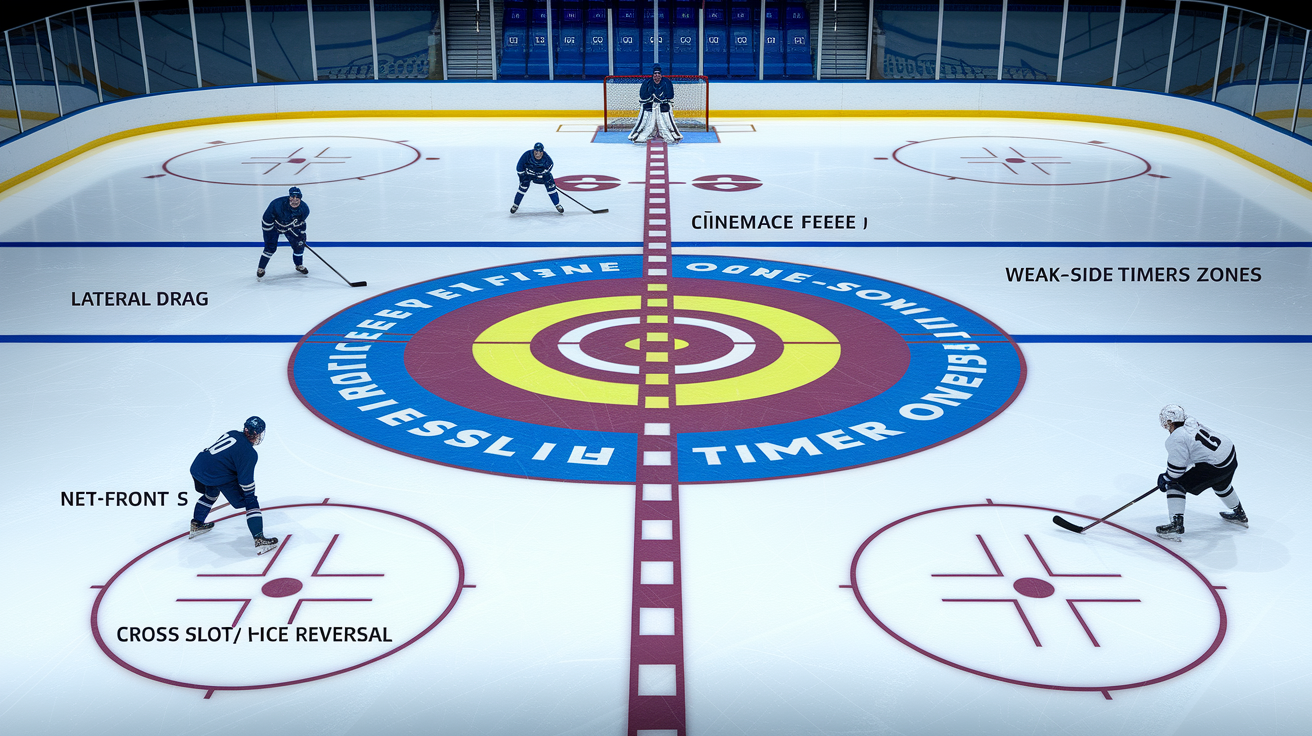
Creating shooting lanes is about geometry and timing. Keep 10 to 15 feet of horizontal spacing between perimeter players so a single penalty-kill defender can’t collapse into two passing or shooting lanes at once. Stagger your two points vertically by 5 to 8 feet so one-timer options don’t run in a straight line. If both points are side-by-side at the blue line, one penalty killer can step into the middle and block both shooting windows. When the spacing is correct, the penalty kill has to choose: respect the left point, the right point, or the bumper, but not all three at once. That impossible choice is where shooting lanes open.
Heat-map zones show where goals actually happen. The highest-danger areas are the home plate (slot from the top of the circles to 10 feet in front of the net), the net-front crease area (3 to 6 feet from the goal line), and the weak-side one-timer position (opposite half-board or point when the puck cycles strong side). Shooting-lane windows open during 1 to 2 second defensive hesitation moments, after a quick reversal, after a net-front scramble, or after a seam pass forces a penalty killer to turn their hips and recover. If you can get a shot off inside that 1 to 2 second window, the lane is usually clean because the penalty kill is in transition.
Lane creation isn’t passive. It’s an active process driven by lateral drags, screens, and off-puck cuts. A half-board player who drags the puck two feet toward the middle pulls a defender with them, opening a passing lane to the point or a shooting lane for a one-timer. A net-front screen forces the penalty kill to commit a second defender, which opens a high-slot lane for the bumper. A bumper who fakes a cut to the net and then pops back to the high slot creates a moment of hesitation, just enough for a feed and release before the defender can close.
Three lane-creation methods that turn spacing into shots:
- Lateral drag and shoot: Half-board player drags puck 2 to 3 feet toward middle to pull a defender, then fires a shot or feeds the now-open point for a one-timer.
- Net-front screen and high-slot feed: Net-front presence draws two defenders into a scrum, bumper pops to open high slot for a quick feed and release within 1 to 2 seconds.
- Cross-ice reversal with immediate release: Cycle strong side for 2 to 4 passes, snap a cross-ice pass to weak-side shooter, and release within 1 second before penalty kill can rotate and close the lane.
Drills to Train Power Play Spacing, Movement, and Timing

The 1-3-1 five-option drill builds decision-making and spacing discipline under structure. Set up your five-man unit in the 1-3-1 alignment and run through all five option sequences (point one-timer, half-board cycle, low net-front feed, reverse-umbrella trigger, quick overload) in order. Execute 6 sequences per rotation, rotate units, and complete 4 rotations per practice for a total of 24 reps. The goal is to teach players to recognize which option is open based on penalty-kill positioning and to execute the pass-and-shot sequence within the prescribed timing windows (1 to 2 seconds for one-timers, 2 to 4 passes before a slot shot). Track how often each option generates a high-quality chance, and adjust spacing or timing if one option consistently fails. See detailed 1-3-1 Power Play: 5 Options breakdown for teaching sequences and progression steps.
Timed possession drills train your unit to maintain controlled power play possession under pressure. Start in your chosen formation, add a passive or semi-active penalty-kill unit, and task your power play with holding the puck for 20 to 30 seconds while executing at least three perimeter passes and two rotation movements. Repeat the drill 8 to 12 times per session, and track turnovers, shot attempts, and whether spacing collapsed during the sequence. This drill builds the puck-management and rotation discipline needed to avoid panic when the first shooting lane doesn’t appear right away.
One-timer point practice isolates the pass-to-shot release window that makes umbrella and 1-3-1 formations dangerous. Position a half-board passer and a point shooter, and run 30 repetitions per session where the half-board player feeds the point and the shooter releases in under 1.5 seconds. Add a net-front presence for tips and screens after the first 15 reps. Track release time and shooting accuracy. Point shooters need to be automatic on this play because the penalty kill will respect the threat only if the execution is clean and fast. Power play simulation segments (3 sets of 4-minute special-teams periods with video feedback) let you test spacing, rotations, and option reads against live penalty-kill looks, and video review after each segment shows where spacing broke down or where a quicker rotation would have opened a seam.
Four drill types that build spacing, movement, and timing:
- 1-3-1 five-option sequences: 6 option cycles per rotation, 4 rotations per practice, teaches decision-making and timing discipline within structured spacing.
- Timed possession (20 to 30 seconds): Maintain puck control with 3+ perimeter passes and 2 rotation movements, repeated 8 to 12 times to build composure and spacing under pressure.
- One-timer point practice: 30 repetitions of half-board-to-point feeds with sub-1.5 second release, isolates the quick-shot timing that makes formations dangerous.
- Power play simulation (3 × 4-minute segments): Live special-teams periods with video feedback to test spacing, rotations, and reads against penalty-kill adjustments in real time.
Coaching Cues, Adjustments, and Reading Penalty-Kill Structures

Communication cues keep five skaters aligned on spacing and timing decisions during live play. Simple verbal calls like “Swing it,” “Bumper open,” “Shoot,” “Reset” tell the puck carrier which option is available without requiring eye contact or hesitation. Non-verbal cues matter too. A stick tap on the ice signals a passing lane is open, a hand up from the point means the shooter is ready for a one-timer, and a net-front player posting hard on the crease tells the half-board to look low for a seam feed. When penalty-kill pressure rises, clear cues prevent the puck carrier from forcing a bad pass or holding the puck too long while a shooting lane closes.
Reading penalty-kill structures in real time dictates which formation and option to deploy. A box collapse (all four penalty killers inside the dots) is countered with a quick high-low pass to the net-front or a point shot through traffic. The penalty kill has given up the perimeter to protect the slot, so use that space. If the penalty kill overplays the half-board (two defenders pressuring the wall), swing the puck to the point within 2 seconds for a shooting lane before the box can rotate. Aggressive penalty kills that pressure the point or half-board aggressively can be beaten with rapid 2-second passes that move the puck faster than the fore-checker can recover. See additional tactical reads in Power Play Strategies: Maximizing Offensive Opportunities.
Track key performance indicators during practice and games to guide adjustments. Time-to-first-shot should be under 8 seconds from zone entry, passes-per-possession should range from 3 to 6 before a shot attempt, and your unit should generate at least one dangerous chance (slot shot, net-front tip, or cross-ice one-timer) per power play sequence. If time-to-first-shot creeps above 10 seconds, your entry or setup is too slow. If passes-per-possession exceeds 8 without a shot, your spacing is likely too tight or your rotation triggers are being ignored. Use video to mark these metrics after every game and practice, then adjust spacing rules or rotation cadence in the next session to correct the pattern.
Three common penalty-kill structures and counters:
- Box (four skaters inside the dots): Counter with high-low feeds to net-front or point shots through screens. Penalty kill has surrendered perimeter space to protect the slot, so exploit the outside lanes and use traffic to create tips and deflections.
- Diamond (one high, two mid, one low): Counter with lateral point-to-point passes to pull the high forward wide, then slip a seam pass to the bumper in the middle lane. Diamond structure creates a natural seam in the high slot when the puck moves laterally.
- Wedge+1 (aggressive triangle high, one low): Counter with quick two-touch passing (under 2 seconds per pass) to move the puck faster than the high pressure can recover, then release a shot or seam pass before the wedge re-establishes. This structure gambles on forcing turnovers, so clean passing and quick decisions neutralize the pressure.
Final Words
In the action, we ran through why the 5-on-4 advantage is about creating time and space, the 10-15 foot perimeter and 3-6 foot net-front metrics, quick 1-2 second pass tempo, and a 6-8 second rotation cadence. We covered formations, clean entries, off-puck work, puck circulation, and drills so you know what to teach and practice.
Use short, timed reps in practice. Focus on reads, rotation triggers, and simple cues. Practice these power play movement and spacing strategies and you’ll start generating higher-quality chances and more confidence on the man advantage.
FAQ
Q: What strategies are used during a power play?
A: The strategies used during a power play are to exploit the 5‑vs‑4 advantage by creating time and space with quick 1–2 second passes, using umbrella/1‑3‑1/overload formations, and keeping a 3–6‑foot net‑front presence.
Q: What is the Gretzky rule in power plays?
A: The Gretzky rule in power plays is to skate to where the puck will be, not where it is, moving into space ahead of passes to open lanes and set up better one‑timer opportunities.
Q: What is the 1-3-1 power play?
A: The 1‑3‑1 power play is a formation with one high point, three across the middle and one net‑front player; it prioritizes perimeter spacing, seam passes, quick 1–2 touch circulation and five‑option attacks.
Q: What are common power play mistakes?
A: The common power play mistakes are poor spacing (crowding or too wide), slow pass tempo over 2 seconds, weak net‑front presence, predictable puck movement and failing to force PK rotations for seams.