

Think a 2.3 GPA and a decent SAT automatically gets you an NCAA hockey scholarship?
Not exactly.
The NCAA requires 16 approved core courses and a core GPA (2.30 for Division I, 2.20 for Division II), then uses a sliding scale that pairs that GPA with a minimum SAT or ACT score.
You must register with the Eligibility Center early, have your counselor send an official transcript, and request test scores go directly to NCAA code 9999.
This post explains the GPA/test thresholds, the sliding scale, and the timeline to protect your scholarship chances.
Key Academic Benchmarks Needed for NCAA Hockey Scholarship Eligibility

You need 16 core courses and a minimum core GPA. For Division I, that’s 2.30. Division II requires 2.20. But here’s where it gets interesting: those numbers work with a sliding scale.
If your core GPA sits right at the minimum, your SAT or ACT score needs to be higher. Got a stronger GPA? The test score requirement drops. The NCAA built this scale so classroom performance can offset lower test scores. Works both ways.
Test scores have to go straight from the testing agency to the NCAA Eligibility Center. Sending them only to your college doesn’t count. Your high school submits an official transcript listing every core course, and your guidance counselor confirms the course classification. The Eligibility Center recalculates your GPA using only those 16 approved courses. Your transcript GPA and core GPA are often two different numbers.
Register with the Eligibility Center by the start of junior year if you’re aiming for Division I or II. Division III schools don’t offer athletic scholarships, so DIII players aren’t required to register. DIII hockey programs award academic and need-based aid through each school’s financial aid office, following their own admission standards instead of NCAA sliding scales.
Here’s what you need:
16 core courses from approved high school classes in English, math, science, and social studies
2.30 minimum core GPA for Division I; 2.20 minimum for Division II
SAT or ACT score that pairs with your core GPA on the NCAA sliding scale
Official test scores sent directly from the testing agency to the Eligibility Center
Official high school transcript submitted through your counselor, listing all core courses
Eligibility Center registration completed by early junior year for Division I and II prospects
Academic Structures Across NCAA Divisions for Hockey Recruits

Division I hockey programs can award up to 18 scholarship equivalencies. They split those across an average roster of 29 players. Most DI guys get partial scholarships.
To qualify at the Division I level, you need that 2.30 core GPA and the corresponding SAT or ACT score on the sliding scale. Fall short and you might be ruled a partial qualifier or nonqualifier. That limits practice, competition, and scholarship access during freshman year.
Division II programs operate under a 13.5 scholarship cap with a 2.20 core GPA floor. Same sliding scale pairing of GPA and test scores. Division II rosters average 31 players, so partial awards are standard there too.
Division III sponsors 84 men’s hockey teams and doesn’t allow athletic scholarships. DIII schools control all financial aid through their admissions and financial aid offices. Academic merit scholarships, need-based grants, and institutional aid replace athletic money. Every DIII program sets its own GPA, test score, and course standards independent of NCAA minimums.
| Division | Core GPA Minimum | Core Courses Required | Scholarship Type |
|---|---|---|---|
| Division I | 2.30 | 16 | Athletic (equivalency, 18 max) |
| Division II | 2.20 | 16 | Athletic (equivalency, 13.5 max) |
| Division III | Institutional standard | Institutional standard | Academic/need-based only |
Core Courses Needed for NCAA Hockey Eligibility

Core courses are high school classes the NCAA pre-approves in five academic areas. Only these count toward your 16-course requirement and your core GPA. Electives like physical education, driver’s ed, and most career-tech classes don’t count.
Your high school submits a list of NCAA-approved core courses to the Eligibility Center. You can check which of your classes qualify by reviewing that list with your counselor before senior year.
The 16 required courses break down like this:
4 years of English
3 years of mathematics (Algebra I or higher)
2 years of natural or physical science (including one lab course if your school offers lab science)
2 years of social science
4 additional years from English, math, natural or physical science, social science, foreign language, comparative religion, or philosophy
The NCAA recalculates your GPA using only these 16 courses. That A in woodshop or B in study hall? They disappear from the eligibility calculation.
Weighted grades may count if your high school includes them on the official transcript and the Eligibility Center recognizes the weighting scale. Course repeats can improve your core GPA only if the repeat is an NCAA-approved core course and your high school lists both attempts on the transcript. Some schools replace the old grade, others average both. The Eligibility Center follows your school’s policy.
Understanding Advanced NCAA GPA Calculations and Sliding-Scale Mechanics
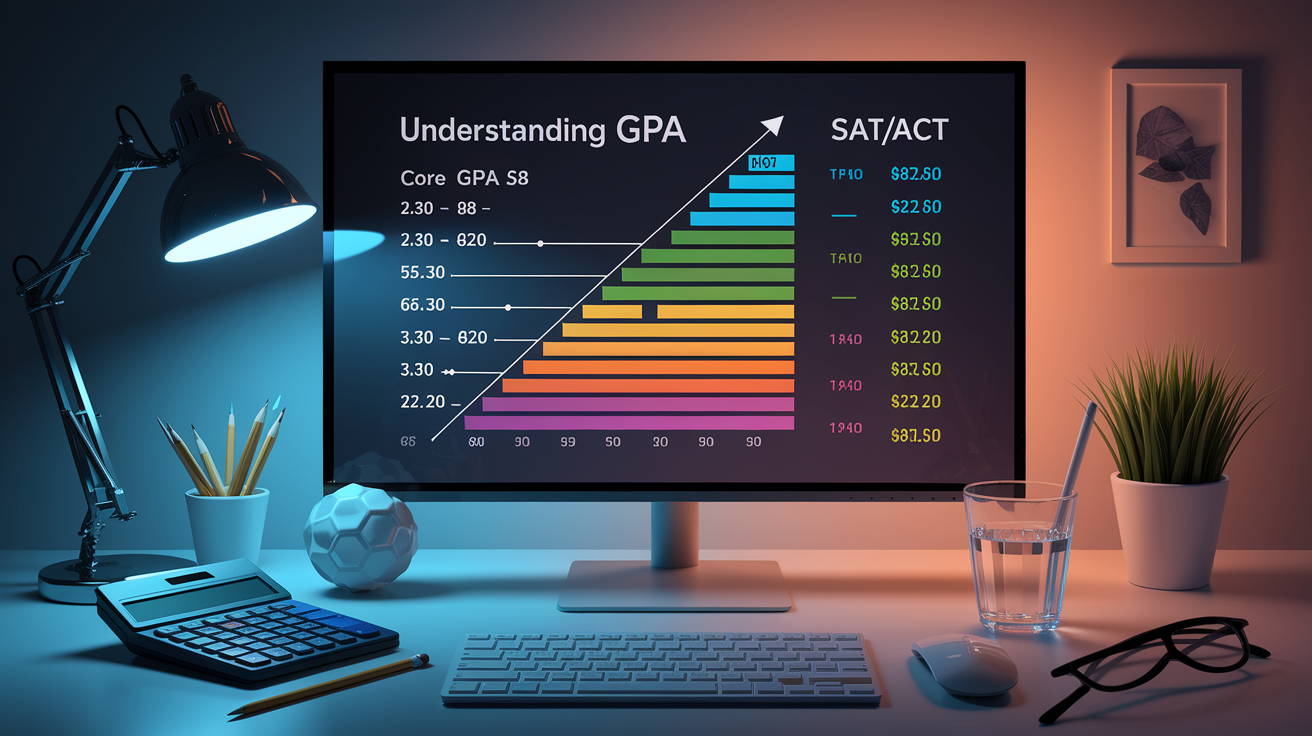
Your transcript GPA includes every class you’ve taken. Art, gym, study skills, everything. Your core GPA uses only the 16 classes that meet NCAA subject requirements.
The Eligibility Center pulls those 16 courses from your transcript, recalculates the average using your school’s grading scale, and applies any approved weighting. If your school weights honors or AP courses, the weighted value shows up in your core GPA as long as the transcript shows it and the Eligibility Center has your school’s scale on file.
The sliding scale pairs your core GPA with a minimum SAT or ACT score. At exactly 2.30 for Division I, you need a combined SAT score of 980 (evidence-based reading and writing plus math) or an ACT sum score of 75 (sum of English, math, reading, and science).
Core GPA of 3.00? Your required SAT drops to 820 and your ACT sum score to 68. It works in reverse too. Score a 1200 SAT and your core GPA requirement can fall below 2.30 and still qualify. The NCAA updates the exact pairings periodically, so confirm current numbers on the Eligibility Center’s published sliding scale chart.
SAT/ACT Score Management
Take the SAT or ACT during spring of junior year. Score falls short of the sliding scale pairing? Retake it in the fall of senior year.
The NCAA uses your best subsection scores from a single test date for the SAT and your best single-sitting composite for the ACT. Superscoring policies change, so verify the current rule before you register.
After each test, request that the testing agency send your official score report directly to the NCAA Eligibility Center using code 9999. Scores listed on your high school transcript or sent only to your college don’t satisfy NCAA requirements.
NCAA Eligibility Center Requirements for Hockey Prospects

Division I and Division II hockey recruits must create an account at the NCAA Eligibility Center website. Start during spring of sophomore year or early in junior year. You’ll answer questions about your high school, your sport participation, and any outside competition or payment you’ve received. The system collects basic contact information and asks you to pay a registration fee. Fee waivers are available to students who qualify for ACT or SAT fee waivers or who meet federal free lunch guidelines.
After you register, your high school must upload an official transcript showing all completed coursework and your current GPA. Request this from your guidance counselor. The Eligibility Center won’t process your file without it.
As you take the SAT or ACT, make sure the testing agency sends scores directly to NCAA code 9999. Once all documents are received and you’ve completed your amateurism questionnaire, the Eligibility Center reviews your file and issues a certification decision, typically after your seventh semester of high school or after you graduate.
You must submit a final official transcript after you graduate, showing proof of graduation and your final grades in all core courses. The Eligibility Center can’t issue final certification without this document.
Missing or incomplete transcripts, late test scores, or unanswered amateurism questions will delay certification and can prevent you from practicing or competing as a college freshman. Coaches can’t offer you an athletic scholarship until you’re certified, so every missed deadline affects recruiting.
- Register at the NCAA Eligibility Center during sophomore spring or early junior year.
- Complete the amateurism questionnaire and pay the registration fee (or apply for a waiver).
- Request that your guidance counselor upload your official high school transcript, including a list of NCAA-approved core courses.
- Take the SAT or ACT and send official scores directly to NCAA code 9999.
- Submit a final official transcript after graduation, showing proof of diploma and all final grades.
- Monitor your Eligibility Center account for missing documents and respond to any requests immediately.
Academic Timeline for NCAA Hockey Scholarship Preparation
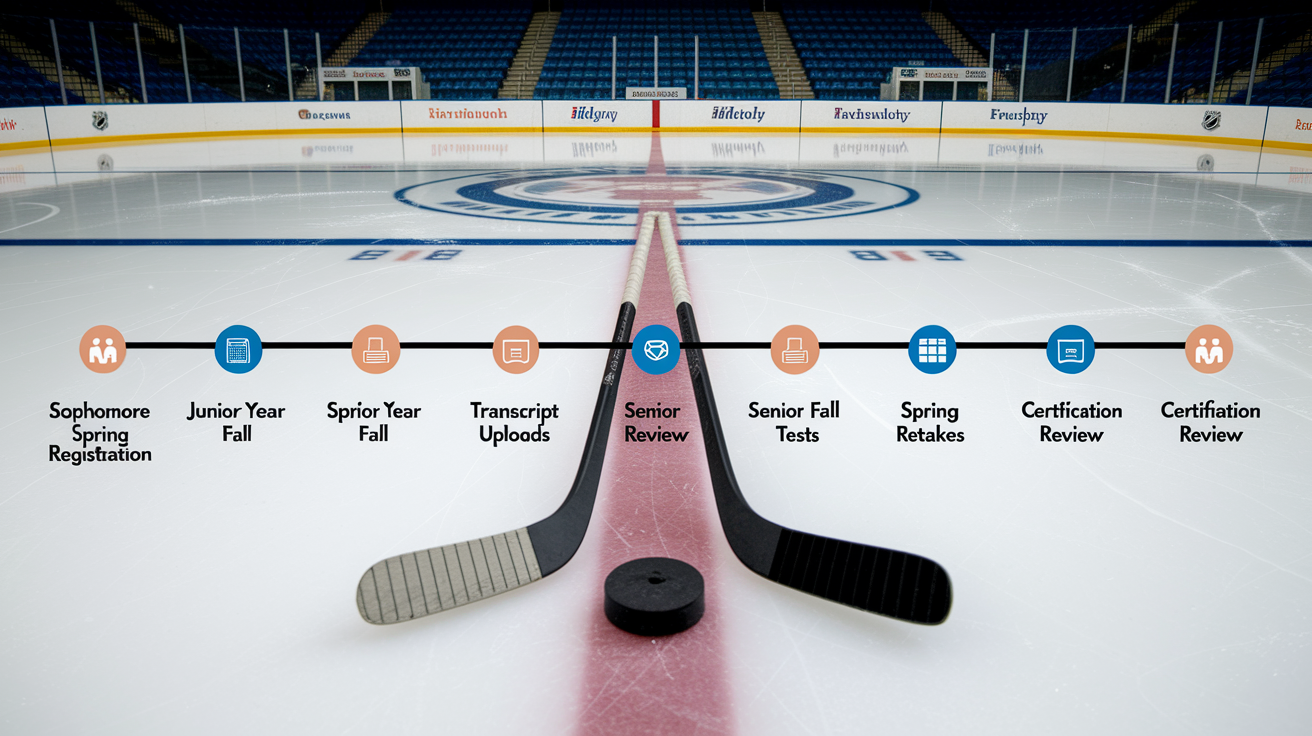
Plan your core course schedule as a freshman. Meet with your guidance counselor before you register for classes each year and confirm that the courses you select appear on your school’s NCAA-approved core course list.
Skip a required math or science class early? You may not have room in your schedule to complete 16 core courses by graduation. Prioritize core academics over electives, especially if your school limits the number of classes you can take each semester.
Junior year is when the clock starts. Register with the Eligibility Center by fall of junior year. Take the SAT or ACT in the spring, and retake it fall of senior year if your first score doesn’t pair well with your core GPA on the sliding scale.
Request your first official transcript upload in winter or spring of junior year so the Eligibility Center can begin reviewing your file. Coaches will ask about your eligibility status during recruiting conversations. An incomplete or delayed file signals disorganization.
Senior year, finish your remaining core courses with grades that protect or improve your core GPA. Submit your final transcript immediately after graduation. Don’t wait for your counselor to remember.
Planning to play junior hockey after high school? You can still enter college one or two years later as a freshman as long as you don’t lose your amateur status. Many hockey players take this path. The Eligibility Center will hold your certification during that time. Just make sure you don’t accept payment beyond necessary expenses while playing junior hockey, or you may forfeit NCAA eligibility under the new CHL rule effective in 2025–2026.
Freshman/sophomore years: Confirm core course planning with your counselor and stay on track for 16 courses.
Junior year fall: Register with the NCAA Eligibility Center and complete the amateurism questionnaire.
Junior year spring: Take the SAT or ACT and send official scores to code 9999; request first transcript upload.
Senior year fall: Retake standardized tests if needed; monitor Eligibility Center account for missing items.
Senior year spring (post-graduation): Submit final official transcript with proof of graduation; confirm final certification before enrolling.
Maintaining Academic Eligibility Once Playing NCAA Hockey

Full-time enrollment is typically defined as at least 12 semester credit hours per term. Fall below that number without an approved waiver and you lose eligibility for competition and scholarship immediately.
You must also meet your school’s satisfactory academic progress standard, which usually requires maintaining a minimum GPA (often 2.0 or higher) and completing a set percentage of attempted credits each term. Miss either benchmark and you can be ruled academically ineligible, even if you remain enrolled.
Progress toward degree is an NCAA rule that layers on top of institutional requirements. By the start of your third year (fifth semester), you must have completed 40 percent of your degree requirements. By the start of your fourth year, 60 percent. By the start of your fifth year, 80 percent.
The percentages refer to total credits and specific major coursework, not just any classes. Schools track this closely. Falling behind can cost you eligibility even if your GPA is fine. Academic advisors assigned to athletes monitor these benchmarks and will flag problems early if you stay in contact.
Scholarship Renewal Standards
Athletic scholarships are renewed annually. Coaches and athletic departments review your athletic performance, conduct, and academics before deciding whether to renew.
Most schools require you to maintain at least a 2.0 GPA to keep your scholarship, but some set higher internal standards. Fall below the required GPA or fail to meet credit completion minimums? Your scholarship can be reduced or eliminated for the following year.
Academic fraud (having someone else complete coursework or cheating on exams) will result in immediate loss of eligibility and possible expulsion from the team and the school.
International, Junior, and Transfer Academic Rules for NCAA Hockey

International transcripts and credentials must be evaluated by an NCAA-approved credential evaluation service. The service translates your grades into a U.S. equivalency, confirms which courses meet core course definitions, and calculates your core GPA using the same 16-course framework that applies to U.S. students.
This process takes time. Start it during your sophomore or junior year if you’re attending high school outside the United States, and budget extra weeks for document gathering, translations, and shipping.
Canadian players follow the same 16 core course rule but must confirm that their provincial curriculum aligns with NCAA subject definitions. Most Canadian high schools offer courses that count, but you need to verify each class with your school’s guidance office and cross-check against the Eligibility Center’s approved list.
Prep schools and junior hockey billet schools sometimes award high school credit for courses completed while playing hockey. These credits count only if they appear on an official high school transcript from an accredited institution and the courses meet NCAA core standards.
Dual enrollment (college courses taken during high school) can count toward your 16 if your high school lists them on your transcript with a letter grade.
Transfer students bring academic credits and eligibility questions from their previous school. Junior college transfers must complete an associate degree or meet specific credit and GPA thresholds before they can compete at a Division I or II school. The NCAA measures transferable credits, not total credits, so some JUCO classes may not count toward your bachelor’s degree or your progress-toward-degree calculation.
Midyear transfers (moving from one four-year school to another) must sit out a residency period unless they qualify for a waiver, and they must meet the same progress-toward-degree benchmarks as continuing students.
Graduate transfers who’ve completed a bachelor’s degree and have remaining eligibility can enroll in a graduate program at a new school and compete immediately, as long as they maintain full-time graduate enrollment and meet the new school’s academic standards.
| Player Type | Key Academic Requirement |
|---|---|
| International | Transcript evaluation by NCAA-approved service; 16 core-course equivalency confirmed |
| Canadian | Provincial course alignment verified; Eligibility Center registration for DI/DII |
| Junior College Transfer | Associate degree or specific credit/GPA thresholds; transferable credits only |
| Midyear Transfer | Residency period unless waived; progress-toward-degree benchmarks must be met |
Avoiding Common Academic Mistakes in NCAA Hockey Eligibility

The most common mistake? Assuming every high school class counts as a core course. Physical education, health, and most career-tech electives don’t meet NCAA standards.
Load your schedule with non-core classes and you may finish high school without completing the required 16 courses. Meet with your counselor every year to map out which classes you still need. Prioritize core courses over electives that don’t move you toward eligibility.
Course repeats can help or hurt, depending on your school’s policy. Fail Algebra I and retake it? The Eligibility Center uses the higher grade only if your school lists both attempts on the transcript. Some schools erase the first attempt entirely, which can lower your core course total if the repeat doesn’t count as an additional class.
Transcript and test score submission errors cause delays every year. Sending your SAT scores to a college doesn’t send them to the Eligibility Center. You must request a separate report to code 9999.
Asking your counselor to upload your transcript once isn’t enough. The Eligibility Center requires updated transcripts after each semester and a final transcript after graduation. Missing any of these uploads will stall your certification.
Academic misconduct (paying someone to write a paper, cheating on a final exam, or falsifying a transcript) will end your eligibility permanently. The NCAA treats academic fraud as seriously as accepting illegal payments. Schools report violations that occur even before you enroll in college.
Taking non-core electives instead of required core courses, leaving you short of 16 by graduation
Repeating a failed course without confirming the repeat counts as a separate core class on your transcript
Sending SAT or ACT scores only to colleges, not to NCAA code 9999
Failing to request updated transcript uploads after each semester and after graduation
Committing academic fraud or allowing someone else to complete coursework on your behalf
Final Words
In the action, you’ve got the master checklist: DI/DII core‑course counts, core GPA minimums, and how the sliding scale links GPA to SAT/ACT scores. You also saw test submission rules and Eligibility Center steps.
Next, we covered course breakdowns, timelines for junior and senior years, maintaining eligibility in college, transfer quirks, and common mistakes to avoid.
Use this as your reference for the academic requirements for NCAA hockey scholarships. Plan early, follow the steps, and you’ll keep doors open and stays in the lineup.
FAQ
Q: What is the NCAA 5 year eligibility rule?
A: The NCAA 5-year eligibility rule is a five-calendar-year window starting with full-time college enrollment to use four seasons of competition; medical redshirts and hardship waivers can pause or extend that clock in special cases.
Q: How do D1 hockey scholarships work?
A: D1 hockey scholarships work by using 18 scholarship equivalencies for men’s programs, split into full or partial awards; coaches divide that money across players, so many athletes receive partial rather than full scholarships.
Q: What is the 40-60-80 rule?
A: The 40-60-80 rule is the NCAA progress-toward-degree benchmark requiring roughly 40% of degree credits by year two, 60% by year three, and 80% by year four to remain academically eligible.
Q: Why can’t D3 give athletic scholarships?
A: Division III can’t give athletic scholarships because DIII rules ban athletic-based aid, so schools provide only need- or merit-based financial help to keep the emphasis on academics and broad participation.