

What if two months off the ice decide your next season?
Too many high school teams treat summer like a long layoff and then wonder why shifts feel slow at tryouts.
This 8-12 week off-season strength and conditioning schedule gives coaches a clear 5 to 6 day weekly plan.
It lays out three resistance sessions, on-ice sprint work, two conditioning days, and built-in recovery so players build strength, power, and repeatable shift endurance without losing skating feel.
Complete Off-Season Training Schedule Framework for High School Hockey Teams
Most high school hockey programs need an 8 to 12 week off-season plan that fits between spring break and late August. Eight weeks is standard, long enough to build real strength and power without losing your edge on the ice. If you’ve got more time, stretch to twelve weeks and add a peaking phase. You’re looking at five to six training days each week: three resistance sessions, one to three on-ice skill or conditioning sessions, two additional conditioning days, and one full rest or active recovery day.
The weekly training split separates lower body strength, upper body strength, and power work across three gym sessions. Two conditioning sessions cover either high-intensity intervals or tempo aerobic work, depending on where you are in the program. On-ice sessions can be shift-simulation drills or small-area games. Structured overlap matters here, not duplication. If Tuesday is an on-ice sprint session, don’t schedule heavy lower-body lifting the same day.
Younger athletes (14 to 15 years old) should work at 40 to 70% of their estimated one-rep max, focusing on sets of 8 to 12 reps to lock in movement quality and build work capacity. Older high schoolers (16 to 18) can push to 60 to 85% 1RM during strength phases and include true maximal-strength sets of three to six reps. Power work requires full intent but lighter loads for both age groups. Olympic derivatives, plyometrics, explosive jumps.
| Program Element | Recommendation |
|---|---|
| Total Duration | 8–12 weeks |
| Weekly Frequency | 5–6 training days (3 resistance, 2 conditioning, 1–3 on-ice, 1 recovery) |
| Load Range | 14–15 yrs: 40–70% 1RM; 16–18 yrs: 60–85% 1RM |
Day to day adjustments are normal. If your team can only get ice twice a week, shift one conditioning session to the gym and use sled sprints or bike intervals. If you’ve got ice every day, fold conditioning into shift work and keep gym sessions shorter, more focused on strength and power.
Foundational Principles Behind an Effective Hockey Off-Season Plan
The periodization model moves from general preparation to sport-specific peaking. Start with movement quality, hypertrophy, and work capacity during the first two weeks. Spend the next four weeks building maximal strength with heavier loads and lower reps on compound lifts. The final two to four weeks shift to power conversion: Olympic lifts, plyometrics, explosive speed work, paired with on-ice shift simulation. Volume drops as intensity climbs. More sets and reps early. Heavier loads and faster movements later.
Younger athletes need extra time on technique. A 14 year old learning a back squat for the first time should spend most of the program at moderate loads with 8 to 12 controlled reps per set. Older high schoolers who’ve lifted for a year or more can handle true strength blocks with three to six reps at 75 to 85% of max. Even for advanced athletes, never skip the adaptation phase. Two weeks of higher-rep work prevents early program injuries and builds the tissue resilience needed for heavier loading later.
Core principles that guide the entire schedule:
Progressive overload. Add 2.5 to 5% load per week on major lifts when form stays clean. Increase plyo volume by no more than 10 to 15% weekly.
Movement quality first. Technique breaks at heavy loads signal the need to drop weight, not push through.
Volume to intensity shift. Early phases use higher total reps (sets times reps). Later phases use heavier weight and lower reps with longer rest.
Specificity progression. Start with general strength and conditioning, then layer in explosive lifts, plyos, and sprint work that mirror on-ice demands.
Recovery built in. Schedule deload weeks every four to six weeks if extending past eight weeks. Reduce volume by 30 to 50% while keeping intensity moderate.
Baseline Testing and Athlete Screening Before Off-Season Training

Testing before the program starts gives you objective numbers and highlights movement limitations or injury risk. Run all baseline tests during the first week, ideally within the first two sessions, so athletes are fresh but familiar with the gym environment. Retest at the program midpoint (week four or six) and again at the end (week eight or twelve). Comparing numbers across those windows tells you whether the plan’s working and where individual athletes need adjustments.
The core battery includes vertical jump (best of three attempts), 10 meter and 30 meter sprint times, a repeat sprint or aerobic test (Yo-Yo Intermittent Recovery Level 1 or beep test), and either a true one-rep max or an estimated 1RM for back squat and trap bar deadlift. Vertical jump measures lower body power. Sprint times capture acceleration and top speed. The Yo-Yo or beep test tracks aerobic capacity and repeat sprint endurance. Strength testing with the squat and deadlift anchors your load prescriptions for the next eight to twelve weeks.
Safety and movement screening come first. Before any max testing, watch every athlete perform a bodyweight squat, a single leg Romanian deadlift balance hold, and an overhead reach. If someone can’t squat to parallel with a neutral spine or can’t balance on one leg for ten seconds, skip the barbell max test and use a three-rep or five-rep estimate instead. The screening isn’t about exposure. It’s about identifying who needs extra technique work before heavy loading.
Standard testing order and logistics:
Session one (movement screen, vertical jump, sprints). Bodyweight screen, warm up, three vertical jump attempts, 10 meter and 30 meter sprints with full recovery between reps.
Session two (strength testing). Specific warm-up sets, estimated or true 1RM for squat and deadlift. Use conservative jumps (10 to 20 lb per set) and stop at technical breakdown.
Session three (aerobic/repeat sprint test). Yo-Yo test or beep test. Make sure athletes are rested (no heavy lifting the day before).
Retest schedule. Repeat all tests at week four or six (mid-program check) and week eight or twelve (post program). Track improvements: strength typically climbs 3 to 8%, sprint times improve 2 to 6%, vertical jump gains 3 to 7% over eight weeks.
The 12-Week Off-Season Hockey Training Schedule (Macrocycle Structure)
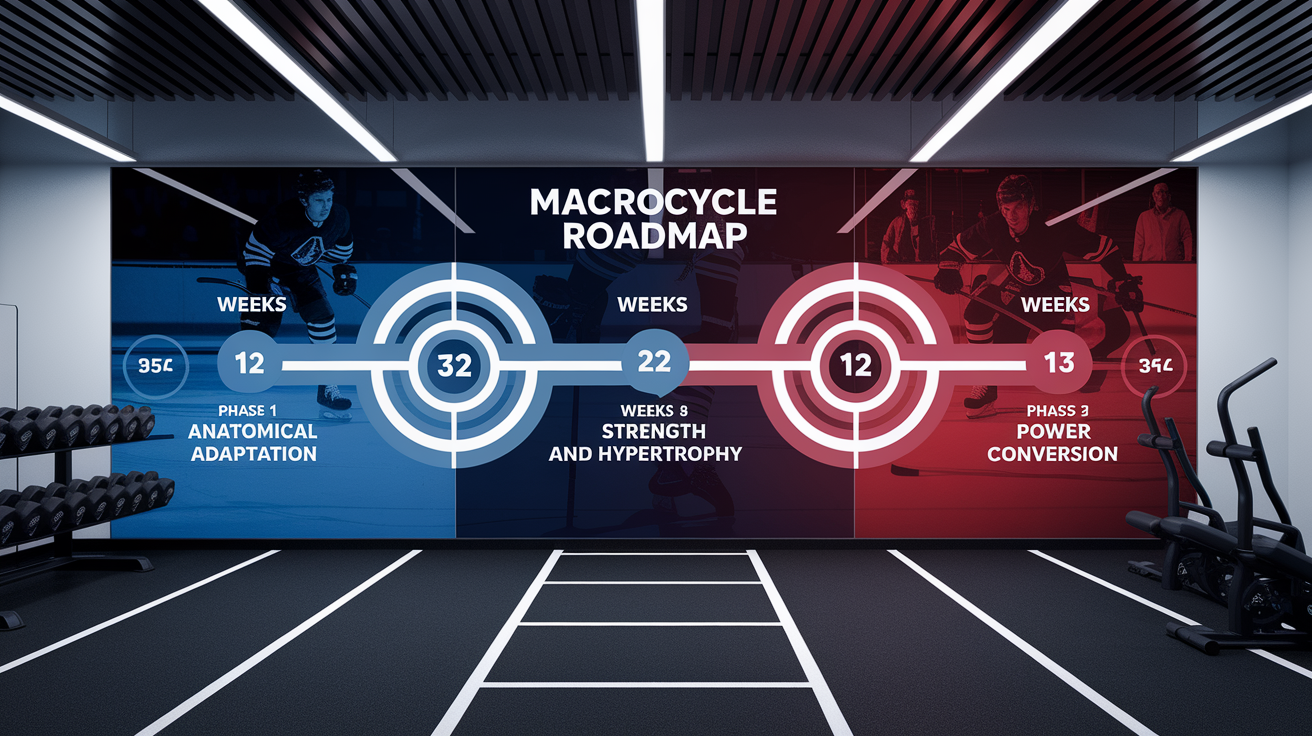
The twelve-week macrocycle divides into three distinct phases, each with a specific training goal. Phase one runs two weeks and focuses on anatomical adaptation and movement quality. Athletes work at moderate loads (50 to 65% 1RM) with higher reps (8 to 12) to prepare connective tissue, dial in lifting technique, and build general work capacity. This phase also introduces basic plyometrics, low-height box jumps and simple bounds, and includes two to three on-ice skill sessions per week to maintain skating mechanics.
Phase two is the strength and hypertrophy block, lasting four weeks. Training frequency increases to three or four weight sessions per week, with loads climbing to 60 to 85% of one-rep max. Sets drop to three to five, and reps fall into the three to six range for primary lifts like squats, deadlifts, and presses. Accessory work stays at eight to twelve reps. Conditioning shifts toward higher-intensity intervals. Short sprints with long rest and tempo runs at 65 to 75% of max heart rate. On-ice sessions remain at one to two per week but now include compete drills and small-area games that demand repeated accelerations.
Phase three converts strength into power and integrates sport-specific conditioning. This phase runs two to four weeks depending on total program length. Olympic lifts or their derivatives (hang cleans, clean pulls, push presses) move to the front of each session, programmed for three to six sets of one to four explosive reps. Plyometric volume and complexity both increase: depth jumps, lateral bounds, and single leg hops replace basic box jumps. On-ice work becomes the priority. Shift-simulation intervals (six to ten efforts of 45 to 60 seconds with 90 to 120 seconds rest) and live scrimmages take over two to three sessions per week. Off-ice conditioning volume drops as on-ice intensity climbs.
Key priorities by phase:
Phase 1 (Weeks 1 to 2). Movement quality, tissue preparation, hypertrophy stimulus, introduction to plyometrics and speed mechanics.
Phase 2 (Weeks 3 to 6). Maximal strength development, increased training frequency, moderate conditioning volume with aerobic base work.
Phase 3 (Weeks 7 to 10 or 7 to 12). Power conversion through explosive lifts and advanced plyos, peak on-ice integration, reduced gym volume to prioritize recovery and ice performance.
Weekly Microcycle Template for High School Hockey Players
Monday, lower body strength. This session targets maximal strength in the squat, deadlift, or trap bar variation. After a dynamic warm-up and activation drills (glute bridges, mini-band walks), move into three to five working sets of three to six reps at 75 to 85% of max. Follow with accessory work: split squats or step-ups for three sets of eight to twelve reps per leg. Finish with core anti-rotation exercises like Pallof presses.
Tuesday, on-ice skills and conditioning. Sixty minutes on the ice split between edge-work drills, puck-handling under fatigue, and shift-simulation intervals. Run six to ten efforts of 45 to 60 seconds at high intensity, resting 90 to 120 seconds between reps. Focus stays on skating mechanics and first-step acceleration out of turns.
Wednesday, upper body strength and plyometrics. Warm up with band pull-aparts and thoracic mobility. Work three to four sets of six to eight reps on bench press or push-up variations, then the same volume on rows or pull-ups. Add three sets of six to ten bounds or box jumps, emphasizing quick ground contact and full hip extension. Close with shoulder and rotator cuff prehab.
Thursday, tempo aerobic work or active recovery. Twenty to forty minutes of low-intensity movement at 65 to 75% of max heart rate. Options include a bike, rower, or easy jog. Pair it with fifteen minutes of foam rolling, static stretching for the hips and groin, and ankle mobility drills. This day’s about flushing metabolic waste and preparing for Friday’s power session.
Friday, power and speed development. Start with Olympic derivatives (hang cleans, clean pulls, or jump squats) for three to five sets of one to three explosive reps with full recovery (two to three minutes between sets). Then move to sled sprints or unloaded 20 to 30 meter accelerations for six reps with complete rest. Finish with medicine ball slams or rotational throws for three sets of six.
Saturday, on-ice scrimmage or off-ice sprint repeats. If ice is available, run a thirty to sixty minute scrimmage or small-area game focusing on compete level and positioning under fatigue. If no ice, substitute eight to twelve sprints of 30 to 40 meters with a 1:6 work to rest ratio. Keep the intensity high and the volume manageable.
Sunday, full rest or mobility session. Complete day off or a short twenty minute session of light movement, stretching, and soft tissue work. No intensity. The goal is central nervous system recovery and tissue repair.
Essential warm-up components before every session:
5 to 10 minutes general movement. Bike, skip, or light jog to raise core temperature.
Dynamic stretching circuit. Leg swings, walking lunges with a twist, inchworms, and spiderman stretches.
Activation drills. Glute bridges, clamshells, band walks, and scapular wall slides to wake up stabilizers.
Movement-specific prep. Empty bar squats, light medicine ball throws, or low box jumps before the main working sets.
Strength Training Framework for Hockey Athletes (Lower, Upper, Power)

Strength work divides into three categories based on load, rep range, and intended adaptation. During the maximal-strength phase, primary lifts use three to five sets of three to six reps at 70 to 85% of one-rep max. Rest periods extend to two to four minutes to allow full central nervous system recovery. The focus is pure force production: how much weight you can move with perfect technique. Common prescriptions include back squats, front squats, trap bar deadlifts, and Romanian deadlifts for the lower body. Bench press, overhead press, and weighted pull-ups for the upper body.
Hypertrophy and strength-endurance work uses three to four sets of eight to twelve reps at 60 to 75% of max. Rest shortens to 60 to 90 seconds. These blocks build muscle mass and work capacity, preparing connective tissue and improving movement efficiency under fatigue. Exercises include goblet squats, Bulgarian split squats, dumbbell bench variations, and single arm rows. Tempo can be controlled (two seconds down, one second pause, one second up) to increase time under tension.
Power sessions emphasize intent and bar speed, not absolute load. Use three to six sets of one to four explosive reps with loads between 30 to 60% of max for Olympic lifts or bodyweight for plyometric variations. Rest fully between sets, two to three minutes minimum, so every rep is executed at maximum velocity. The adaptation here is rate of force development: how fast you can generate force, which directly transfers to skating acceleration and shooting power.
Recommended exercise categories and examples:
Explosive/Olympic lifts. Hang clean, power clean, clean pull, push press, jump squat with light load.
Multi-joint lower body (bilateral). Back squat, front squat, trap bar deadlift, sumo deadlift, hip thrust.
Multi-joint lower body (unilateral). Split squat, Bulgarian split squat, step-up, single leg Romanian deadlift, lateral lunge.
Upper body pressing. Bench press, incline dumbbell press, push-up variations, overhead press, landmine press.
Upper body pulling. Barbell row, dumbbell row, pull-up, chin-up, inverted row, face pull.
Posterior chain/hip extension. Romanian deadlift, single leg RDL, glute-ham raise, Nordic hamstring curl, kettlebell swing.
Core and anti-rotation. Pallof press, stir the pot on stability ball, dead bug, single arm farmer carry, anti-extension plank.
Trunk rotational power. Medicine ball rotational throw, woodchop, half kneeling chop and lift.
Conditioning Sessions for Hockey: HIIT, Sprint Work, and On-Ice Conditioning

High-intensity interval training for hockey should mirror the sport’s demand profile. Short bursts of near-maximal effort followed by incomplete recovery. Repeated sprint training uses six to ten reps of 30 to 40 meters with a work to rest ratio between 1:5 and 1:8. If a sprint takes six seconds, rest for 30 to 48 seconds. The goal is to maintain speed across all reps, not to accumulate fatigue. Run these sessions on grass, turf, or a track, never when legs are still sore from heavy squats.
On-ice shift simulation replicates game conditions more directly. Set up six to ten intervals of 45 to 60 seconds at high intensity (full speed skating with quick starts, stops, and transitions), then rest for 90 to 120 seconds. You can structure these as timed efforts or small-area compete drills (one on one, two on two). The rest interval is key: long enough to partially recover but short enough that the next rep starts before full restoration. That incomplete recovery trains the repeat sprint system that drives third period performance.
Aerobic tempo work builds the base that lets athletes recover between shifts and maintain output across a full game. Schedule twenty to forty minutes at 65 to 75% of max heart rate once or twice per week, especially during the early phases of the program. Use a bike, rower, or steady skating if ice is available. Keep the intensity conversational. Athletes should be able to talk in short sentences. This isn’t about suffering. It’s about expanding aerobic capacity so the anaerobic system can reload faster during actual shifts.
| Conditioning Type | Protocol | Target Adaptation |
|---|---|---|
| Repeated Sprint | 6–10 × 30–40 m, work:rest 1:5–1:8 | Maximal speed maintenance, phosphagen recovery |
| Shift Simulation (On-Ice) | 6–10 × 45–60 s, rest 90–120 s | Repeat-sprint endurance, lactate tolerance |
| HIIT Intervals | 4–8 × 2–4 min high intensity, 1:1 rest | Aerobic power, VO₂ max improvement |
| Aerobic Tempo | 20–40 min continuous at 65–75% HRmax | Aerobic base, between-shift recovery capacity |
Plyometrics, Speed Development, and Acceleration Training for Hockey

Plyometric training develops the stretch-shortening cycle, the elastic recoil that turns a deep knee bend into an explosive first stride. Program two to four sets of four to eight reps per exercise, with total weekly ground contacts between 80 and 120 for most high school athletes. Younger or less experienced players should start at the low end (60 to 80 contacts) and progress slowly. Quality matters more than volume: every landing should be controlled, every takeoff should be maximal intent.
Speed work for hockey prioritizes acceleration over top-end velocity. Most shifts never reach true max speed, so train the first three to five strides hardest. Use six to ten reps of 10 to 40 meter sprints with full recovery (three to five minutes between reps). Start from a hockey-specific position: push start from a static skating stance, or react to a coach’s whistle and explode forward. Add resistance with a sled (10 to 20% of body weight) or a partner providing light manual resistance for the first five meters, then release into a free sprint.
Lateral and multidirectional plyometrics transfer more directly to skating than straight-line jumps. Single leg lateral hops, skater bounds, and lateral box jumps all train the frontal plane power that drives crossovers and tight turns. Program these after the primary strength work but before conditioning, when the nervous system is still fresh but muscles are warm. Never do plyometrics on back to back days. Central nervous system fatigue increases injury risk and reduces quality.
Sample plyo and speed drill menu:
Bilateral jumps. Box jump, broad jump, depth jump (advanced athletes only, 16+ years).
Unilateral jumps. Single leg box jump, single leg broad jump, single leg hurdle hop.
Lateral plyos. Lateral bound (skater jump), lateral box jump, single leg lateral hop over line.
Acceleration drills. 10 m sprint from push start, 20 m sprint from static hockey stance, 30 m build-up sprint (gradual acceleration).
Resisted speed work. Sled push 20 m, partner-resisted sprint (first 5 m resistance, then release), hill sprint 20 to 30 m.
Reactive/agility work. Pro agility shuttle (5-10-5), L drill, reaction sprint to coach’s directional cue.
Mobility, Prehab, and Injury Prevention Essentials for High School Hockey Teams

Every training session should include ten to fifteen minutes of targeted prehab and mobility work. This isn’t optional filler. It’s the piece that keeps athletes on the ice instead of in the training room. Focus on the four highest risk areas for hockey players: hips and groin, hamstrings, ankles, and shoulders. Structure prehab into the warm-up before lifting or conditioning, or program it as a standalone circuit on lighter training days.
Hip and groin strength prevents the most common soft tissue injuries in hockey. Use mini-band walks (monster walks, lateral walks), Copenhagen planks or side-lying adductor lifts, and clamshells to build both abductor and adductor strength. Pair strength work with mobility: 90/90 hip stretches, deep squat holds, and hip flexor stretches targeting the psoas. Hamstring eccentrics (Nordic curls, single leg Romanian deadlifts, or eccentric-focused leg curls) address the high injury rate during skating accelerations and should appear in every lower body session.
Ankle mobility and shoulder health round out the injury-prevention priorities:
Ankle mobility drills. Kneeling ankle mobilization against a wall, calf stretches (straight leg and bent knee), single leg balance work on an unstable surface.
Groin and hip strengthening. Mini-band lateral walks, Copenhagen adductor plank, fire hydrants, deep goblet squat holds.
Hamstring eccentric work. Nordic hamstring curl (partner-assisted or with a band), single leg RDL, Swiss ball leg curl with slow eccentric phase.
Shoulder and rotator cuff stability. Band pull-aparts, external rotation with light band or cable, scapular wall slides, prone Y-T-W raises.
Nutrition, Hydration, and Recovery Strategies for Off-Season Hockey Progress
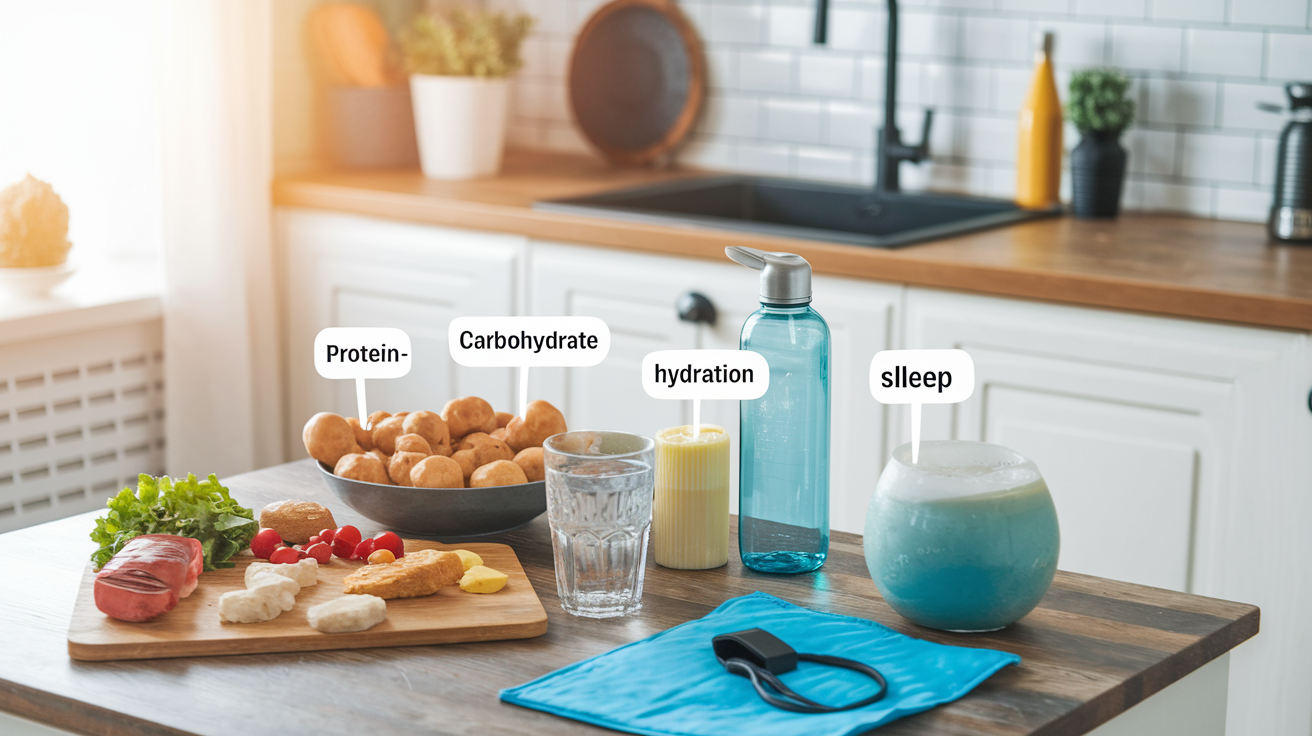
Sleep is the foundation. High school athletes need eight to ten hours per night to support training adaptation, especially during heavy strength phases. Growth hormone release peaks during deep sleep, and central nervous system recovery depends on consistent sleep cycles. If an athlete’s consistently getting six hours or less, strength gains will stall and injury risk climbs. Track sleep in the same log used for training load. It’s that important.
Protein intake should land between 1.6 and 2.0 grams per kilogram of body weight per day. For a 70 kg (154 lb) athlete, that’s 112 to 140 grams spread across four meals. Prioritize whole sources: chicken, lean beef, fish, eggs, Greek yogurt, and cottage cheese. Supplement with whey protein post-workout if whole food intake falls short, but food comes first. Carbohydrate needs rise during high-volume training weeks. Athletes should load carbs around training sessions (before and after) to fuel performance and replenish glycogen.
Hydration during heavy sessions requires deliberate planning. Aim for 0.5 to 1.0 liters per hour of intense training, adjusted for sweat rate and temperature. Athletes should start sessions hydrated (pale yellow urine) and finish within 2% of starting body weight. Dehydration beyond that threshold reduces power output and increases core temperature, both of which hurt performance and recovery. Creatine monohydrate (3 to 5 grams per day) is optional but well supported for strength and power athletes. It’s safe, inexpensive, and effective when paired with adequate hydration.
Key nutrition and recovery rules:
Sleep target. 8 to 10 hours/night. Track it and adjust training load if sleep drops below 7 hours consistently.
Protein distribution. 1.6 to 2.0 g/kg/day spread across 4 meals. Post-workout within 60 to 90 minutes.
Carbohydrate timing. Load carbs pre and post training (1 to 1.5 g/kg body weight). Moderate intake on rest days.
Hydration protocol. 0.5 to 1.0 L/hour during training. Monitor body weight and urine color daily.
Creatine (optional). 3 to 5 g/day with water. Skip the loading phase, just take it consistently.
Four-Week and Eight-Week Progression Templates for Coaching Staff
Short four week blocks work well for teams with limited off-season windows or athletes new to structured training. The template begins with a two week hypertrophy phase using moderate loads and higher reps to build work capacity and refine movement patterns. Week three shifts to a strength emphasis with heavier loads and lower reps. Week four tapers volume while maintaining intensity, preparing athletes for return to higher on-ice frequency or the start of team practices.
Eight week templates allow full periodization from base building through power conversion. The first two weeks focus on anatomical adaptation: learning lifts, building tissue resilience, and establishing movement quality with 8 to 12 reps at 50 to 65% of max. Weeks three through six increase load to 70 to 85% and drop reps to 3 to 6 for primary lifts, targeting maximal strength. Weeks seven and eight convert that strength into power with Olympic lifts, plyometrics, and explosive speed work at lower volume but higher intent.
| Week | Focus | Sets × Reps (Primary Lifts) | Load (%1RM) |
|---|---|---|---|
| 1–2 | Hypertrophy / Work Capacity | 3–4 × 10–12 | 55–65% |
| 3 | Strength Introduction | 4 × 6–8 | 70–75% |
| 4 | Taper / Deload | 3 × 5–6 | 65–70% |
| Week | Phase | Sets × Reps (Primary) | Load (%1RM) | Plyo Volume (Contacts/Week) |
|---|---|---|---|---|
| 1 | Anatomical Adaptation | 3 × 10–12 | 50–60% | 40–60 |
| 2 | Anatomical Adaptation | 3 × 10–12 | 55–65% | 50–70 |
| 3 | Strength / Hypertrophy | 4 × 6–8 | 70–75% | 60–80 |
| 4 | Strength | 4 × 5–6 | 75–80% | 70–90 |
| 5 | Strength | 5 × 4–5 | 80–85% | 70–90 |
| 6 | Strength Peak | 5 × 3–4 | 82–87% | 60–80 |
| 7 | Power Conversion | 4–6 × 2–3 (explosive) | 60–75% or BW | 80–100 |
| 8 | Power / Taper | 3–5 × 1–3 (explosive) | 50–65% or BW | 60–80 |
Load progression follows a simple rule: increase weight by 2.5 to 5% each week as long as bar speed and technique stay consistent. If an athlete grinds through reps or form breaks down, hold the load for another week or drop back 5 to 10% and rebuild. Plyometric volume can increase 10 to 15% per week during the adaptation phase but should stabilize or decrease slightly when strength loads peak. The heaviest lifting weeks (weeks 5 to 6 in the eight week template) pair with moderate plyo volume to manage total stress and keep the nervous system fresh.
Monitoring Training Load and Adjusting the Off-Season Schedule
You can track training stress without expensive software by using session rating of perceived exertion (RPE). At the end of each workout, athletes rate the session difficulty on a 1 to 10 scale. Multiply that number by the session duration in minutes to calculate session load. For example, a 60 minute workout rated as an 8 out of 10 produces a session load of 480 arbitrary units. Sum the loads across a week to monitor total training stress, then compare week to week. A sudden spike of more than 15 to 20% often precedes overreaching or injury.
Watch for signs of excessive fatigue: persistent muscle soreness lasting more than 48 hours, poor sleep quality, irritability, or a drop in performance on lifts or sprint times that were previously consistent. When these appear, reduce training volume by 30 to 50% for three to five days while keeping intensity moderate. An unplanned deload week is better than pushing through and losing two weeks to injury or burnout. Retest key metrics (vertical jump, 10 meter sprint) at the program midpoint. If numbers haven’t improved or have regressed, volume’s likely too high or recovery too low.
Basic load management tools and checkpoints:
Session RPE log. Collect a 1 to 10 rating after every workout. Calculate session load (RPE times duration in minutes). Flag any week to week increase over 15%.
Sleep and soreness tracker. Athletes self report daily sleep hours and muscle soreness (scale 1 to 5). Persistent scores above 3 for soreness or below 7 hours sleep trigger a conversation.
Performance benchmarks. Retest vertical jump and 10 m sprint at week 0, week 4 or 6, and week 8 or 12. Expect small improvements at each checkpoint if programming’s on track.
Readiness questionnaire (optional). Quick daily check in on mood, energy, and motivation. Useful for identifying central nervous system fatigue before it shows up in performance.
Final Words
Get in the weight room and the rink with a clear 8-12 week plan: 5-6 days/week, three resistance sessions, 1-3 on-ice sessions, two conditioning days, one recovery day.
Follow the phases—movement quality, hypertrophy/strength, then power. Test baseline (vertical, sprint, 1RM), use the weekly microcycle, and adjust load with RPE.
Keep this off-season strength and conditioning schedule for high school hockey teams flexible, shift sessions by rink access and athlete age (younger 40-70% 1RM, older 60-85%). Track progress and you’ll enter the season stronger and faster.
FAQ
Q: How long should a high school off-season hockey program run?
A: The high school off-season hockey program should run 8–12 weeks to build movement quality, strength, then power while allowing testing and recovery between phases for steady, measurable progress.
Q: What is the recommended weekly frequency and work distribution?
A: The recommended weekly frequency is 5–6 days: three resistance sessions, one to three on-ice sessions, two conditioning days, and at least one full recovery day, adjusted for rink access and athlete age.
Q: What intensities should younger versus older high-school players use?
A: Younger athletes should train at 40–70% of estimated 1RM emphasizing technique; older high-school players should use 60–85% 1RM with heavier sets and 3–6 rep ranges for maximal strength.
Q: What baseline tests should coaches run before the off-season and how often?
A: Coaches should run vertical jump, 10m/30m sprints, Yo-Yo or beep test, and a 1RM or estimated squat/deadlift before the program, then retest at week 8 or 12 to track gains.
Q: How should a 12-week off-season macrocycle be phased?
A: A 12-week macrocycle should phase from movement quality and work capacity, to hypertrophy/strength, then power and on-ice integration so each phase builds game-ready speed and force.
Q: What does a sample weekly microcycle look like?
A: A sample week: Monday lower strength; Tuesday on-ice plus conditioning; Wednesday upper plus plyos; Thursday tempo or active recovery; Friday power and speed; Saturday scrimmage or sprint repeats; Sunday rest.
Q: What set and rep schemes should hockey strength work use?
A: Strength blocks use 3–5 sets of 3–6 reps at 70–85% 1RM; hypertrophy uses 3–4 sets of 8–12 reps at 60–75%; power uses 3–6 sets of 1–4 explosive reps.
Q: What conditioning protocols work best for hockey off-season?
A: Sprint training: 6–10 x 30–40m with 1:5–1:8 rest; shift simulation: 6–10 x 45–60s with 90–120s rest; aerobic tempo: 20–40 minutes at 65–75% HRmax.
Q: How much plyometric work and which drills should teams use?
A: Plyometrics should total 80–120 weekly contacts at 2–4 sets of 4–8 reps. Use lateral hops, bounds, single-leg hops, and short full-rest sprints for acceleration and first-step speed.
Q: What are the key nutrition, hydration, and recovery rules for the off-season?
A: Key rules: sleep 8–10 hours nightly, eat 1.6–2.0 g/kg protein daily, optional creatine 3–5 g/day, hydrate 0.5–1.0 L/hour during heavy sessions, and time carbs around workouts.
Q: How should coaches monitor training load and when should they deload?
A: Coaches should use session RPE, track fatigue and sleep, and test at baseline and week 8/12. Cut volume 30–50% or schedule a deload if fatigue or RPE stay elevated.
Q: How flexible should the plan be when rink access is limited?
A: The plan should be flexible: replace on-ice sessions with off-ice power, sprint work, or skill simulators, keep strength and conditioning priorities, and preserve recovery and session intensity.