

Think you need weights, cones, and bands to condition a hockey team?
You don’t.
This no-equipment circuit runs as a continuous loop you can fit in a locker room or hallway and it mirrors on-ice shift demands.
It builds single-leg power, lateral drive, rotational core strength, and game-like fatigue, so players get stronger and fitter without a gym.
Read on for a ready-to-run team plan: warm-up, station timing, progressions for every level, and plug-and-play 20- and 30-minute templates coaches can use today.
Complete No-Equipment Team Circuit for Immediate Use

The circuit runs as one continuous loop. Groups start at their assigned stations, knock out the prescribed reps or time, then rotate to the next exercise after a quick rest. After finishing all exercises once, the entire circuit repeats for a second and third round depending on fitness level and what you’re trying to accomplish that day. Each round flows station to station with almost no downtime, designed to fit locker rooms, hallways, or any open space roughly the size of two parking spots per athlete.
The exercise sequence builds from lower-intensity dynamic work into explosive single-leg and lateral movements, then finishes with high-output plyometrics. Coaches assign one athlete per station at the start, call time or rep targets, and rotate the group clockwise every 30 to 90 seconds. No equipment changes hands. No cones, bands, or weights are required. You can deploy the entire circuit in under three minutes once athletes understand station order.
Standard timing uses 30 to 60 seconds of work per station, followed by 15 to 30 seconds of transition. Between complete rounds, rest for 60 to 120 seconds to allow partial recovery while keeping heart rate elevated. Beginners run two full rounds over 18 to 22 minutes. Intermediate and advanced teams complete three rounds in 25 to 35 minutes. Adjust rest intervals down to 30 seconds between rounds when conditioning improves and session intensity becomes the priority over movement quality.
Dynamic Warm-Up Sequences for Team Off-Ice Sessions

Start with one to two minutes of light movement to raise core temperature and prep your joints. Athletes jog in place, perform arm circles, or complete one lap around the training space at conversational pace. After the initial pulse raise, insert six dynamic drills performed in continuous sequence with 10 to 15 seconds per drill and minimal rest. Two sets of 16 push-ups follow the dynamic sequence, with 20 to 30 seconds rest between sets. After the second push-up set, rest two to three minutes before starting the main circuit.
Static stretching before the warm-up increases injury risk and reduces explosive power output. Save all floor stretches, hip openers, and hamstring holds for the post-session cooldown. Dynamic movements prepare the nervous system for high-output work and rehearse the movement patterns athletes will use during the circuit.
Six-drill dynamic warm-up sequence:
- Butt-kicks (15 yards forward, focus on heel-to-glute contact)
- High knees (15 yards forward, driving knee to hip height)
- Walking lunges (10 total reps, controlled descent with upright torso)
- Lateral shuffle (10 yards each direction, low athletic stance)
- Half-speed sprints (2 × 15 yards, building to 70 percent effort)
- Bodyweight squats (12 reps, pause one second at the bottom)
Core Team Conditioning Blocks: Bodyweight Power & Endurance Work
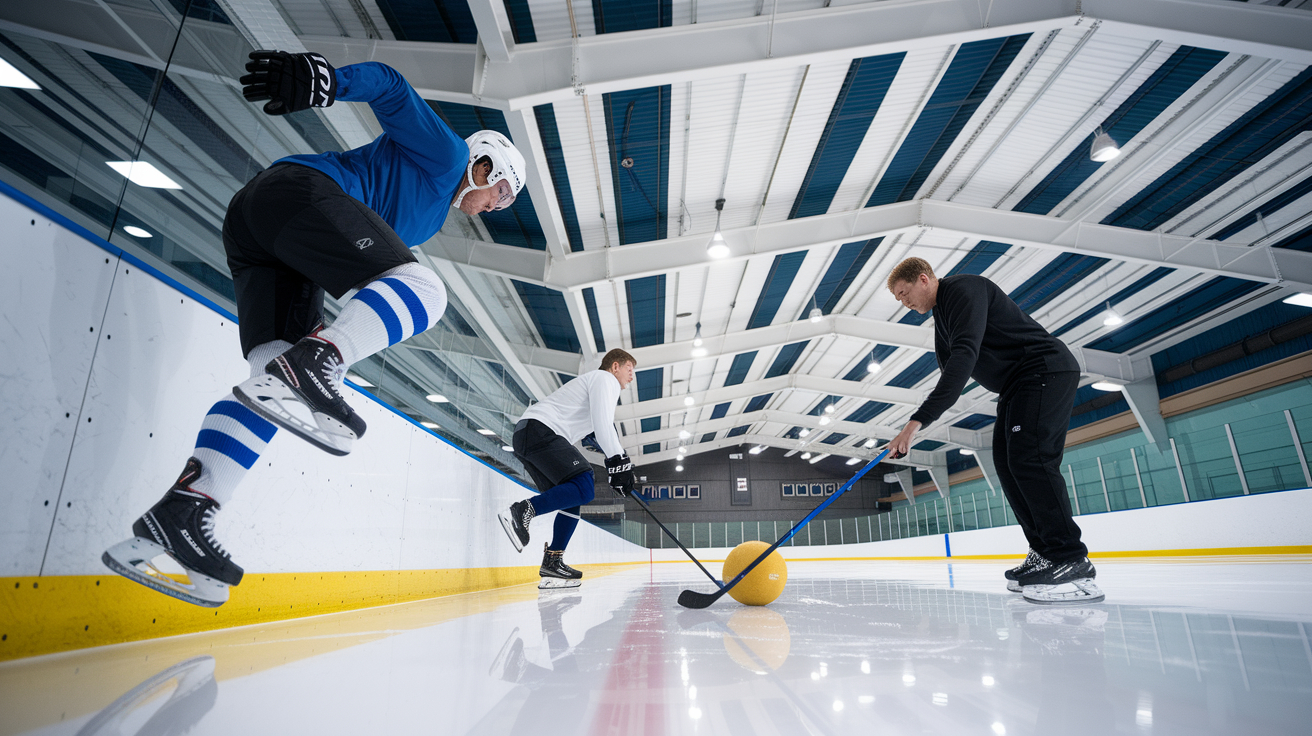
Every exercise inside the circuit targets one or more hockey-specific movement demands. Single-leg work develops the unilateral power and balance required for every skating stride. Lateral shuffles and skater movements train the side-to-side propulsion that defines gap control and transition skating. Rotational drills prepare the core to transfer force from hips through shoulders during stick handling, shooting, and contact. Plyometric exercises build the explosive triple extension (ankle, knee, hip) that creates first-step quickness and separation speed.
Exercises like the one-leg squat jump (12 reps each side) and skater hop (8 reps each side) force athletes to decelerate, stabilize, and re-accelerate on one leg. Russian lunges (8 reps each side) combine a deep split position with a rotational reach, simulating the hip and trunk angles players hold during tight turns. The lateral shuffle drill (16 reps each side) mimics defensive gap skating, while the two-leg rapid rotation response (16 reps each side) trains quick directional changes without losing postural control. Together, these movements prepare your neuromuscular system for the multi-planar, high-velocity demands of a live shift.
Programming these exercises in a circuit format delivers conditioning and strength work at the same time. Athletes sustain elevated heart rates across multiple movement patterns rather than isolating one energy system or muscle group. The result is functional fatigue that mirrors late-game shifts when legs are heavy but the next battle still requires explosive output.
Four hockey-specific transfer points:
- Explosive single-leg drive (skating acceleration and crossover power)
- Deceleration and re-direction control (gap closing and tight-turn stability)
- Rotational core strength (stick work, shooting, body positioning in contact)
- Lateral push mechanics (defensive shuffles, backward-to-forward transitions)
Interval Timing, Rest Periods, and Team Rotation Logistics
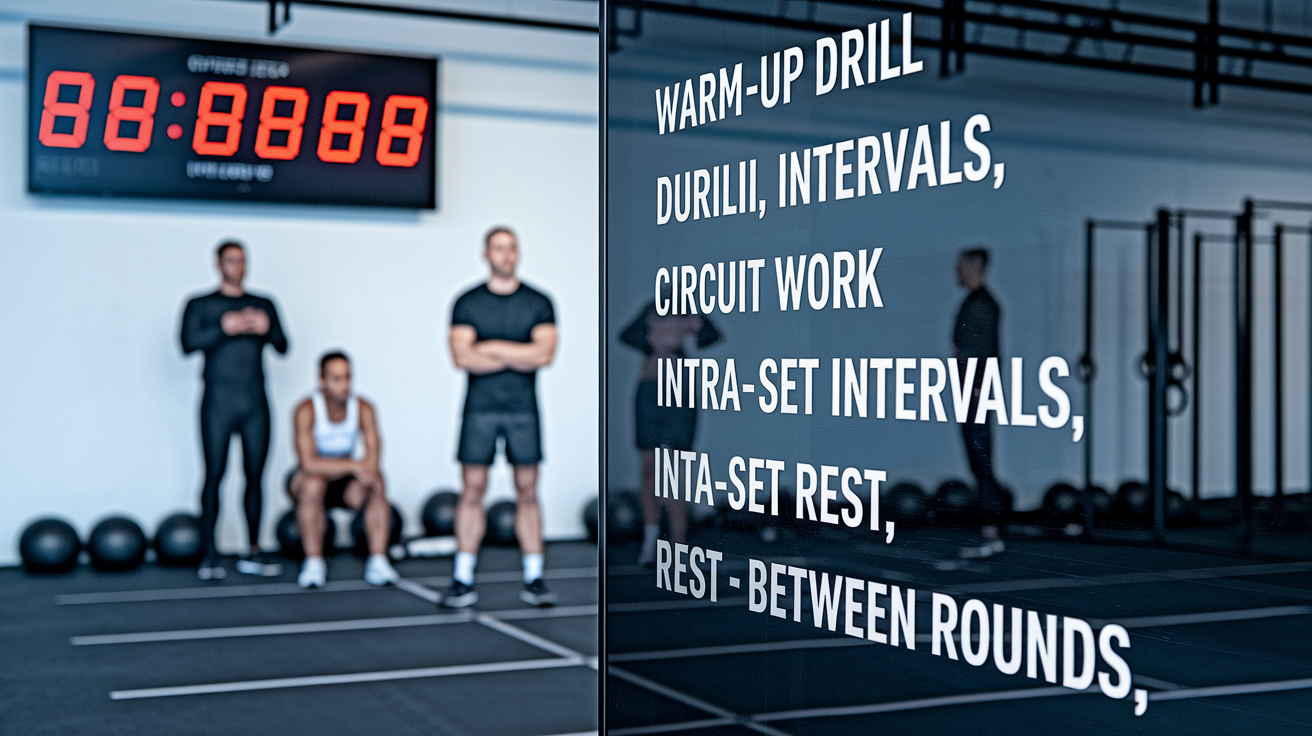
Work intervals should match the metabolic and neuromuscular load of a game shift. Most players skate all-out for 30 to 45 seconds before changing. Circuit stations mirror that demand by prescribing 30 to 60 seconds of continuous work followed by short transition periods. Rest between full rounds allows partial recovery but keeps the session intense enough to drive adaptation. Longer rest produces better movement quality and power output. Shorter rest increases cardiovascular load and mental toughness under fatigue.
Intra-set rests apply when a single exercise uses multiple rounds or positions. For example, a conditioning block built around 60-second efforts may include 30 seconds of rest between each set to preserve quality. Athletes should never stand idle for more than two minutes during the active session. If one round finishes early, coaches can use the extra 20 to 40 seconds for water, repositioning, or quick coaching cues before the next round starts.
| Interval | Duration | Purpose |
|---|---|---|
| Warm-up drill intervals | 10–15 seconds each | Raise core temperature, activate movement patterns, prepare joints |
| Circuit work intervals | 30–60 seconds per station | Match game-shift demands, train power and conditioning simultaneously |
| Intra-set rest (multi-round exercises) | 15–30 seconds | Preserve movement quality, allow partial phosphagen recovery |
| Rest between full circuit rounds | 60–120 seconds | Partial recovery for next round, adjust based on session goal (shorter = conditioning, longer = power/quality) |
Progressions and Scaling Options for All Team Levels

Beginners should reduce prescribed reps by 25 to 50 percent and complete only one full circuit round. If the template calls for 12 single-leg squat jumps per side, beginners perform six to eight reps and focus on controlled landings. If a conditioning block prescribes five sets of 60-second work, beginners complete two to three sets of 45 seconds with 60 to 90 seconds of rest between sets. The goal is to finish the session with good movement quality rather than grinding through high volume with poor mechanics.
Intermediate athletes follow the prescribed reps and times but limit total rounds to two. Rest periods stay at 60 to 90 seconds between rounds to balance intensity and recovery. Coaches should watch for compensations during the second round. If athletes can’t maintain explosive intent on jumps or start cutting depth on lunges, the session has delivered enough stimulus. Adding a third round in that state trains poor movement patterns under fatigue rather than building useful capacity.
Advanced teams complete three full rounds with rest intervals shortened to 30 to 60 seconds. Coaches can increase difficulty further by adding unilateral plyo reps (14 to 16 per side instead of 12), inserting tempo holds at the bottom of squats or lunges (two to three second pause), or converting bilateral exercises into single-leg variations. Another progression option is the double-shift model: athletes work every other 30-second interval with only 30 seconds of rest instead of the standard 60. This format simulates late-game situations when top players log back-to-back shifts without full recovery.
Sample 20-Minute and 30-Minute Team Circuit Templates

20-minute circuit (two full rounds, 60 seconds rest between rounds):
- Prisoner squats, slow descent, explosive drive; 30 seconds maximum reps.
- Skater lunge jump, 8 reps each side, emphasize soft landing and immediate re-acceleration.
- Mountain climbers, high hip drive, controlled cadence; 30 seconds.
- Lateral shuffle drill, 16 reps each side, athletic stance with push off outside foot.
- Burpees, full range or squat-thrust modification; 30 seconds.
- Two-leg rapid rotation response, 16 reps each side, quick feet and stable torso.
- One-leg squat jump, 12 reps each side, focus on vertical power and balance on landing.
- High plank shoulder touch, 12 total reps, slow tempo to challenge core stability.
30-minute circuit (three full rounds, 90 seconds rest between rounds):
- Sumo squat into hip raise into downward dog stretch, 2 full reps, controlled transitions.
- Three-dimensional stretch lunge, 4 reps in each position (forward, lateral, rotational).
- Shoulder diagonals, 8 reps each side, emphasize range and control.
- Three-dimensional jumping jacks, 5 sets of 60 seconds (20 seconds each direction), 30 seconds rest between sets.
- Walking lunges, 20 total reps, upright torso and knee tracking over toes.
- Squat jumps, 10 reps, maximum vertical intent with soft landing.
- Russian lunge, 8 reps each side, deep split with rotational reach.
- Skater hop, 8 reps each side, lateral power and single-leg deceleration.
- Split squat jumps, 12 total reps alternating, explosive drive off front leg.
- High knees with up-downs, 30 seconds, sprint posture with quick ground contact.
Safety, Recovery, and Post-Circuit Cooldown

Athletes must be healthy and injury-free before starting high-intensity circuits. Any player dealing with a current injury, recent concussion, or unresolved joint pain should receive medical clearance before participating. Coaches should emphasize proper landing mechanics during all plyometric work. Knees track over toes, hips hinge back to absorb force, and athletes land softly rather than crashing into the ground. Poor landing patterns under fatigue increase ACL and ankle injury risk.
Post-circuit cooldown begins immediately after the final round. Athletes walk for two to three minutes to bring heart rate below 120 beats per minute, then move into static stretching. Hold each stretch for 20 to 30 seconds without bouncing. Focus on hip flexors, hamstrings, adductors, and shoulders. Breathing should return to a conversational rhythm within five minutes of finishing the last exercise.
Five post-session checkpoints:
- Walk or jog lightly for two to three minutes to clear lactate and lower heart rate gradually.
- Perform static stretches only after cooldown walk (hip flexors, hamstrings, quads, groin, shoulders).
- Use slow nasal breathing during stretches to activate parasympathetic recovery (four-second inhale, six-second exhale).
- Hydrate with 16 to 24 ounces of water within 15 minutes of finishing the session.
- Log any pain, excessive soreness, or movement quality issues for follow-up before the next training day.
Final Words
Start the circuit and you’ve got a ready-to-run plan: 11 bodyweight drills, space-efficient rotations, and clear timing so a group can take the ice fitter after one session.
We also covered warm-up flows, core power and lateral blocks, interval timing, progressions for all levels, sample 20- and 30-minute templates, and safety and cooldown steps to protect players.
Use this off-ice team conditioning circuit without equipment to build explosive drive, better deceleration, and team endurance. Run it often, scale it sensibly, and expect steady, game-ready gains.
FAQ
Q: What is the 3-3-3 rule for workout?
A: The 3-3-3 rule for workout is a simple session structure: three blocks of three—three exercises, three sets or three-minute efforts—repeated three times to keep team circuits short, balanced, and easy to run.
Q: What is the 5 5 5 30 rule?
A: The 5 5 5 30 rule is a compact interval format: five exercises or five reps per station across five rounds, with roughly 30 seconds rest between efforts—useful for high-tempo bodyweight circuits.
Q: What is the 5-3-1 rule?
A: The 5-3-1 rule is a strength cycle that uses a main lift performed as a five-rep set, a three-rep set, then a heavy single, each at planned percentages to drive steady strength gains.
Q: What are the best off-ice exercises?
A: The best off-ice exercises include skater hops for lateral power, single-leg squat jumps for balance and explosiveness, Russian lunges for hip drive, lateral shuffles for footwork, and rapid rotation drills for core transfer to shooting.