

Want longer, game-changing shifts? Stop running long slow laps that don’t match hockey.
Team skating endurance drills to improve shift length performance must mimic a real shift: a 10-second explosion, 20 to 35 seconds of sustained pace, then a short bench recovery.
This post gives practical, team-ready drills, intervals, shift simulators, and game-situation patterns that build glycolytic tolerance, speed endurance, and recovery so players stay sharp through the last 10 seconds of a shift.
Run them with line rotations and controlled rest windows and you’ll train the movement and energy systems that actually extend usable shift length.
Core Team Endurance Drills That Directly Extend Shift Length

Hockey shifts last 30–45 seconds and demand repeated accelerations, transitions, and rapid direction changes. That’s not distance jogging. That’s not rowing for time. Every drill you run for shift-length endurance has to mirror that physiology. If players are coasting for two minutes between reps, they’re not learning how to sustain the second half of a 40-second shift when the battle is still live and their legs are burning.
Training specificity matters more in conditioning than almost anywhere else. The work window, the rest window, and the movement pattern all have to reflect what happens between whistles.
Interval structure directly increases shift capacity because it trains all three energy systems in the same sequence your players use them on the ice. The first 5–10 seconds of a shift come from phosphocreatine. Explosive, immediate, gone fast. The next 20–35 seconds tap glycolytic pathways, the ones that produce lactate and make legs heavy. Recovery between shifts relies on aerobic metabolism to clear metabolites and restock fuel. When your drills replicate 20–45 seconds of hard skating followed by 60–90 seconds of bench-rest recovery, you teach the body to tolerate lactate, recover faster, and repeat the effort without technique falling apart. More on how shift-structured conditioning integrates across the season can be found in Ice Hockey Conditioning Drills for Endurance & Late-Game Stamina.
Running these drills with a full team means using line rotations to control rest windows and total volume. Set up stations so each line completes an identical interval block while other lines rest at the bench or in designated recovery zones. If you have four lines, each line works for one rep, rotates off, and the cycle repeats. You can manage intensity, rest precision, and total reps without losing the structure that makes interval training effective.
Shift Simulator Drill (Step-by-Step)
- Work phase 1: Skate all-out from goal line to far blue line for 10 seconds (max acceleration and top-end speed).
- Work phase 2: Continue skating at 8–9/10 intensity for another 20–30 seconds, using controlled crossovers, transitions, or puck carry to sustain the pace.
- Rest phase: Return to bench or designated rest zone for 60 seconds of passive or very light active recovery (simulate real bench time).
- Repetitions: Complete 6–8 reps per set. Run 2–3 sets with 3–5 minutes of easy skating or skill work between sets.
- Intensity target: First 10 seconds should be 9–10/10 effort. Sustained phase should hold 8–9/10. If technique breaks down or pace drops significantly, end the set and allow full recovery before the next block.
Interval-Based Team Skating Patterns That Build Sustained Pace
Controlled pacing drills prevent mid-shift energy collapse because they teach players how to distribute effort across the full length of a shift instead of emptying the tank in the first 15 seconds. When a forward blows through their glycolytic capacity chasing a dump-in, they’re coasting for the next 20 seconds or heading straight to the bench. Sustained-pace intervals train the skill of holding an efficient stride at 7–8 out of 10 intensity for 30–45 seconds, which is exactly what separates a useful shift from a wasted one.
These drills also build the aerobic base that speeds recovery between shifts, so players can repeat high-quality efforts instead of needing two full minutes to stop gasping.
Coaches should structure these sets for 3–5 minutes of total work time at moderate-high intensity, broken into repeatable intervals that match or slightly exceed typical shift length. A 1:1 work-to-rest ratio (30 seconds work, 30 seconds rest) is a good starting point. Progress to 1:0.5 ratios (30 seconds work, 15 seconds rest) as conditioning improves. Keep the intensity around 7–8 out of 10. Hard enough that players have to focus on maintaining their stride, but controlled enough that they can complete all prescribed reps without form breakdown. If players are bent over or stride quality collapses halfway through, dial back intensity or add rest.
| Drill Name | Work Window | Rest Window | Team Setup |
|---|---|---|---|
| 30/30 Shuttle Tempo | 30 seconds continuous skating (blue-to-blue or corner-to-corner pattern) | 30 seconds light recovery skate or passive rest | Run 2 lines at a time; rotate lines every rep; 8–10 total reps per player |
| 1:00 / 1:00 Full-Ice Circuit | 60 seconds sustained skating through predetermined path (figure-8, weave pattern, or continuous loop) | 60 seconds active recovery (easy skate or stretch at boards) | Stagger start times by 15 seconds so all lines work simultaneously; 4–6 reps per player |
| 4-Minute Continuous Engine Builder | 4 minutes of controlled high-pace skating (multi-direction, change-of-edge patterns at ~7/10 intensity) | 3–5 minutes active recovery or skill work | Full team or by position group; 1–2 total reps; focus on maintaining consistent stride mechanics for entire duration |
Game-Situation Conditioning to Improve Shift-End Performance
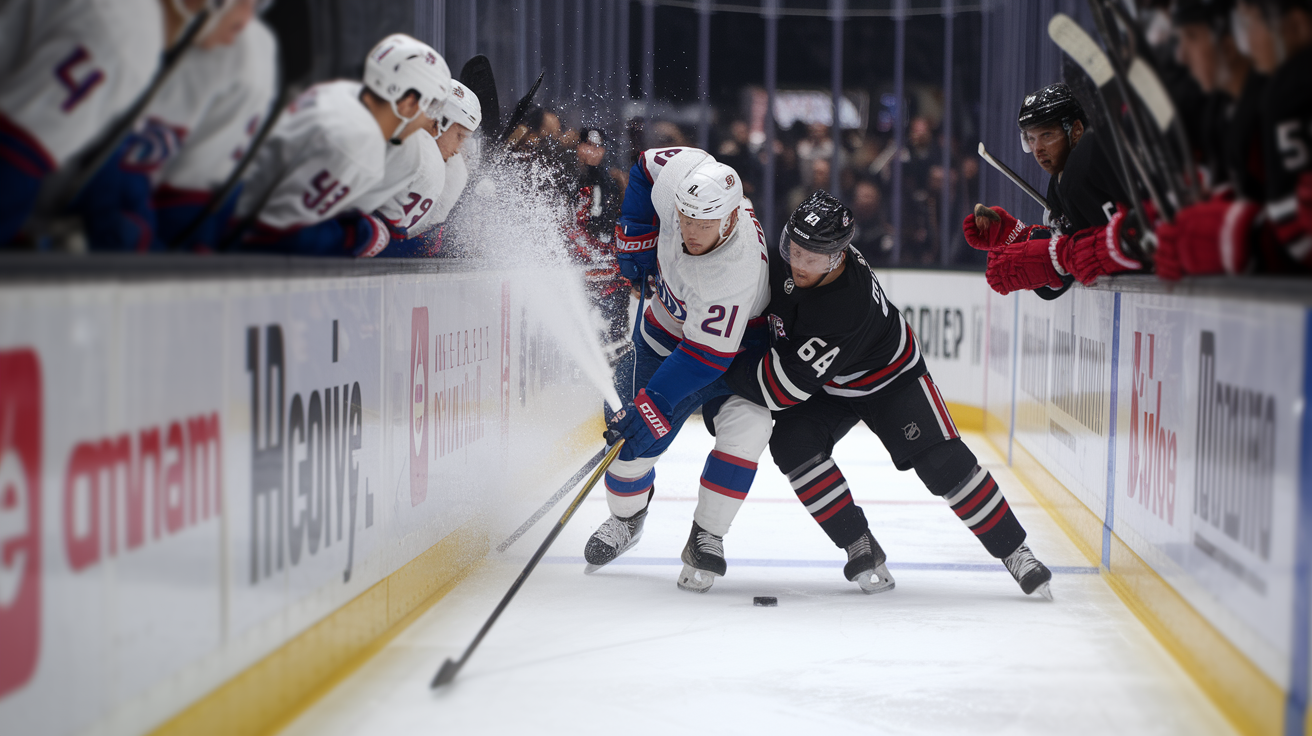
High-intensity, multi-direction patterns replicate the chaos that happens late in a shift when the puck is still live and players are fighting through fatigue. Straight-line sprints don’t prepare anyone for the reality of pivoting off a wall battle, accelerating into the slot, and then transitioning backward to cover a late release. Drills that force repeated direction changes, tight turns, and explosive re-accelerations build the specific stamina needed to execute under real shift conditions.
These patterns also expose inefficient movement habits. Players who waste energy with wide turns or poor edge control will fade faster, and coaches can see exactly where technique needs work.
Battle and possession drills force repeated accelerations because the puck is contested and players have to win small spaces over and over. A 30-second 2-on-2 or 3-on-3 possession game in a reduced zone is more conditioning-effective than a 30-second skating pattern without resistance. Players accelerate to pressure the puck, decelerate to defend gaps, re-accelerate to support, and battle through body contact. All while decision-making is still required. That combination of physical and cognitive load is what builds late-shift performance. If your players can hold their positioning, make the right read, and win a wall battle in the final 10 seconds of a drill, they’ll do it in the final 10 seconds of a shift.
Defensive players need backward skating endurance and gap-control conditioning that forwards don’t. A forward can sometimes coast through the neutral zone. A defenseman skating backward while reading a rush and managing gap cannot. Defensive-specific drills should include extended backward skating intervals (30–45 seconds), tight-gap pivots under pressure, and repeated transition skating (forward to backward and back). Forwards benefit more from repeated acceleration bursts, change-of-direction at speed, and net-front battle conditioning where they’re fighting for inside position while fatigued.
Game-Situation Conditioning Drill Examples (with timing prescriptions)
- 2-on-2 Continuous Possession (confined zone): 45 seconds of live play, offensive team must complete 5 consecutive passes to score, defensive team battles to regain puck. Rotate pairs every 45 seconds with 60-second rest.
- D-Zone Gap Control Repeats: Defensemen start at blue line, forwards attack from red line. D maintains gap while skating backward for 30 seconds, then transition and close. 6 reps with 60-second recovery.
- Wall Battle to Breakout Conditioning: 30-second live 1-on-1 or 2-on-2 wall battle, winner must complete breakout pass within 5 seconds. Loser backchecks. 8 reps per player, 60-second rest between reps.
- Transition Sprint Sequences: Forward to backward to forward skating through full neutral zone (red line to blue line to red line). 20 seconds per rep, 8–10 reps, 45-second passive rest.
- Net-Front Battle Holds: Offensive player fights for position in front of net while defensive player clears for 30 seconds. Switch roles. 6 reps per player, 60-second rest.
- Small-Area 3-on-3 High Tempo: Confined to one zone, continuous play for 60 seconds. Team with puck possession at end of time wins. 4–6 reps per group, 90-second rest between reps.
Off-Ice Conditioning That Transfers to Longer Shifts
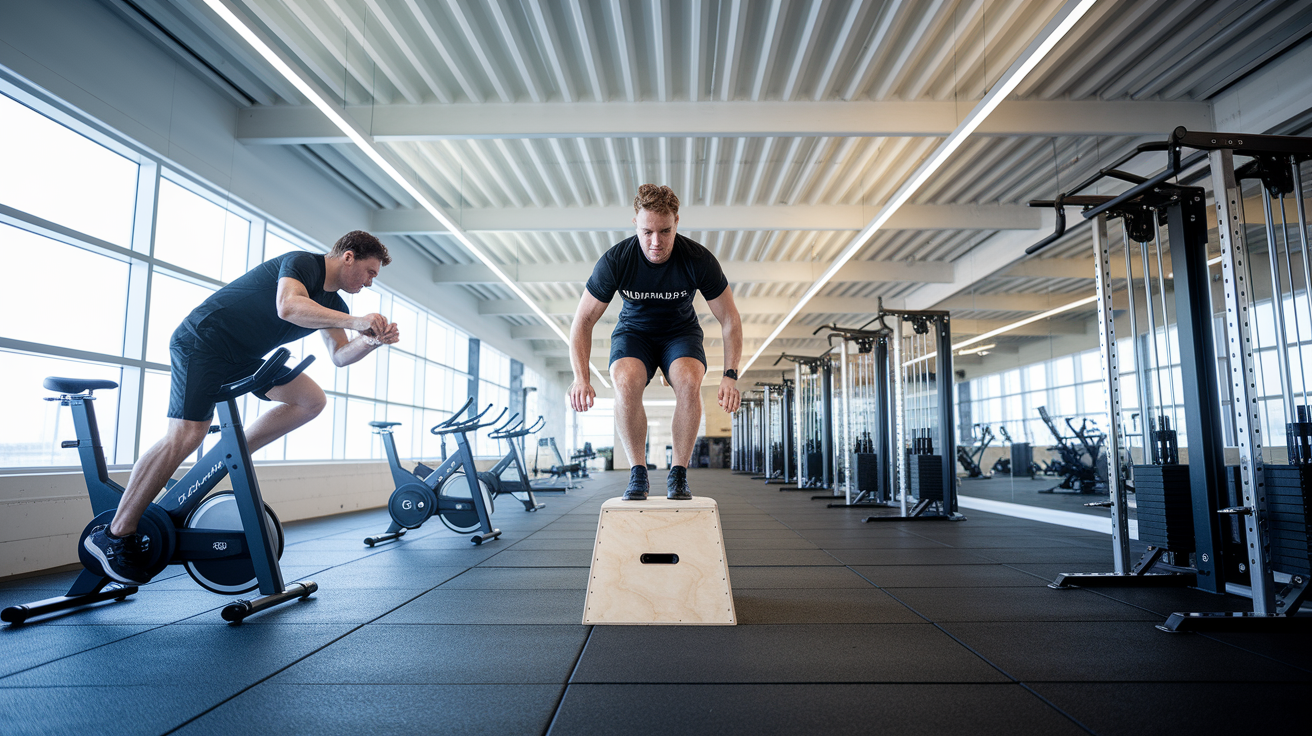
Off-ice interval training transfers directly to on-ice shift endurance when the work and rest windows match skating demands and the movement patterns support skating mechanics. A 20-second all-out bike sprint with 40 seconds of recovery teaches the same glycolytic tolerance and repeat-sprint ability as an on-ice line rush. A 10-second hill sprint with full recovery trains the same phosphocreatine system that powers the first explosive steps out of a corner.
The key is choosing modalities and intervals that don’t just make players tired. They have to build capacities that show up in stride power, acceleration out of transitions, and sustained pace across a full shift. Conditioning research on interval formats, including prescriptions for HIIT, SIT, and RST, is covered in detail at Conditioning for Hockey Players: A Complete Guide.
Plyometrics and core stability reduce the mechanical cost of skating, which directly extends how long a player can hold an efficient stride under fatigue. When hip stability breaks down or a player’s core can’t control posture through crossovers, every stride wastes energy. Plyometric work (box jumps, broad jumps, lateral bounds) builds the reactive strength that supports explosive skating. Core circuits that emphasize anti-rotation and anti-extension (dead bugs, Pallof presses, planks with perturbation) teach the trunk control needed to transfer force through the lower body without energy leaks.
Better mechanics mean less oxygen cost per stride, and that shows up as longer sustainable shifts and faster recovery.
Off-Ice Interval Template for Shift-Length Endurance (5-step progression)
- Warm-up (5–8 minutes): Dynamic movement prep, light jogging or skipping, hip mobility, and activation drills targeting glutes and core.
- Main interval block (choose one format per session): Tabata sprints (8 rounds of 20 seconds all-out effort on hill sprints, bike, or rower with 10 seconds passive rest), or SIT format (6 rounds of 30 seconds near-maximal effort with 90 seconds light active recovery, repeat for 2 sets with 5 minutes rest between sets).
- Plyometric accessory (8–12 minutes): 3 sets of box jumps (5 reps), broad jumps (5 reps), and lateral bounds (6 reps per side) with full recovery between sets. Focus on landing mechanics and explosive intent, not volume.
- Core stability circuit (6–10 minutes): 3 rounds of dead bug (10 reps per side), Pallof press (8 reps per side), and plank with shoulder taps (20 total taps). Rest 60 seconds between rounds.
- Cool-down and recovery (5–10 minutes): Light aerobic work (Zone 1–2 bike or walk), static stretching for hip flexors and adductors, and nasal breathing practice (4-second inhale, 5-second exhale for 3–5 minutes to accelerate parasympathetic recovery).
Practice Planning, Progression, and Monitoring for Shift-Length Gains

Conditioning plans must adjust across off-season, pre-season, and in-season periods because the goals and available recovery windows change. In the off-season, players have time to build aerobic base and glycolytic tolerance with longer intervals (30 to 90 seconds of work with incomplete recovery ratios like 1:1 or 1:0.5). This is when you can push total volume and introduce twice-a-day protocols if the roster allows it. Pre-season shifts the focus to shift-specific intervals that replicate game demands: 20–45 second skating sets with 60–90 second recovery, high intensity, and movement patterns that include transitions and puck skills.
Once the season starts, conditioning drops to 1–2 short, high-intensity sessions per week to maintain adaptations without adding fatigue that impairs game performance.
Progressive overload for skating endurance happens by manipulating one variable at a time. Add reps per set, shorten rest intervals, increase work intensity, or add a third set. A safe progression might look like this: start with 6 reps of 30-second intervals with 60-second rest in week one. Move to 8 reps in week two. Reduce rest to 45 seconds in week three. Then add intensity (faster pace or tighter turns) in week four. Don’t change multiple variables in the same week. Players should be able to complete all prescribed reps with good mechanics before you increase the challenge. If stride quality breaks down or players can’t finish the set, you’ve progressed too fast.
Monitoring tools show whether conditioning work is transferring to actual shift performance. Rate of perceived exertion (RPE) is simple. Ask players to rate each interval on a 1–10 scale and track whether the same prescription feels easier over weeks. Pacing control is another clear signal: if players can hold a target lap time or maintain consistent stride tempo across all reps in a set, conditioning is improving.
The best indicator is late-rep stride efficiency. Watch the final two reps of a conditioning set and compare mechanics to the first two reps. If players are still driving through their edges, maintaining posture, and accelerating out of turns in rep eight, the program is working.
| Season Phase | Main Conditioning Focus | Recommended Interval Types |
|---|---|---|
| Off-Season | Build aerobic base, increase glycolytic tolerance, develop work capacity | HIIT 30–90s intervals with 1:1 or 1:0.5 rest; continuous tempo skates 3–5 minutes; occasional SIT sessions (30s work, 90s rest) 1–2×/week |
| Pre-Season | Shift-specific repeatability, high-intensity sprint work, position-specific endurance | Shift simulators (10s max + 20–30s sustained); RST 10–15s sprints with full recovery; game-situation drills 30–45s with 60–90s rest |
| In-Season | Maintain conditioning adaptations, minimize fatigue, target low-minute players | 1–2 short SIT or shift-simulator sessions per week; 4-minute Tabata sets for quick intensity; prioritize skill work and recovery for high-minute players |
Final Words
In the action, you practiced shift-simulator sets, interval-based skating patterns, game-situation conditioning, and off-ice templates, all built to mirror real 30-45 second shift demands. We showed how to structure work/rest, run team rotations, and track progress across season phases.
Use these team skating endurance drills to improve shift length by training with game-like intensity, monitoring RPE and stride quality, and steadily increasing load. Stick with the plan, and your shifts will get longer and cleaner when it matters most.
FAQ
Q: How to increase skating endurance?
A: Increasing skating endurance requires on-ice, shift-specific intervals plus off-ice HIIT, progressive overload, and technique work under fatigue. Use 20–45s high-intensity efforts with 60–90s rest and track RPE.
Q: What is the Gretzky drill in hockey?
A: The Gretzky drill is a support-and-passing exercise named for Wayne Gretzky that teaches always being open. Players cycle passes, support the puck carrier, and finish with a quick shot to stress decision-making.
Q: Where do you put your weakest player in hockey?
A: You place your weakest player in lower-pressure roles: fourth-line shifts, sheltered wing minutes, or specific development roles. Give clear reads, short stints, and positive feedback to build confidence and game sense.
Q: What is the hardest hockey drill?
A: The hardest hockey drill is often full-shift simulation sets combining repeated all-out sprints, rapid direction changes, puck battles, and short rests, because it mimics late-shift fatigue and tests technique, decision-making, and recovery.