

Think the delayed offside rule is the same everywhere? Think again.
Both NHL and IIHF start with the same delayed signal, where the linesman raises an arm and play continues, but how players can “tag up”, what counts as a clean clear, and when officials finally blow the whistle differ in crucial ways.
This post breaks down the real differences in tag-up rules, clearing requirements, whistle timing, and enforcement.
You’ll learn how those differences change forechecking, zone time, and coaching choices, and what to watch for next game.
Key Differences Between NHL and IIHF Delayed Offside Rules
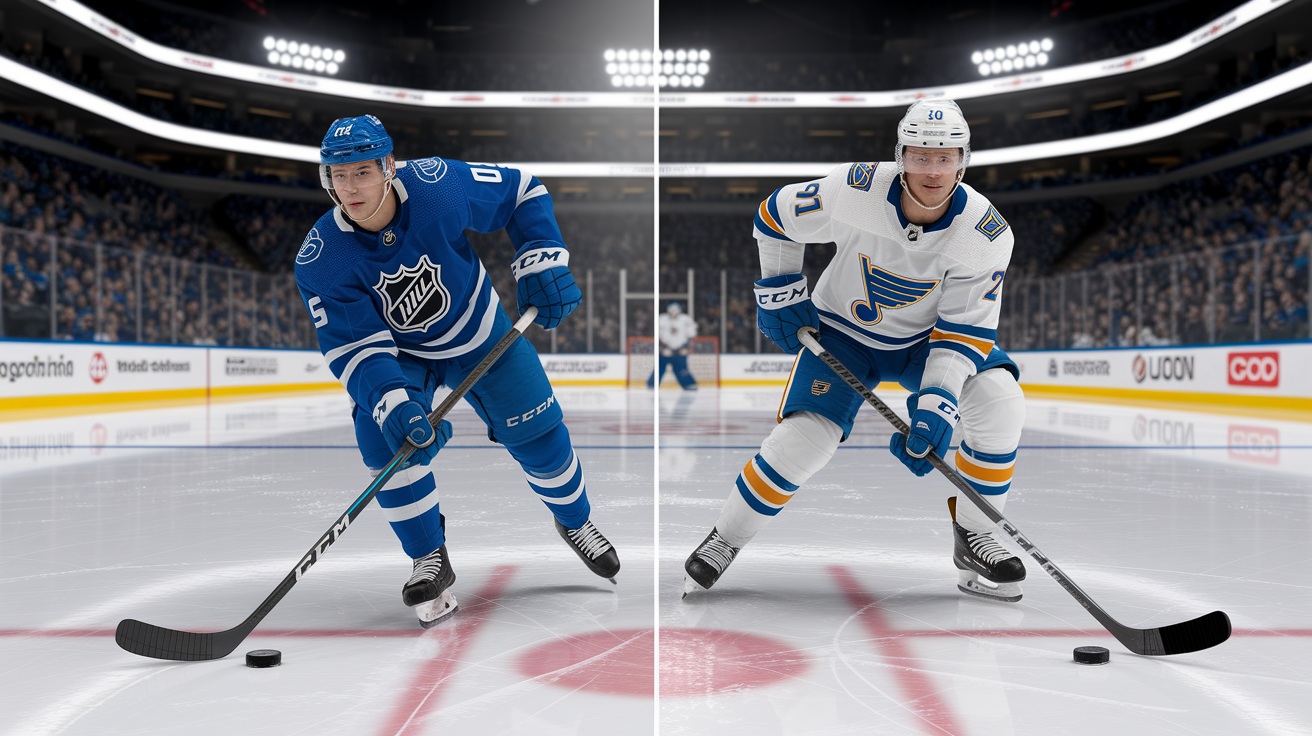
Both the NHL and IIHF start with the same basic trigger for delayed offside. When attacking players cross the blue line before the puck does, the linesman raises an arm but doesn’t blow the whistle right away. Play keeps going as long as the defending team has possession. But what happens next is where things split.
NHL rules let attacking players “tag up” by skating back and touching the blue line with at least one skate. Once they do that, they can jump back into the zone legally if the puck’s still there. IIHF brought tag-up back in 2017 after yanking it for three years. So now both rulebooks technically allow it. The real differences show up in how officials actually call it, how fast they blow the whistle, and what counts as a clean clear.
Here’s where the two codes split:
Tag-up allowance: NHL permits it fully. IIHF does too, but only since 2017.
Clearing requirement: NHL players just need one skate on the blue line. IIHF players have to fully exit back into the neutral zone.
Whistle trigger: NHL linesmen blow it if an offside player touches the puck or nobody clears. IIHF linesmen tend to whistle faster if the clear looks slow or messy.
Enforcement strictness: IIHF officials whistle quicker when tag-up isn’t obvious. NHL officials give attacking players more room to work.
Crease interaction: IIHF enforces stricter crease rules that can mess up delayed offside plays. NHL doesn’t restrict crease entry.
Delayed signal duration: NHL often lets delayed offside situations run longer during offensive pressure. IIHF resets play faster.
In real games, the NHL’s looser timing on tag-up lets forechecking teams keep zone pressure going even after a questionable entry. IIHF enforcement creates more neutral-zone faceoffs and shorter offensive shifts.
| Rule Element | NHL Version | IIHF Version |
|---|---|---|
| Tag-up allowed | Yes | Yes (since 2017) |
| Clearing method | Touch blue line with one skate | Fully clear zone into neutral zone |
| Whistle timing | Delayed; allows extended clearing attempts | Quicker whistle if clearing is marginal |
| Crease enforcement | No crease prohibition | Crease entry can trigger immediate whistle |
| Offensive pressure | Extended forechecking during delayed offside common | More frequent stoppages and resets |
| Tag-up history | Continuous since adoption | Removed 2014, reinstated 2017 |
Definitions of Key Offside Terms
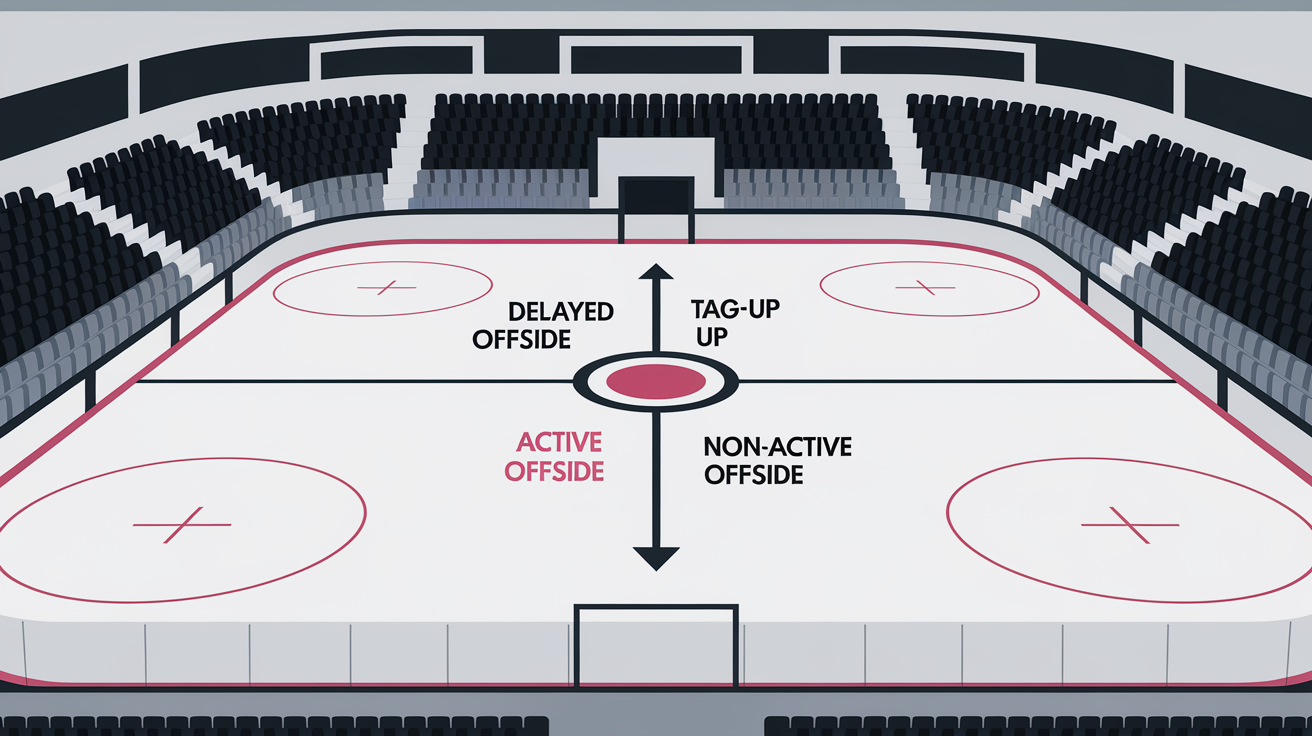
Delayed offside happens when one or more attacking players cross the blue line before the puck crosses into the offensive zone. The linesman raises an arm to show the entry’s illegal but doesn’t blow the whistle yet. Play continues as long as the defending team controls the puck or the attacking players clear out and tag up before touching anything.
Tag-up is the move that lets attacking players fix a delayed offside by backing out of the offensive zone. In the NHL, you tag up by skating back and touching the blue line with at least one skate. Once all offside attackers have tagged up, the linesman drops the arm and everything’s legal again. IIHF rules make you fully clear the zone into the neutral zone, not just touch the line.
Active offside is when an offside attacking player touches the puck or gets in a defender’s way, forcing the linesman to blow the whistle and call it. Non-active offside is when attacking players are technically offside but don’t touch the puck and tag up successfully before the defending team clears, letting the delayed offside get wiped without a stoppage.
How Tag‑Up Rules Affect Game Flow
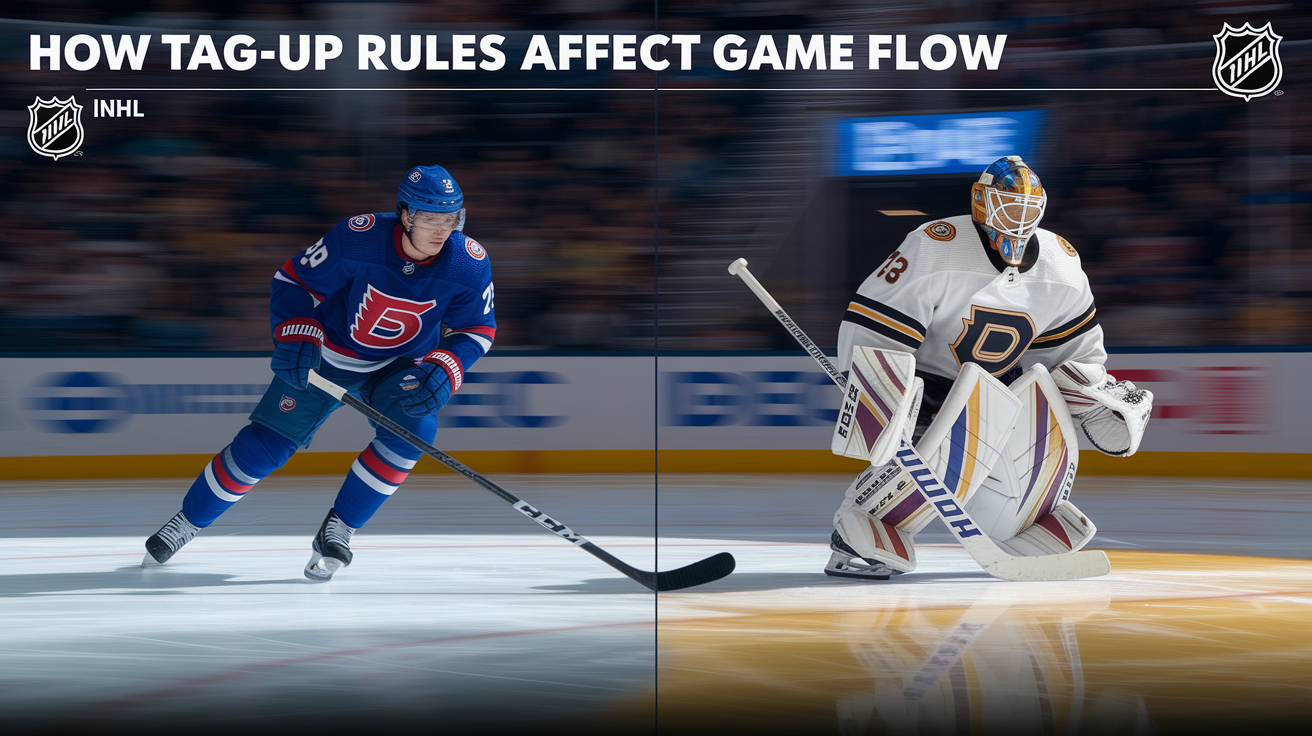
The NHL’s tag-up system cuts down on whistles and keeps things moving during borderline zone entries. When an attacking winger enters early on a dump-in but immediately skates back to the blue line and tags up while a teammate grabs the puck, the play just keeps going. This rewards aggressive forechecking and lets teams maintain offensive pressure even after a technically illegal entry. Over a full game, you get fewer faceoffs and longer stretches in the offensive zone.
IIHF enforcement created way more stoppages during 2014 through 2017 when tag-up got axed entirely. Even after bringing the rule back in 2017, IIHF linesmen whistle delayed offsides faster than NHL refs do. Especially if the clearing action drags or if an attacking player hangs around the crease. The stricter crease rules in IIHF play make this worse. An attacking player who enters the crease during delayed offside often gets an immediate whistle and a neutral-zone faceoff, even without touching the goalie.
Specific ways tag-up differences show up in games:
Forecheck intensity: NHL teams can send all three forwards deep on dump entries and recover from borderline offsides. IIHF teams need to be more careful about early entries or risk instant stoppages.
Breakout patterns: Defending teams in the NHL have to deal with extended offensive pressure during delayed offside. IIHF defending teams can count on quicker whistles to reset.
Offensive zone time: NHL games get longer average offensive possessions per entry. IIHF games get more transitions and neutral-zone play.
Coaching strategy: NHL coaches push aggressive pursuit on borderline entries. IIHF coaches stress clean entries and avoiding marginal tag-up situations that might get whistled dead.
Real Game Examples Showing Rule Differences in Action
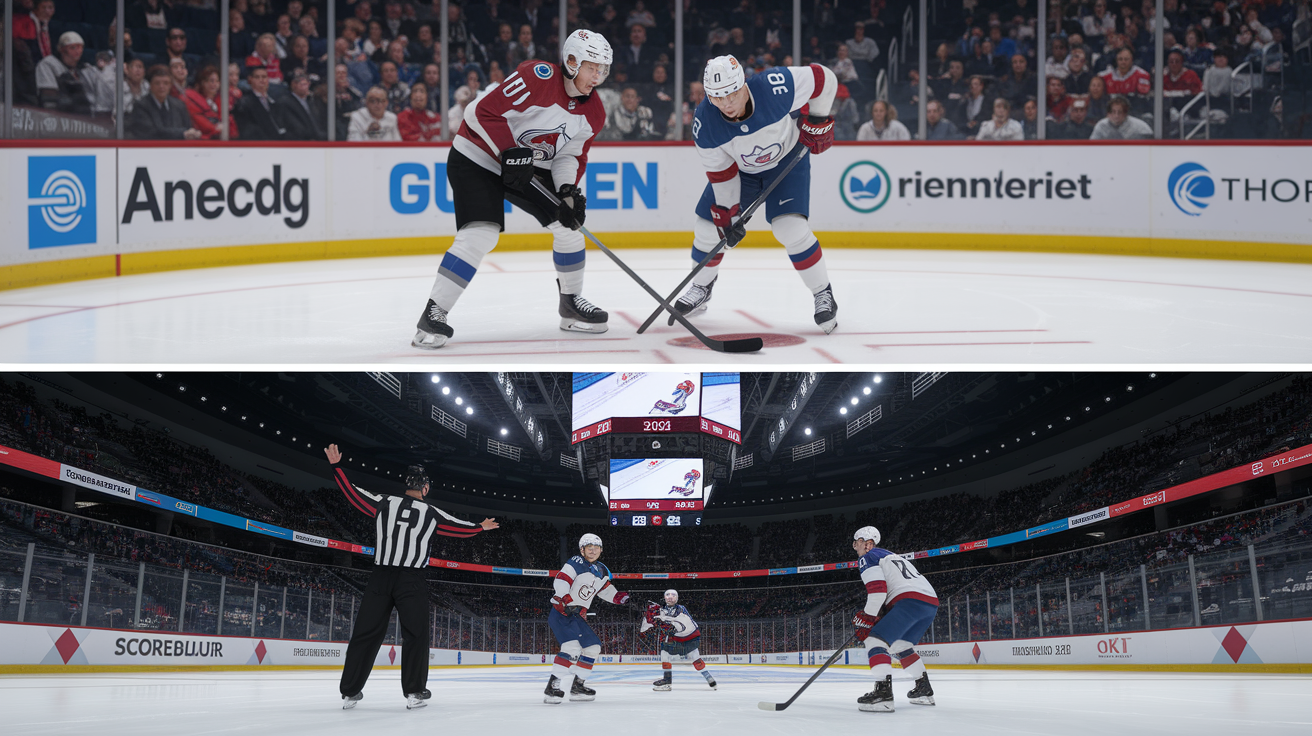
In a 2023 NHL regular season game between the Colorado Avalanche and Dallas Stars, an Avalanche winger dumped the puck into the Dallas zone while a teammate entered early. The linesman raised his arm for delayed offside. The early attacker immediately skated back, touched the blue line with one skate, and re-entered as his teammate got the puck along the boards. The linesman lowered his arm and play continued. Colorado kept offensive zone pressure for the next twenty seconds and eventually drew a penalty. Under IIHF enforcement, the linesman probably would’ve blown the whistle sooner since the clearing skate touch wasn’t a full exit into neutral territory.
During the 2022 Beijing Olympics quarterfinal between the United States and Slovakia, a U.S. forward entered the offensive zone ahead of the puck on a dump-in. The linesman raised his arm for delayed offside. The U.S. player started to retreat but hesitated near the top of the faceoff circle instead of immediately clearing the zone. The linesman blew the whistle within two seconds, even though the player hadn’t touched the puck and Slovakia hadn’t gained full control yet. Faceoff moved to neutral zone. In an NHL game with identical positioning, the linesman would typically give another second or two for the player to finish clearing before whistling it dead.
A common situation that shows the difference happens on a rush where the puck carrier hesitates at the blue line while wingers cross early. In the NHL, if the wingers immediately retreat and tag the line before the puck carrier enters, the linesman drops the arm and the rush continues legally. In IIHF play, if the wingers don’t fully clear the zone into neutral ice and instead touch the line but keep a trailing skate inside, the linesman might whistle the play offside even if the puck carrier hasn’t crossed yet. This stricter read of “clearing the zone” creates more neutral-zone faceoffs and shorter offensive sequences in international hockey.
Visual Breakdown: How Delayed Offside Works

A step-by-step diagram showing delayed offside starts with the puck sitting just outside the blue line and one attacking player already across the line in the offensive zone. The linesman’s shown with an arm raised. The next frame shows the offside attacking player skating back toward the blue line while the puck crosses into the zone. The third frame shows the attacking player’s skate touching the blue line (NHL) or fully clearing into the neutral zone (IIHF), with the linesman’s arm lowering. The final frame shows the player re-entering the zone legally and play continuing without a whistle.
Each diagram element should show:
Puck position relative to the leading edge of the blue line: exact location before, during, and after the attacking player’s entry.
Attacking player skate placement: both skates shown in each frame, with clear indication of which skate crosses the line and which touches to tag up.
Linesman arm position: raised for delayed offside, lowered once all attackers have cleared and tagged up.
Zone boundaries and player positioning: blue line markings, neutral zone, offensive zone, and where each player stands at each step.
Historical Evolution of the Delayed Offside Rule

The NHL adopted tag-up provisions early in the modern era and has kept consistent enforcement since the 1980s. The rule was built to cut stoppages and reward skilled players who could manage zone entries under pressure. Over decades, NHL linesmen developed tolerance for marginal tag-up situations, letting play continue as long as the offside player made a visible effort to clear the zone and didn’t touch the puck or interfere with a defender.
IIHF rules followed a similar path until 2014, when the federation removed tag-up entirely trying to simplify officiating and reduce judgment calls. The change backfired. Games saw way more whistles, longer average faceoff counts, and constant complaints from players and coaches about disrupted offensive flow. In 2017, the IIHF brought tag-up back to align more closely with NHL standards and restore pace of play. Despite bringing it back, IIHF enforcement stays stricter than the NHL, reflecting a long-standing preference for clear, unambiguous rule application and lower tolerance for borderline situations that need linesman judgment.
Final Words
The winger glides across the blue line. The referee raises an arm, and that’s delayed offside in action.
This piece compared NHL and IIHF rules, defined tag-up and active vs non-active offside, showed how tag-up changes game flow, gave three real-game scenarios, a visual step-by-step, and a short history.
Knowing the delayed offside rule nhl vs international differences helps players and coaches read plays faster, adjust pressure, and train with intent. Small know-how like this leads to smarter shifts and cleaner hockey.
FAQ
Q: Does the NHL use delayed offsides?
A: The NHL uses delayed offside, allowing tag-up: attacking players who enter the zone early can clear back across the blue line and touch up without a whistle, keeping play continuous when done correctly.
Q: Are international hockey rules different?
A: International hockey rules are different from the NHL’s, especially on tag-up/offside wording, rink size, and enforcement, which changes game tempo, forechecking, and tactical choices for teams.
Q: What is the Gretzky rule?
A: The Gretzky rule is an informal nickname for rules tied to Wayne Gretzky’s trade or legacy; its exact meaning varies by context and league, so check the specific rulebook for precise language.
Q: What country loves hockey the most?
A: Canada loves hockey the most, with the sport woven into national culture, the highest per-capita participation, and strong grassroots-to-pro pathways that shape daily life and community identity.