

If your team still banks on long, steady-state cardio, you’re training the wrong system.
Hockey shifts are 30 to 45 seconds of hard work followed by 90 seconds to four minutes of lower effort, so off-ice intervals should match that pattern.
Bench-to-ice HIIT that uses 20 to 45 second all-out efforts with partial rest trains the glycolytic system, the one that lets players repeat high-power shifts without fading.
This post gives practical, ready-to-run bench protocols, how to schedule them, and what to watch for on the ice.
Immediate Bench‑to‑Ice HIIT Protocols for Hockey Performance

Hockey shifts run 30 to 45 seconds of explosive work, then 90 seconds to four minutes of rest. If your off-ice conditioning doesn’t match that pattern, you’re training the wrong systems.
Bench HIIT works when the intervals actually look like shifts. Hard enough to hit the anaerobic system. Short enough for real recovery. Structured to repeat the way a game does.
The point is preparing your glycolytic system to produce power over and over without your shift quality falling apart. Steady cardio trains aerobic endurance at intensities that never touch what happens during a breakout or forecheck. HIIT closes that gap. It forces your body to buffer lactate, resynthesize ATP fast, and keep explosive output intact across multiple efforts. Build your off-ice intervals around 20 to 45 seconds of work with rest that allows partial recovery, not full. Just like the game.
Six complete bench protocols you can use right now:
Assault Bike Repeat Sprints: 8 rounds, 20 seconds all out, 60 seconds light spin. Go near maximal RPM. Builds repeat power and lactate tolerance. Total time around 10 minutes after warmup.
Prowler Push Intervals: 6 rounds, 30 seconds heavy push, 90 seconds passive rest. Use bodyweight plus load on turf or grass. Mimics lower body drive. Targets anaerobic endurance.
Slide Board Sprints: 10 rounds, 25 seconds continuous lateral pushes, 45 seconds active recovery walk. Matches skating stride and hip engagement. Trains repeat acceleration off edges.
Battle Rope Slams: 2 sets of 6 rounds (30 seconds max effort, 60 seconds rest between reps, 3 minutes between sets). Upper body power under fatigue. Supports body contact and shot power late in shifts.
Burpee to Box Jump Combo: 5 rounds, 40 seconds continuous work, 2 minutes passive rest. Alternate burpees and box jumps inside the interval. Trains explosive hip extension and repeat vertical power for net front battles and recovery skates.
Treadmill Sprint Repeats: 8 rounds, 15 seconds at 10 to 12 mph with 3 to 5 percent incline, 75 seconds walk recovery. High speed, short duration running that hits acceleration and high force leg drive with controlled landing stress.
Fit these into team practice weeks by swapping out low intensity steady state sessions. Schedule HIIT on non-game days, somewhere between 24 to 48 hours before or after hard on-ice work. One to two sessions per week in season. Two to three during preseason blocks. Pair them with technical skill work on separate days so you’re not creating competing demands, and keep total weekly volume aligned with game and practice load.
Physiological Demands of Hockey and HIIT Adaptation

A typical shift is 30 to 45 seconds of repeated bursts. Accelerations, direction changes, battle work, top speed skating. Separated by brief coasts or lower intensity positioning.
The main energy source? Anaerobic glycolysis. It breaks down stored glycogen without oxygen to fuel high power output. The phosphagen system (ATP-CP) covers the first few seconds of each burst, then glycolysis takes over. Aerobic metabolism helps recovery between shifts and contributes during longer possessions, but the real challenge is how well you can repeat glycolytic efforts without losing power or speed.
HIIT targets exactly that. Work intervals in the 20 to 45 second range at near maximal or supra-threshold intensities force the glycolytic pathway to produce energy while lactate and hydrogen ions climb. Incomplete rest periods (45 seconds to two minutes) prevent full ATP restoration, so each interval starts with partial debt. Over weeks, that stress drives real changes: better buffering capacity, improved lactate clearance, more muscle glycogen storage, enhanced mitochondrial efficiency even in fast twitch fibers. You end up with an athlete who can produce the same power on shift six that they did on shift one, without the gradual fade that marks poor conditioning.
Off‑Ice Conditioning Tools That Translate Best to the Ice
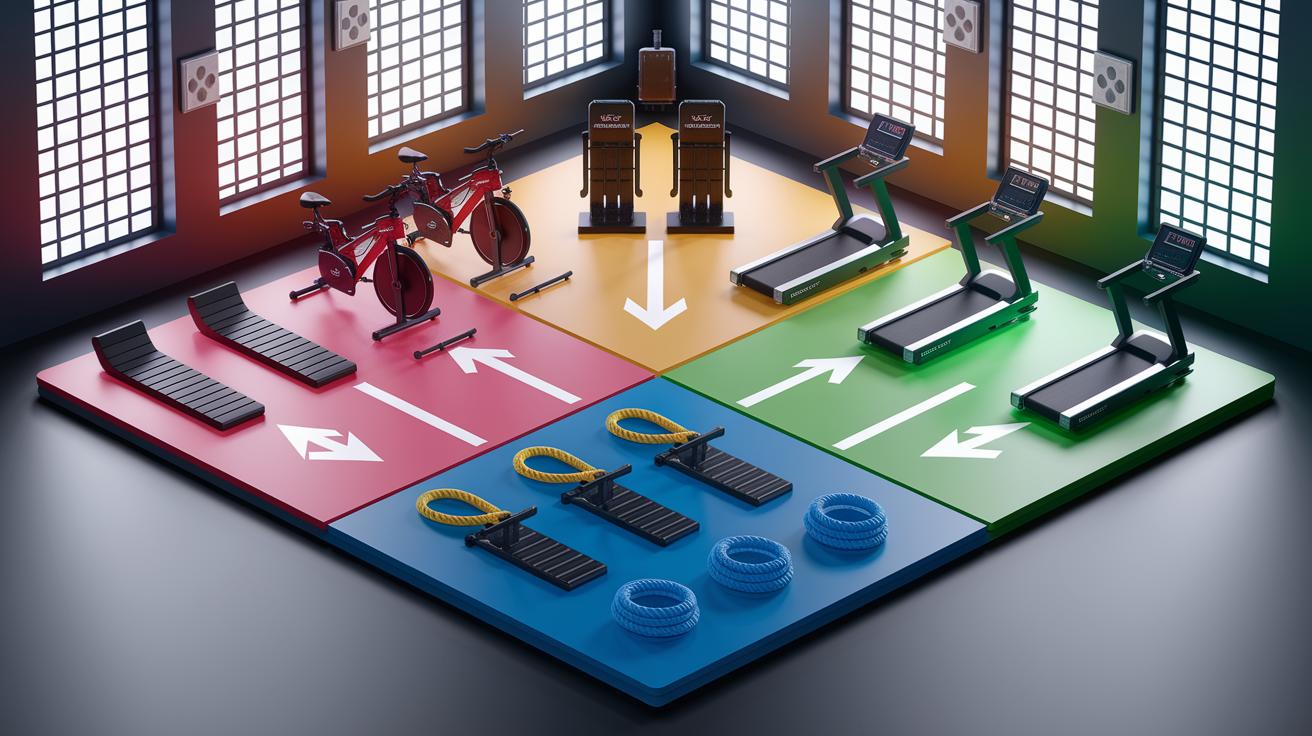
Not every tool replicates what skating actually demands. The best bench-to-ice transfer comes from equipment that loads the hips in similar planes, trains lateral or rotational power, and allows true max effort without teaching bad patterns.
Picking the right tool means understanding which qualities you need to develop off the ice (stride mechanics, repeat acceleration, lower body force, upper body power endurance) and which tools do that job without creating competing motor patterns.
Slide Boards: Lateral pushing motion mirrors skating stride. Trains hip abduction and adduction under load. Builds the specific endurance you need for repeat crossovers and edge work.
Assault Bikes or Echo Bikes: Let you go all out with low landing impact. Engage the whole body in a push-pull rhythm similar to skating effort. Permit precise work-to-rest control for team rotations.
Prowler Sleds (Push and Pull): Heavy pushing trains horizontal force and hip extension at angles that transfer to acceleration phases. Low handles replicate forward lean during explosive starts.
Battle Ropes: Build upper body power endurance and core stability under fatigue. Support body contact, stick battles, and shot power that fall apart late in games when conditioning isn’t there.
Treadmills (Incline Sprints): High speed incline running develops powerful leg drive, controlled eccentric landing, and repeat sprint capacity with manageable impact when sprint volume on hard surfaces needs control.
The main constraint is space and how many athletes you can cycle through a station in a fixed window. A 20 player team rotating through four stations needs each one to handle five athletes at once or in tight sequence. Session length (20 to 30 minutes of actual interval work) limits total volume, so each tool must deliver maximum transfer per minute. Avoid tools that teach patterns incompatible with skating (long distance running that reinforces heel strike) or that require so much technical learning that intensity drops while athletes figure out the movement.
These tools complement the interval protocols, they don’t duplicate them. The assault bike and slide board can swap depending on what’s available. Prowler work and battle ropes target different qualities (lower body horizontal force versus upper body repeat power), so they fit different phases or occupy separate stations in a circuit. Select based on the performance gap you’re addressing: if your team fades in the third, prioritize lactate tolerance intervals on the bike. If first step quickness off the wall is the problem, load the slide board or prowler.
Designing Weekly Bench‑to‑Ice Conditioning Schedules

Weekly planning balances HIIT frequency with recovery and on-ice practice demands. Two to three HIIT sessions per week during preseason builds the base without overloading the central nervous system. In season, drop to one to two sessions depending on game frequency. Always schedule at least 24 hours between high intensity conditioning and game day.
Recovery isn’t optional. HIIT stresses the glycolytic system and creates localized muscle damage that needs 48 to 72 hours to fully repair, especially early in a block.
| Day | Conditioning Focus | Duration | On-Ice Transfer Goal |
|---|---|---|---|
| Monday | Assault Bike Repeat Sprints | 22 minutes total | Repeat shift power without fade |
| Tuesday | On-ice skill / light tempo | 45 minutes | Technical execution, active recovery |
| Wednesday | Slide Board + Prowler Circuit | 28 minutes | Acceleration mechanics, edge work endurance |
| Thursday | Battle Rope Intervals | 18 minutes | Upper body power late in games |
| Friday | Rest or mobility only | 30 minutes | Preparation for weekend competition |
During tournament weeks or heavy practice cycles, cut HIIT volume by one-third to one-half or replace a full session with a short neuromuscular primer. Three to five very short sprints (10 seconds) with full rest maintain power output without adding fatigue. Monitor practice intensity: if Tuesday’s on-ice work includes multiple bag skates or high tempo small area games, skip Wednesday’s scheduled HIIT or swap it for low intensity aerobic work.
The goal is arriving at games with the glycolytic system primed, not depleted. Adjust based on readiness markers and performance trends, not rigid adherence to a printed schedule.
Readiness, Monitoring, and Performance Testing

Simple readiness indicators tell you whether an athlete is adapting to HIIT or piling up fatigue that’ll hurt performance.
Heart rate recovery is the most accessible metric: measure how many beats per minute heart rate drops in the first 60 seconds after a maximal interval. A well conditioned athlete typically sees a 25 to 35 beat drop. Anything under 20 suggests incomplete recovery or overtraining. Track this weekly.
Countermovement jump height or broad jump distance offers another low tech window into neuromuscular readiness. If jump performance trends downward across a week despite consistent effort, reduce HIIT volume before the next session.
On-ice repeat shift tests give direct performance feedback. Set up a simple protocol: skate six 30 second high intensity shifts with 90 seconds rest between each, recording lap time or distance covered per shift. The goal? Maintain output across all six efforts with less than five percent decline from shift one to shift six. Run this test every three to four weeks. Improvements in repeat shift maintenance signal effective conditioning. Deterioration means either the HIIT prescription is mismatched to the athlete’s current capacity or total training load (practice plus conditioning plus games) exceeds recovery ability.
Adjust HIIT intensity and volume based on what the monitoring shows. If heart rate recovery is slow and jump height is down, extend rest intervals or reduce the number of work bouts in the next session. If on-ice repeat shift times stay flat or improve week over week, you can gradually increase work duration (from 20 to 25 seconds) or shorten rest intervals (from 90 to 75 seconds) to keep driving adaptation.
Use objective data to guide decisions, not assumptions about toughness or effort. The best conditioning program is the one the athlete can recover from and then repeat at higher quality the following week.
Final Words
In the action, we laid out immediate bench-to-ice HIIT protocols that mirror 20–45 second shift bursts, linked them to hockey energy systems, listed off-ice tools that transfer best, gave sample weekly schedules, and covered readiness testing.
Pick the interval prescriptions that match your team’s shift demands, use slide boards or bikes for transfer, schedule 2–3 HIIT sessions per week, and track heart-rate recovery or jump trends to guide load.
When coaches apply this bench-to-ice high-intensity interval conditioning for hockey teams with steady monitoring, players get sharper, more repeatable shifts.
FAQ
Q: Why must bench-based HIIT mirror on-ice shift demands?
A: Bench-based HIIT must mirror on-ice shift demands because hockey shifts are intense 20–45 second bursts, so matching that builds relevant power, repeatability, and better on-ice transfer for shifts and recovery.
Q: How should off-ice intervals be structured to match hockey energy systems?
A: Off-ice intervals should be structured to emphasize anaerobic-glycolytic efforts with 20–45 second high-intensity work, brief rests of 1–3 minutes, and repeated sets to improve repeated-sprint ability.
Q: What are quick bench-to-ice HIIT protocol examples coaches can use?
A: Quick bench-to-ice HIIT protocol examples include 20s maximal effort/40s rest for power, 45s high-intensity/90s rest for glycolytic capacity, and 6x10s sprint/50s rest for neuromuscular speed.
Q: How often should teams schedule bench-to-ice HIIT each week?
A: Teams should schedule bench-to-ice HIIT two to three times per week, balancing quality sessions with recovery days and limiting maximal efforts before heavy practices or games.
Q: How should coaches adjust HIIT during tournament weeks or heavy practice cycles?
A: Coaches should reduce volume and intensity during tournament weeks, keeping one short, quality session or maintenance bursts, then ramp back up after 48–72 hours of lighter loading.
Q: Which off-ice conditioning tools translate best to on-ice performance?
A: Off-ice conditioning tools that translate best include slide boards for lateral skating, assault bikes for repeated power, prowlers for hip drive, ski-erg for leg extension, and short sled pushes for acceleration.
Q: What constraints affect choosing off-ice tools for team sessions?
A: Constraints that affect choosing off-ice tools include limited space, equipment availability, large team size, session duration, and the need to rotate stations to keep everyone engaged and safe.
Q: How do coaches avoid redundancy between tools and interval protocols?
A: Coaches avoid redundancy by varying modality, prioritizing different outputs each session, such as power, glycolytic capacity, or speed, and changing work-to-rest ratios rather than repeating the same stimulus.
Q: What readiness indicators and performance tests should coaches use to monitor HIIT effects?
A: Readiness indicators and tests include heart-rate recovery, vertical jump trends, perceived exertion, and on-ice repeat-shift tests (three 30–45 second shifts with set rest), then adjust HIIT based on declines or improvements.