

Think a certification sticker guarantees your child won’t get a concussion? Not exactly.
CSA, HECC, and CE mean a helmet met independent lab tests for impact, shell strength, and strap retention, the basics that reduce skull fractures and bad cuts.
But certified is a baseline, not a promise: fit, liner type, age of the shell, and rotational protection change real-world performance.
This post breaks down what each mark tests, where they’re required, and what parents should check before their kid hits the ice.
Quick Explanation of Hockey Helmet Safety Certifications
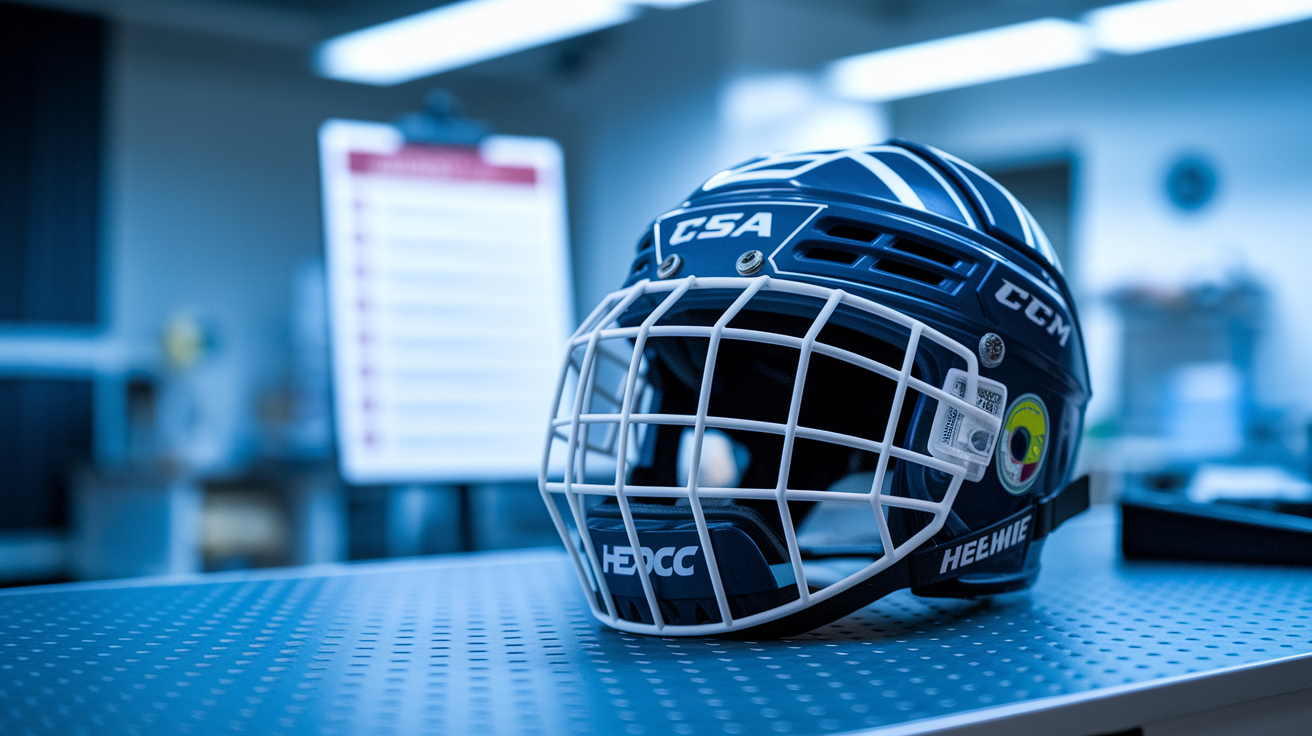
CSA is the Canadian Standards Association. HECC is the Hockey Equipment Certification Council. CE stands for Conformité Européenne. These groups test helmets to confirm they meet baseline safety thresholds for impact protection, shell strength, and whether the chin strap actually keeps the helmet on your head during a hit.
CSA certification is required for players registered in Hockey Canada programs and most provincial associations. HECC is what USA Hockey wants, plus many high school leagues and the NCAA. CE certification gets used mostly in European leagues and IIHF international play.
Leagues enforce these requirements because they need proof that every helmet on the ice has passed independent lab testing. No certified helmet? You’re not playing. The certification sticker is your evidence that a third-party lab evaluated the helmet and it met the standard in place when it was made.
These certifications confirm a helmet can handle specific force levels during impact testing, that the chin strap holds under stress, and that the shell resists penetration from sharp objects. But they’re the legal minimum, not the ceiling. A certified helmet can still vary in real-world concussion protection depending on liner materials, shell thickness, and whether it addresses rotational impacts.
What Each Certification Tests For
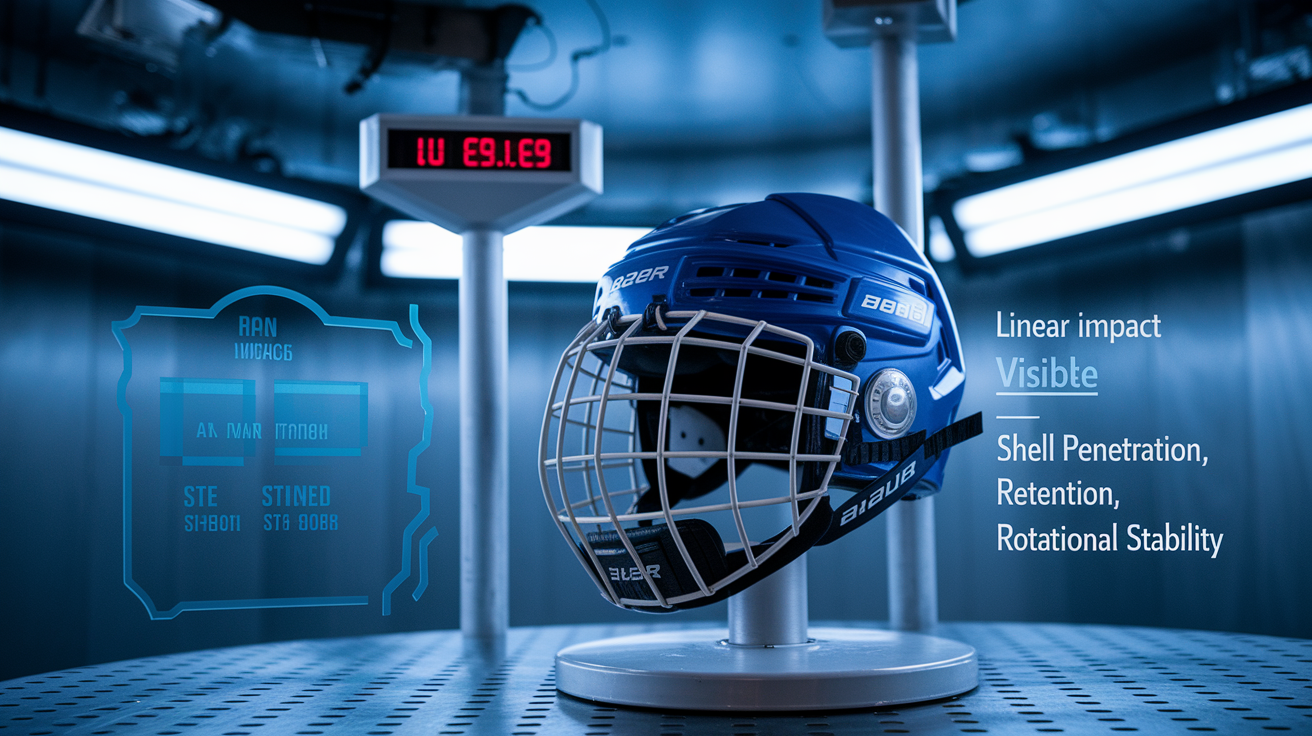
CSA, HECC, and CE all evaluate helmets across multiple categories to verify they protect consistently under game conditions. Testing protocols differ slightly, but the fundamentals overlap.
Linear impact absorption: Drop tests onto flat, hemispherical, and curbstone anvils measure peak linear acceleration. HECC requires forces stay below 300g. CSA and CE use comparable thresholds.
Shell penetration resistance: A weighted striker drops onto the shell to make sure it won’t fracture or allow penetration from pucks, stick blades, or skate edges.
Retention system strength: Chin straps and hardware get pull-tested to confirm the helmet stays on during collisions. Buckles, snaps, and rivets must hold under specified loads.
Positional stability: Helmets are tested to verify they don’t shift or rotate too much when force comes from the front, back, or sides. Too much movement leaves parts of the head exposed during a fall.
Environmental conditioning: Tests run at room temperature and at cold temperatures (typically −25°C for CSA and HECC) to confirm foam and shell performance in rink conditions.
Coverage area and field of vision: Standards specify minimum coverage zones and verify the helmet doesn’t obstruct peripheral vision or interfere with face protection when it fits correctly.
These lab tests simulate the physics of common hockey impacts. Puck strikes, player checks, falls into boards or ice. No helmet stops every concussion, but certified helmets cut the risk of skull fractures, lacerations, and catastrophic head injuries. The testing process gives parents confidence that any helmet carrying a CSA, HECC, or CE sticker delivers baseline performance.
How Certifications Compare
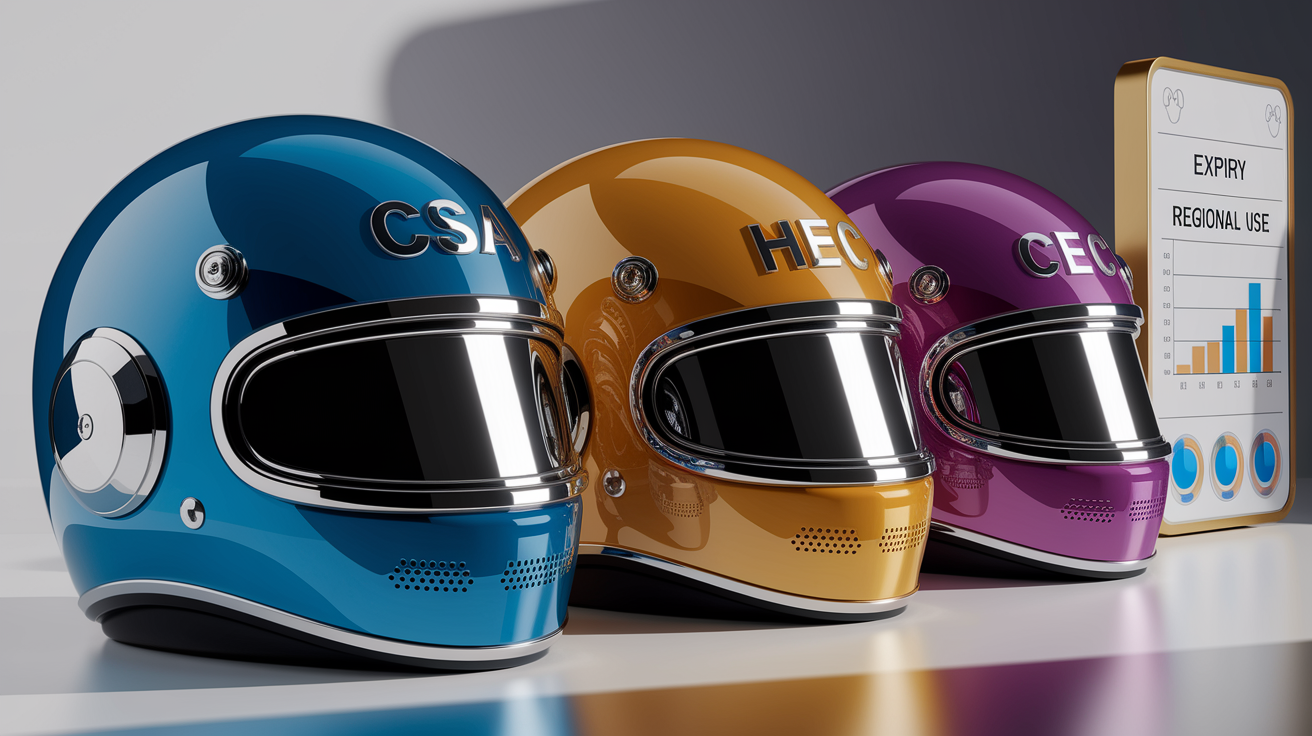
CSA and HECC certifications use nearly identical testing protocols and get accepted interchangeably by many cross-border leagues and tournaments. Both require impact testing on multiple anvil shapes, penetration resistance, retention strength, and cold-temperature performance. The main difference is administrative oversight and recertification timelines. HECC helmets carry a blue-bordered sticker that expires 6.5 years from manufacture. CSA helmets follow similar aging guidance but don’t always print a fixed expiry date on the sticker.
CE certification follows European Norm EN 967 and is required for helmets sold and used in the European Union and in many IIHF competitions. CE testing covers impact attenuation, retention, and penetration resistance but doesn’t mandate the same cold-temperature testing as North American standards. CE helmets also don’t carry a fixed expiry rule on the certification mark, though manufacturers usually recommend replacement after five to seven years.
| Certification | Where Used | Expiry Rules |
|---|---|---|
| CSA (Z262.1) | Canada, Hockey Canada programs | No fixed printed expiry; replace after 6–7 years or per manufacturer |
| HECC (ASTM F1045) | USA Hockey, high school, NCAA | Sticker expires 6.5 years from manufacture date |
| CE (EN 967) | European leagues, IIHF international play | No fixed expiry; manufacturer guidance typically 5–7 years |
For parents in North America, it’s straightforward. If your kid plays in the United States, look for a HECC sticker. In Canada, look for CSA. Plenty of helmets carry both to cover cross-border tournaments and families who move between leagues. CE certification is less common in North American retail but works for international competition and European club play.
How to Identify Certified Helmets

Certified helmets display a permanent sticker on the inside or back of the shell. It lists the certification body, the safety standard met, and key dates. HECC stickers are blue-bordered and include the ASTM standard number (usually F1045 for players or F1587 for goalies), the year the standard was last revised, and the year after which certification expires. CSA stickers are often black text on white or silver and reference CSA Z262.1. CE marks get printed or molded directly into the shell and include the EN 967 designation.
The sticker is your proof the helmet’s been independently tested and validated. No visible, legible certification mark? The helmet doesn’t meet league requirements and shouldn’t be used in organized play. Counterfeit or expired stickers occasionally show up on second-hand gear, so verify both the presence and condition of the mark before you buy or register.
Check the inside rear of the shell for a sticker or molded mark. HECC and CSA stickers usually sit near the base of the helmet, just above the neckline.
Read the manufacture date printed on a separate label inside the helmet. HECC helmets expire 6.5 years from this date, regardless of use.
Verify the standard listed matches your league requirements. ASTM F1045 is for player helmets. ASTM F1587 is for goalie helmets. CSA Z262.1 covers both.
Inspect the sticker for damage or tampering. Faded, peeling, or missing stickers may mean the helmet’s too old or has been stored improperly.
Practical Buying Advice for Parents

Fit matters more than brand or price when you’re picking a certified helmet. A helmet that passes every certification test in the lab will fail on the ice if it shifts during play or sits too high on the forehead. Measure your child’s head circumference about one inch above the eyebrows and match that to the manufacturer’s size chart. Most youth helmets fit head sizes between 48 and 56 centimeters.
Try the helmet in person when you can. The front edge should rest approximately one finger-width above the eyebrows. It should feel snug without pinch points. It shouldn’t rock or slide when you gently shake your child’s head side to side.
Replace helmets on a schedule even if they look fine. HECC helmets expire 6.5 years from manufacture, and that timeline’s printed on the certification sticker. CSA and CE helmets don’t always carry a printed expiry, but manufacturers typically recommend replacement after five to seven years. Foam liners degrade from sweat, temperature cycles, and accumulated micro-impacts you can’t see. A seven-year-old helmet with a valid sticker likely offers less protection than it did when new.
Replace the helmet immediately after any significant collision, even if there are no visible cracks. Internal foam can compress permanently without external signs.
Youth players grow quickly. Helmet fit changes as head size increases. Recheck fit at the start of each season and adjust or replace as needed. Look for helmets with tool-free adjustment dials and multiple padding inserts to extend usable life. Skip helmets marketed as “one size fits most” unless they include robust internal sizing systems.
Competitive players at bantam level and above should consider helmets with rotational-impact technology in addition to CSA or HECC certification. Slip-plane liners or MIPS-style systems. Adult recreational players should apply the same standards as youth players. Certification, fit, and timely replacement matter at every level.
Final Words
You’re checking the sticker on the back of a helmet. This post broke down CSA, HECC, and CE, the tests they run, and why leagues care.
You saw what each standard measures, how to read certification stickers and expiry dates, and the fit and replacement rules that actually keep kids safer.
Keep this as your quick checklist — certified helmet safety ratings explained for hockey parents — check fit, check the sticker, replace on schedule. Do that, and you’ll shop with more confidence and protect the player.
FAQ
Q: What do the helmet safety ratings mean?
A: Helmet safety ratings mean a helmet met specific tests by a standards body (CSA, HECC, CE), verifying impact absorption, shell penetration resistance, strap retention, and basic protection required by leagues and programs.
Q: What is the 2 2 2 rule when fitting a helmet on your head?
A: The 2‑2‑2 rule when fitting a helmet on your head is a quick fit check: two fingers of clearance at the forehead, two fingers at the temples/side, and two fingers under the chin strap for a snug, level fit.
Q: What is a CSA approved hockey helmet?
A: A CSA approved hockey helmet is one certified by the Canadian Standards Association, showing it passed defined impact, penetration, and retention tests and meets requirements for many Canadian youth and adult leagues.
Q: Is ECE 22.06 a safe helmet rating?
A: ECE 22.06 is a modern European motorcycle helmet standard with tougher impact and oblique tests; it’s considered safe for motorcycling but is not a hockey certification and won’t replace CSA/HECC/CE hockey approvals.