

If your team treats every week the same, you’re losing games.
Periodization fixes that.
In hockey, periodization plans training so players peak for games, can explode on a 45-second shift, and still have gas in the third period.
Without a real plan you’re guessing, and guessing leads to overtraining in January, injuries in playoffs, and late-game fades.
This post walks through off-season, pre-season, and in-season blocks and shows how to match workouts to your schedule so players stay fast, healthy, and ready.
Core Framework for Structuring a Hockey Conditioning Year

Periodization is how you plan training over time so players peak when it counts. In hockey, that means being able to explode during a 45-second shift, recover fast enough to do it again, and still have gas left in the third period. Without a real plan, you’re guessing. And guessing gets you overtrained players in January, injuries during playoffs, and guys who can’t keep up when games get tight.
The training year breaks into three main chunks: off-season, pre-season, and in-season. Each one has different goals, and the work changes as you move through the calendar. Off-season builds the foundation. You’re developing aerobic capacity, adding strength, fixing movement problems, and giving bodies time to recover from the wear of the previous year. Pre-season cranks up the intensity. You’re converting that baseline fitness into hockey power, anaerobic endurance, and high-speed execution through on-ice drills and interval work. In-season is about maintenance and managing fatigue. Shorter sessions, focused work, and keeping players sharp without grinding them down through games, travel, and practice.
You can’t treat every week the same. A high school team done in March has months to build aerobic base and strength. A junior team finishing playoffs in June doesn’t. And a midseason stretch with back-to-back games needs a completely different approach than a week with three full practices. Coaches who match conditioning to the calendar and competition schedule see better consistency, fewer soft-tissue injuries, and athletes who can still fly in the third period.
Here’s what each phase is actually about:
Off-Season: Fix imbalances, build aerobic base and general strength, work on movement patterns, let the brain and body recover.
Pre-Season: Turn strength into hockey power, develop anaerobic endurance and repeated-sprint ability, get systems and chemistry dialed in.
In-Season: Keep strength and conditioning from dropping off, manage fatigue through smart practice planning, let games be the main high-intensity work.
Transition (Active Rest): Short mental and physical break with light, unstructured activity. Review what worked, set goals for the next cycle.
Periodization Models Used in Hockey Team Conditioning

Three models show up most often: linear, undulating, and block periodization.
Linear periodization is straightforward. You start with high volume and low intensity, then gradually shift toward lower volume and higher intensity as the competitive season gets closer. It works well when you’ve got a long, uninterrupted off-season. Players build a broad aerobic and strength base before transitioning into power and speed work. The progression is predictable and easy to plan, which is why you see it a lot at youth and high school levels where schedules stay pretty consistent.
Undulating periodization mixes things up more often, sometimes week to week or even session to session. A team might do high-intensity intervals Monday, moderate-volume strength Wednesday, and low-intensity conditioning Friday. This model is helpful during the in-season when you’re trying to maintain multiple fitness qualities at once. It also keeps things from getting stale. But you’ve got to watch it carefully so high-intensity sessions don’t mess with game performance or recovery.
Block periodization groups training into concentrated phases focused on one or two specific capacities at a time. Maybe you run a four-week block emphasizing maximum strength with low conditioning volume, then shift to a three-week block prioritizing power and anaerobic intervals. You see this more in professional and elite junior programs where precise peaking for playoffs or combines matters. The trade-off is that other fitness qualities might temporarily dip during a block, but the targeted adaptations go deeper.
Most hockey programs do best with a hybrid approach. Linear progression in the off-season, undulating structure during the in-season, and block-style focus during pre-season or targeted prep periods.
Structuring the Annual Plan for Hockey Teams

An annual conditioning plan gets divided into macrocycles, mesocycles, and microcycles. The macrocycle is the full training year, running from the end of one season to the end of the next. Mesocycles are intermediate blocks lasting four to eight weeks, each with a primary objective like aerobic development, hypertrophy, or anaerobic power. Microcycles represent the week-to-week structure, showing when conditioning sessions, strength work, practices, games, and recovery days happen.
| Cycle Type | Time Span | Primary Focus |
|---|---|---|
| Macrocycle | 12 months (full season) | Overall performance progression and peaking |
| Mesocycle | 4–8 weeks | Specific adaptation (e.g., strength, power, endurance) |
| Microcycle | 1 week | Daily training loads, recovery, and tapering |
You plan training loads by lining up mesocycle objectives with the competition calendar. During a mesocycle with no games, conditioning volume and intensity can both be high. Once games start, the microcycle structure shifts. You place high-intensity conditioning early in the week, reduce volume before games, and insert recovery sessions after back-to-back games or travel.
Monitoring player readiness through simple metrics like resting heart rate, perceived exertion, or jump height helps you adjust weekly loads. The key is flexibility within structure. A well-designed mesocycle has built-in adjustment points so an unexpected tournament or injury doesn’t derail the entire plan.
Phase-Specific Conditioning Protocols

Off-Season Conditioning
Off-season conditioning is about rebuilding the aerobic base and restoring movement quality after months of high-intensity hockey. Players spend seven to nine months skating at game pace, which creates imbalances, wears on joints, and fries the central nervous system. The first two to four weeks should emphasize active recovery, low-volume conditioning, and corrective exercises to address hip and shoulder mobility.
Conditioning modalities during this phase should be joint-friendly. Sled drags, bike tempo work, or swimming rather than high-impact shuttle runs or repeated plyometrics. The goal is gradual reintroduction of training stimulus without overloading tissues that are still recovering.
As players move deeper into the off-season, aerobic conditioning volume increases through steady-state runs, bike sessions, or tempo intervals lasting 20 to 40 minutes at moderate intensity. This aerobic work supports recovery between future high-intensity efforts and provides a base for the anaerobic intervals coming in pre-season. Conditioning frequency during the off-season is typically two to three sessions per week, kept submaximal to allow simultaneous strength and hypertrophy gains. Cross-training through sports like soccer, lacrosse, or baseball adds variety and reduces mental burnout while maintaining general athleticism.
Pre-Season Conditioning
Pre-season conditioning shifts intensity upward and specificity toward hockey. Aerobic volume decreases, and high-intensity interval work becomes the primary conditioning focus. Sessions include repeated sprint intervals, shuttle runs, and slideboard work performed at near-maximal effort with incomplete recovery.
A typical pre-season conditioning session might involve 6 to 10 repetitions of 15 to 30 seconds of maximal effort on a bike or running shuttles, with 60 to 90 seconds of rest between reps. These sessions train the anaerobic lactic and alactic energy systems that fuel hockey shifts.
On-ice conditioning also intensifies during pre-season. Players perform short sprints, edge work, and small-area games that mimic shift demands while integrating puck skills and decision-making. Systems work such as breakouts, forechecking drills, and transition games are conditioned by design, as they require repeated bursts of speed with brief recovery.
Conditioning frequency increases to three to four sessions per week, and the focus shifts from building work capacity to sharpening the ability to repeat high-intensity efforts. Pre-season is also where team chemistry and mental toughness get developed through competitive drills and situational conditioning that simulates late-game fatigue.
In-Season Conditioning
In-season conditioning operates on a maintenance model. Games provide the primary high-intensity stimulus, and practices are designed to preserve power and speed without adding fatigue. Conditioning sessions are shorter, sharper, and less frequent, typically one to two focused sessions per week depending on the game schedule.
A microcycle with three games might include one 10-minute conditioning block of sprint intervals early in the week, while a week with only one game can tolerate a slightly longer session mid-week.
Practice intensity alternates between hard and light days. A hard practice might include full-ice battles, breakout repetitions, and competitive small-area games, while a light practice focuses on skill work, power play structure, and recovery skating. You’ve got to monitor cumulative load, especially during tournament weekends or playoff runs when games are played on consecutive days.
Strength training continues in-season but shifts to lower volume and higher intensity to maintain power output. The objective isn’t to improve conditioning during the season but to avoid losing the qualities built in the off-season and pre-season.
Integrating Strength Training Into the Periodized Plan

Strength training follows its own periodization cycle that runs parallel to conditioning phases. During the off-season, players focus on hypertrophy and general strength development, using moderate loads and higher volume to build muscle mass and correct imbalances.
A typical off-season strength mesocycle includes compound movements like squats, trap bar deadlifts, and single-leg variations performed for three to five sets of six to twelve repetitions. The goal is to add lean mass and prepare the musculoskeletal system for the heavier loads coming in the next phase.
As the off-season progresses into the final weeks, the focus shifts to maximum strength. Training volume decreases, and intensity increases, with players performing heavy squats, deadlifts, and Olympic lift variations for lower reps at higher percentages of their one-rep max. This phase builds the force production capacity that will later be converted into explosive power. Conditioning volume remains low during this phase to avoid interference with strength gains, typically one to two submaximal sessions per week.
Pre-season strength training transitions to power development. Exercises like medicine ball throws, jump variations, and Olympic lifts are performed explosively to train the nervous system to produce force rapidly. Strength sessions become shorter and more dynamic, often incorporating contrast training where a heavy lift is immediately followed by an explosive movement.
In-season strength training focuses on maintaining power and preventing detraining, using two sessions per week with reduced volume but sustained intensity. The integration of strength and conditioning requires careful scheduling so heavy lower-body lifting doesn’t happen the day before a game or immediately after a high-intensity conditioning session.
Strength goals by phase:
Off-Season: Build hypertrophy and general strength through moderate loads and higher volume.
Pre-Season: Develop maximum strength and begin power conversion with lower reps and higher intensity.
In-Season: Maintain strength and power with reduced volume, shorter sessions, and strategic scheduling around games.
Developing Energy Systems for Hockey Performance

Hockey relies on three primary energy systems: the anaerobic alactic system for explosive starts and maximum-speed skating, the anaerobic lactic system for sustained high-intensity efforts during a shift, and the aerobic system for recovery between shifts.
A typical shift lasts 30 to 60 seconds and involves repeated accelerations, changes of direction, and bursts of maximum effort. The alactic system powers the first 6 to 10 seconds of effort, the lactic system takes over as the shift continues, and the aerobic system restores energy stores during the 60 to 120 seconds between shifts.
Training the anaerobic alactic system requires very short, maximal efforts with full recovery. Sprint intervals of 6 to 10 seconds followed by two to three minutes of rest train this system effectively. These sessions are typically performed during pre-season and maintained sparingly in-season.
The anaerobic lactic system is trained through longer intervals of 15 to 45 seconds at near-maximal intensity with incomplete recovery, such as the 15 to 30 second bike sprints commonly used in late off-season and pre-season conditioning. These intervals prepare players to sustain speed and power through the second half of a shift when lactate accumulates.
The aerobic system is trained through lower-intensity, longer-duration work during the off-season. Steady-state runs, tempo bike sessions, and cross-training build the aerobic base that supports recovery and allows players to maintain performance across a 60-minute game. Hockey isn’t an endurance sport, but a well-developed aerobic system reduces the time needed to clear lactate and restore ATP between shifts.
Coaches who neglect aerobic development often see performance drop-offs in the third period or during tournament weekends when recovery between games is limited.
Recovery and Load Management Across the Season

Recovery isn’t passive rest. It’s an active component of the periodized plan.
Sleep is the foundation of recovery, and players should aim for eight to ten hours per night, especially during high-load training phases and in-season competition periods. Hydration and nutrition support adaptation, and players who undereat during hypertrophy phases or fail to hydrate adequately during games won’t recover fully regardless of sleep quality.
Load monitoring helps you identify when a player is approaching overtraining or underrecovery. Simple tools like resting heart rate, readiness questionnaires, or countermovement jump height can flag fatigue before it impacts performance. During in-season microcycles, monitoring allows you to adjust practice intensity or insert an extra recovery day when cumulative load from games and travel is high.
Recovery sessions such as active recovery skating, stretching, or low-intensity cross-training help maintain movement quality without adding training stress.
Recovery methods integrated into the weekly plan:
Sleep optimization: Prioritize 8 to 10 hours per night, especially during high-load phases and in-season.
Hydration and nutrition: Match calorie and fluid intake to training demands and game schedules.
Active recovery: Use light skating, stretching, or cross-training on rest days to promote circulation without adding fatigue.
Load monitoring: Track readiness metrics to adjust training when fatigue accumulates beyond normal adaptation stress.
Weekly Scheduling and Practical Implementation for Coaches
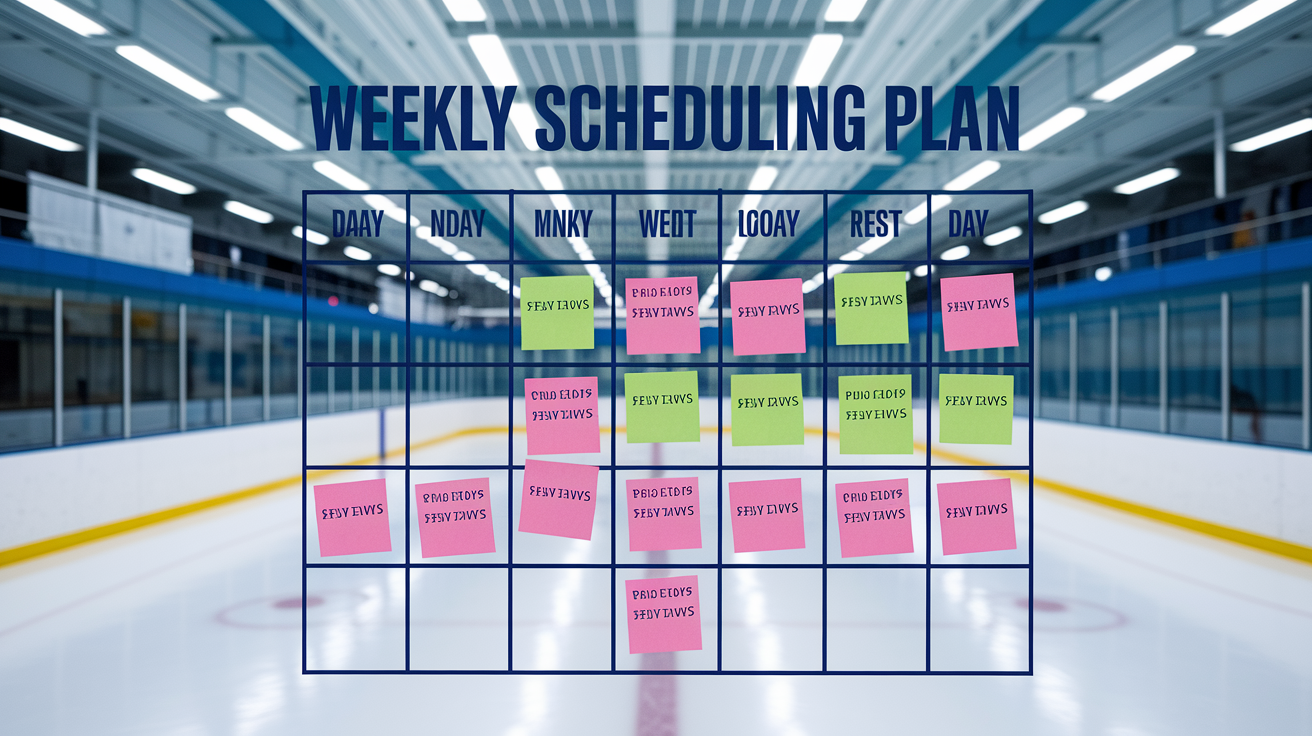
Weekly microcycle design depends on the phase of the year and the competition schedule. During the off-season, a typical week includes three strength sessions, two to three conditioning sessions, and at least one full rest day. Sessions are spaced to allow recovery, with high-intensity conditioning placed at least 24 hours away from heavy lower-body lifting. As the off-season progresses, conditioning intensity increases while frequency remains steady.
Pre-season microcycles get more complex as on-ice sessions are added. A common structure places strength training early in the week, high-intensity conditioning mid-week, and team practices or scrimmages later in the week. Conditioning and strength sessions are shortened to avoid interference with skill development and systems work.
In-season microcycles are dictated by the game schedule. A week with two games might include one strength session, one short conditioning session, one hard practice, and one light practice, with rest or active recovery on the remaining days. During tournament play or playoff runs, conditioning and strength work are reduced to micro-doses designed to maintain readiness without adding fatigue.
Scheduling principles for coaches:
Separate high-intensity conditioning and heavy strength work by at least 24 hours to avoid compounding fatigue.
Adjust weekly volume based on the number of games played, reducing conditioning and practice intensity during heavy competition weeks.
Plan recovery sessions strategically after back-to-back games, long travel, or high-intensity tournament play to restore readiness for the next competitive block.
Final Words
You’ve got a year mapped: off‑season builds the aerobic base and strength, pre‑season ramps intensity and repeat‑sprint power, in‑season keeps shifts sharp while managing fatigue.
This piece walked through the core framework, periodization models, macro/mesocycles, phase protocols, strength timing, energy systems, recovery, and weekly scheduling. The aim is clear—align training with game demands and the calendar.
Use periodization for hockey team conditioning as your roadmap. Start simple, monitor load, tweak as you go, and the team will be fitter and fresher when it counts.
FAQ
Q: What is periodization in hockey conditioning and why does it matter?
A: Periodization in hockey conditioning is the planned division of the training year into phases to build specific qualities at the right time, which prevents overload, maximizes peak performance, and speeds recovery.
Q: How is the training year broken into phases and what are the main objectives?
A: The training year is broken into off-season, pre-season, and in-season phases. Off-season builds base fitness; pre-season develops high-intensity capacity; in-season maintains performance and manages fatigue for games.
Q: What periodization models are used in hockey and when should each be used?
A: Common models are linear (steady progression, good for clear off-season-to-season build), undulating (frequent intensity shifts, useful for varied squads), and block (focused blocks for specific deficits or short prep windows).
Q: How do coaches structure an annual plan using macrocycles, mesocycles, and microcycles?
A: Coaches structure an annual plan with macrocycles (full season), mesocycles (4–8 week focused blocks), and microcycles (weekly layouts), aligning training load to games and recovery windows.
Q: What should off-season, pre-season, and in-season conditioning look like?
A: Off-season conditioning emphasizes aerobic base, tempo runs, and higher volume strength; pre-season focuses on intervals, repeated sprints, and change-of-direction work; in-season uses short, sharp “micro-dose” sessions plus recovery.
Q: How should strength training phases align with conditioning?
A: Strength phases align by prioritizing hypertrophy and general strength in the off-season, max strength in the pre-season, and power plus maintenance during the season to support on-ice explosiveness.
Q: How do you train the energy systems specific to hockey?
A: Training targets the anaerobic alactic system for short explosive shifts, anaerobic lactic for repeated sprints, and the aerobic system to speed recovery between shifts and support longer practices.
Q: What recovery and load‑management tools should teams use across the season?
A: Teams should use sleep optimization, hydration and nutrition, targeted cold or contrast exposure, and objective load monitoring (RPE, GPS, wellness scores) to reduce fatigue and guide daily planning.
Q: How should weekly scheduling be handled and adjusted for travel or back‑to‑backs?
A: Weekly scheduling should balance high-intensity days, skill/practice, recovery sessions, and game prep. Reduce load before games, prioritize sleep on travel days, and add active recovery after back-to-backs.
Q: What are the short practical priorities for coaches implementing a periodized plan?
A: Practical priorities are set clear phase goals, align strength with conditioning, monitor player load daily, and simplify weekly plans so players arrive fresh and role-ready for games.