

Think you need ice to get hockey-fit? Think again.
When ice time is scarce, bodyweight circuits can keep a team explosive, balanced, and hard to play against.
They train first-step power, single-leg push strength, rotational core, and the stop-start endurance players use every shift.
This post lays out warm-ups, shift-length circuits, and progressions your coach can run in a gym, parking lot, or school hall.
No equipment. Short sessions. Scalable for beginners through advanced players.
Key Off-Ice Bodyweight Workout for Hockey Conditioning
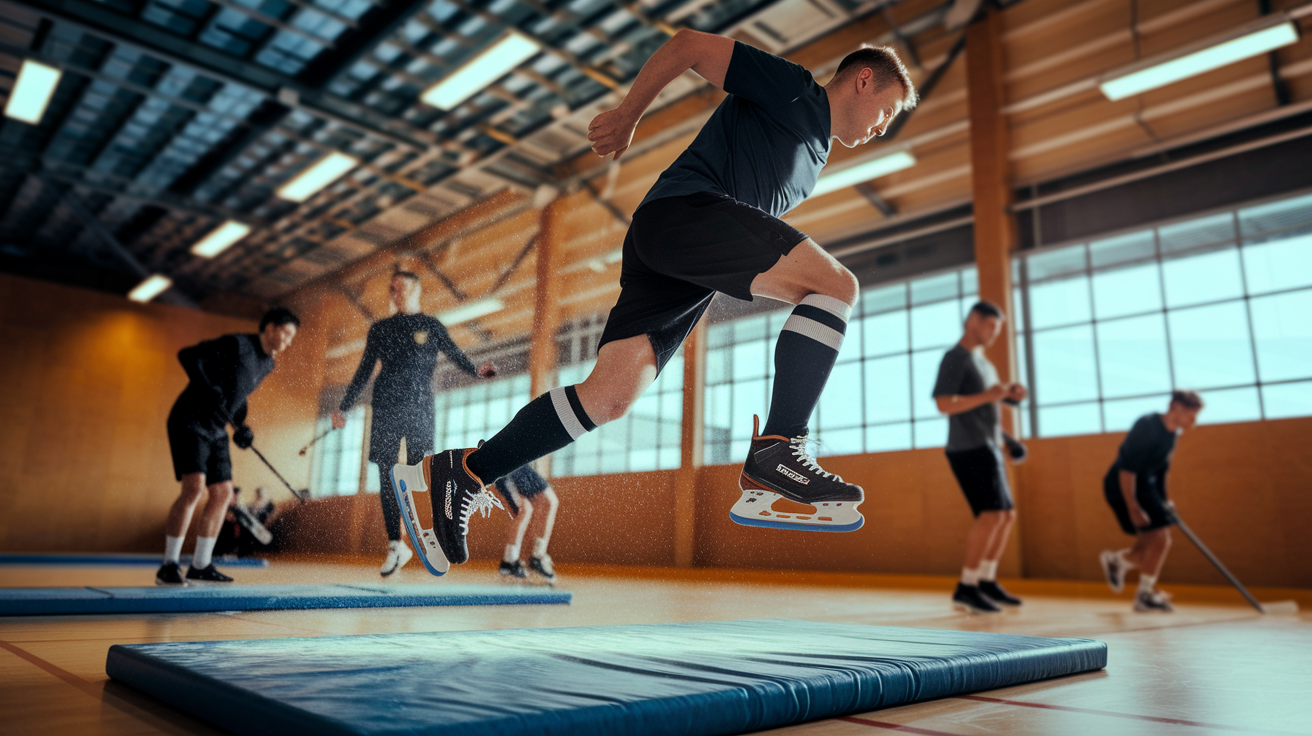
Bodyweight conditioning fixes one of the biggest headaches teams deal with when ice time costs too much or just isn’t available. You can’t get on the rink three or four times a week? Off-ice circuits keep your athletes in hockey shape anyway. These workouts hit the exact energy systems your players tap during shifts: repeated explosive movements, short recovery, do it again.
The right bodyweight session trains acceleration out of turns, deceleration when you’re closing gaps, rotational power for shooting and checking, and the anaerobic endurance that separates fresh legs in the third period from players who stand up straight because they’re cooked. Here’s a complete circuit built around hockey movement patterns:
- Skater Hops (40 seconds) – Explosive lateral bounds from leg to leg. Stick each landing for 1 second to build single-leg stability and simulate crossover power.
- Bulgarian Split Squat Jumps (30 seconds each leg) – Rear foot elevated on a low step or curb, explode up from the front leg. Mimics the skating push and trains unilateral leg drive.
- Plank with Rotation Reach (40 seconds) – High plank position, rotate torso and reach one hand toward the ceiling, then return. Trains anti-rotation core strength you use in every shot and body check.
- Mountain Climbers (40 seconds) – Fast knee drives in plank position to spike heart rate and condition hip flexors for skating stride frequency.
- Lateral Lunge to Single-Leg Balance (30 seconds each side) – Step wide into a lateral lunge, push back to standing on one leg and hold 2 seconds. Builds hip and ankle stability for edge work.
- Burpees (30 seconds max reps) – Full-body conditioning finisher that trains the get-up speed needed after falling or blocking a shot, while spiking anaerobic demand.
Rest 90 seconds between rounds. Complete 3 to 4 rounds depending on your team’s conditioning level.
This circuit improves first-step quickness because explosive jumps train the fast-twitch fibers that fire during acceleration. The single-leg work translates directly to skating stride mechanics. Every push in hockey happens on one leg at a time. Rotational core exercises increase shot velocity and help players stay balanced when they’re shooting under pressure or getting leaned on in the corners. The shift-length intervals (30 to 40 seconds of work) condition the anaerobic energy system so your athletes recover faster between real shifts and maintain their skating posture deep into games.
Essential Warm-Up and Movement Preparation

Movement prep raises your core temperature, activates the muscles that power skating mechanics, and opens up the hip and ankle mobility you need for deep knee bend and lateral crossovers. Skip a proper warm-up before a bodyweight conditioning session? That’s how players pull hip flexors or tweak groins. Cold muscles don’t handle explosive changes of direction.
- Leg Swings (front-to-back and side-to-side, 12 each leg) – Loosens hip flexors and adductors. Hold a wall for balance and swing through a full range without forcing it.
- Walking Lunges with Torso Rotation (10 each leg) – Step into a lunge, rotate your torso toward the front knee. Wakes up hip mobility and thoracic spine rotation for shooting mechanics.
- Inchworms (8 reps) – Walk hands out to plank, hold 1 second, walk feet toward hands. Activates shoulders, core, and hamstrings in one movement.
- Lateral Shuffles (20 seconds each direction) – Stay low in an athletic stance, shuffle side to side without crossing feet. Fires up the glutes and adductors used in lateral skating.
- High Knees in Place (20 seconds) – Drive knees up quickly to activate hip flexors and raise heart rate before the main circuit starts.
A solid 5 to 6 minute dynamic warm-up reduces the risk of muscle strains during explosive drills and primes the nervous system for quick, powerful movements. Players who warm up properly also report better balance and coordination during single-leg exercises. Critical when you’re training skating-specific stability off the ice.
Hockey-Specific Strength and Movement Technique
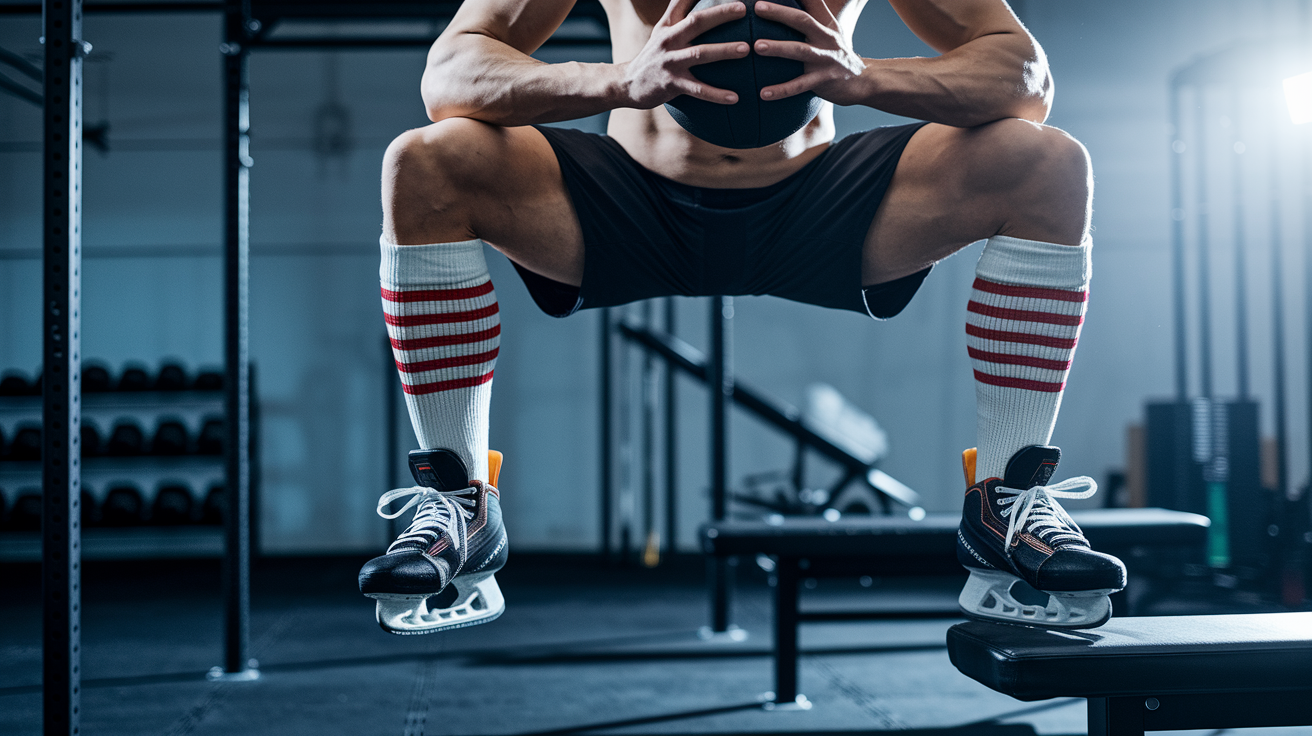
Single-leg strength is the foundation of a powerful skating stride. Every push comes from one leg at a time. If one leg is noticeably weaker, your stride becomes uneven and slower. Bodyweight exercises like split squats, Bulgarian variations, and pistol squat progressions build the unilateral leg strength that translates directly to harder pushes on the ice. Hip stability (your ability to control your pelvis and femur during single-leg loading) determines how well you hold an edge through tight turns and how much power you can transfer into each stride without wobbling.
Rotational core strength matters just as much. Shooting, passing, and checking all require you to generate force through your torso while your lower body stays stable. A weak core leaks power. Your shot loses velocity because energy dissipates instead of transferring from your legs through your stick. Off-ice rotational work, like plank reaches and medicine-ball-style twists (even without the ball), trains your core to resist unwanted movement and channel force efficiently.
Proper form keeps these exercises effective and safe:
- Knee tracking – On all single-leg and lunge variations, keep your knee in line with your toes. Don’t let it collapse inward, which stresses the MCL and reduces power transfer.
- Pelvis position – Keep your hips level during single-leg holds and split squats. If one hip drops, you’re compensating with your lower back instead of building true stability.
- Controlled landings – Land softly on jump exercises with your knee slightly bent and your weight centered over the ball of your foot. Slamming into the ground with a stiff leg invites ankle and knee injuries.
- Full range of motion – Lower until your back knee nearly touches the ground on split squats, and descend until your hip crease drops below your knee on squats. Partial reps build partial strength.
Conditioning Circuits Based on Shift Duration
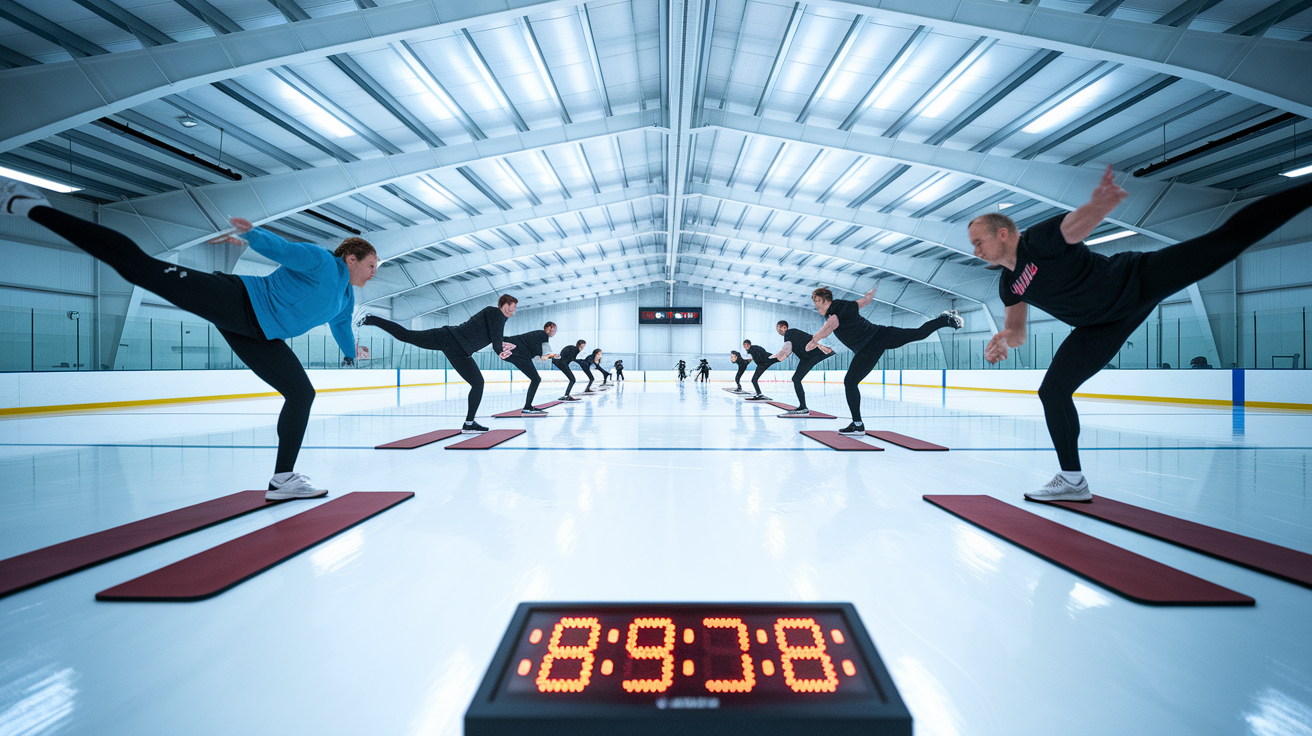
Hockey shifts run 30 to 45 seconds of high-intensity skating, battling, and quick transitions, followed by 1 to 2 minutes of recovery on the bench. Your body uses the ATP-CP system for the first explosive 5 to 10 seconds of a shift, then switches to anaerobic glycolysis to fuel the rest of that 30 to 45 second window. Circuits structured around shift-length work intervals train your athletes to repeat high-power output with incomplete recovery. Exactly what happens in a game.
Circuit 1: Lower-Body Power (repeat 4 rounds, rest 90 seconds between rounds)
- Split Squat Jumps (40 seconds) – Alternate legs each jump, explode up and switch stance in the air.
- Lateral Bounds (30 seconds) – Jump side to side, stick each landing for 1 second on one leg.
- Speed Squats (30 seconds) – Bodyweight squats performed as fast as possible with good form, no pause at the top.
Circuit 2: Core and Stability (repeat 3 rounds, rest 60 seconds between rounds)
- Plank Shoulder Taps (40 seconds) – High plank, tap opposite shoulder while keeping hips stable.
- Bicycle Crunches (40 seconds) – Rotate torso and drive opposite elbow to knee. Mimics rotational demands of skating and shooting.
- Single-Leg Glute Bridges (30 seconds each leg) – Drive through your heel, squeeze glute at the top, control the descent.
Circuit 3: Full-Body Conditioning (repeat 3 to 4 rounds, rest 2 minutes between rounds)
- Burpees (30 seconds max reps) – Chest to ground, explode up to standing.
- Skater Hops (40 seconds) – Lateral hops, land and balance on one leg before pushing off again.
- Mountain Climbers (30 seconds) – Fast knee drives in plank position.
- Push-Ups (20 seconds max reps) – Standard or knee push-ups depending on strength level.
These circuits improve late-game endurance by conditioning your body to clear lactate faster and tolerate the burn that comes with repeated shifts. Players who train this way maintain their skating speed and decision-making in the third period while opponents slow down, stand up out of their hockey stance, and make mistakes. The metabolic adaptation you build here (your ability to work hard, recover quickly, and work hard again) is the difference between a team that fades and a team that finishes strong.
Progressions for Different Skill Levels
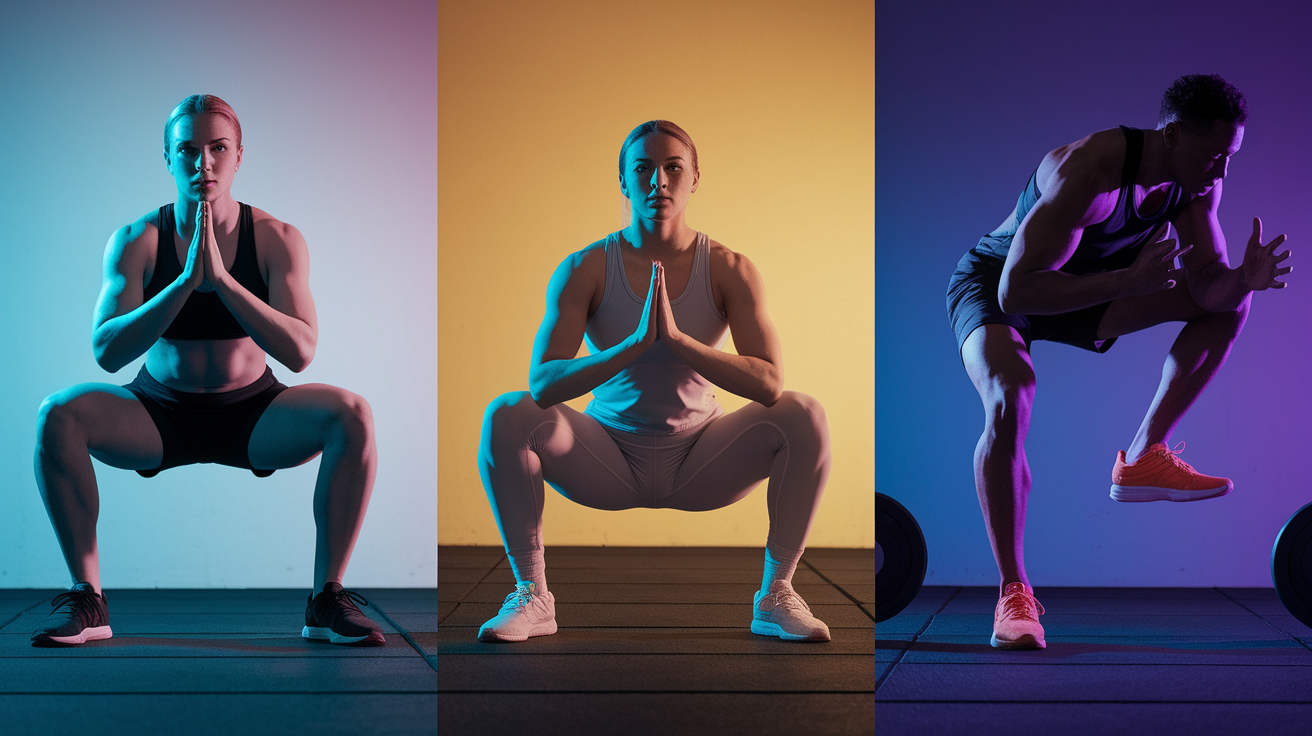
Progression matters because athletes adapt to training stimulus. Once a circuit feels easy, you’re maintaining fitness instead of building it. Bodyweight training scales through tempo changes, added repetitions, increased range of motion, and more complex movement patterns. Gives you multiple ways to keep challenging your team without adding equipment.
- Beginner – Focus on mastering movement patterns with controlled tempo. Use standard split squats instead of jumping variations, knee push-ups instead of full push-ups, and plank holds instead of dynamic plank movements. Rest intervals can be longer (2 minutes between circuits) to allow full recovery and maintain good form.
- Intermediate – Add explosive elements like split squat jumps, increase work intervals from 30 to 40 seconds, reduce rest periods to 60 to 90 seconds, and introduce single-leg balance challenges at the end of lower-body exercises.
- Advanced – Use tempo manipulation (3-second eccentric lowering on split squats, explosive concentric drive), stack circuits with minimal rest (30 to 45 seconds), add plyometric complexity (single-leg burpees, rotational jumps), and increase total volume to 4 to 5 rounds per circuit.
Athletes should progress to harder variations when they can complete all prescribed reps with perfect form and feel like they could do 2 to 3 more reps at the end of each set. If form breaks down (knees caving in, hips sagging during planks, or landings getting sloppy), drop back to an easier progression until strength and stability catch up. Quality reps build hockey performance. Sloppy reps build bad movement patterns that show up on the ice.
Weekly Training Schedule for Limited Ice Time

Teams with restricted ice access need a structured off-ice plan that maintains conditioning without creating fatigue that hurts game performance. Two to four dryland sessions per week keeps players sharp when rink time is scarce. The key is balancing intensity. Hard conditioning sessions need recovery time, and you don’t want to run a brutal circuit the day before a game.
- Monday (45 minutes) – Full conditioning session using Circuit 1 and Circuit 3 from the shift-duration section. Prioritize lower-body power and full-body metabolic work early in the week when players are fresh.
- Wednesday (30 minutes) – Strength and stability focus using Circuit 2 plus single-leg work. Lower intensity than Monday but still builds the unilateral strength and core control that transfers to skating mechanics.
- Friday (20 to 30 minutes) – Light movement prep and speed work. Short explosive intervals (10 to 15 seconds of max-effort skater hops or split squat jumps) with full recovery between sets to prime the nervous system without creating fatigue before weekend games.
- Optional Weekend (15 to 20 minutes) – Active recovery on a non-game day: dynamic mobility flow, light core work, foam rolling. Helps with soreness and keeps athletes moving without taxing their legs.
During tournament weekends or heavy game schedules, drop the volume. One short 20-minute movement-prep session midweek is enough to maintain conditioning without compromising recovery. The goal is to support performance, not bury your players under fatigue. If your team plays Saturday and Sunday, skip Friday’s session or replace it with 10 minutes of dynamic stretching and mobility work.
Transferring Off-Ice Gains to On-Ice Performance

Off-ice strength and conditioning only matter if they show up in games. The transfer happens when dryland training improves the physical qualities that directly impact hockey skills: stride power, recovery between shifts, body control during battles, and the ability to maintain good skating posture when you’re tired.
- Skating speed and acceleration – Single-leg strength from split squats and lateral bounds increases the force you can apply into each push. Stronger legs mean harder pushes, which means faster skating. Players often notice quicker first steps and better separation speed within 3 to 4 weeks of consistent lower-body work.
- Balance and edge control – Stability exercises like single-leg holds and unilateral glute bridges improve your ability to control your body on one skate. Better balance means tighter turns, more confidence on outside edges, and fewer stumbles when you get bumped in traffic.
- Shot power – Rotational core work translates directly to shooting velocity because your shot starts from your legs and transfers through your torso. A stronger, more stable core channels that energy efficiently into your stick instead of leaking it through compensation patterns.
- Endurance and shift quality – Conditioning circuits that mimic shift duration train your body to recover faster between bursts. Players who do this work maintain their skating speed and decision-making late in games instead of standing up, gliding, and making slow reads because they’re gassed.
You can monitor progress by tracking on-ice metrics that matter: Are you beating opponents to loose pucks in the third period? Can you hold a low stance through a full shift without your legs burning out? Are you generating more power on one-timers? Does your first shift of the third period feel as strong as your first shift of the first? When off-ice gains transfer to the ice, those answers shift from “sometimes” to “yes.”
Final Words
The whistle blows, you sprint back to the bench and that last shift still stings. This guide gave a hockey-focused bodyweight workout you can run with limited ice time, plus a dynamic warm-up, single-leg and rotational technique cues, shift-length circuits, progressions, and a weekly plan.
Put the circuit into practice, track on-ice carryover, and scale the progressions as you get stronger and more explosive. These bodyweight conditioning workouts for hockey teams with limited ice time will help players skate harder and recover faster. Keep grinding.
FAQ
Q: How to train for hockey without ice?
A: Training for hockey off the ice focuses on skating-specific power, balance, and shift-style conditioning: lateral bounds, single-leg squats, hip mobility, resisted slide steps or sliders, core rotation, and 30–45s interval circuits.
Q: How to train for hockey off the ice?
A: Training for hockey off the ice uses the same approach as without ice: emphasize unilateral leg work, lateral power, rotational core, mobility, and shift-length intervals to transfer directly to skating mechanics.
Q: What is Connor McDavid’s workout routine?
A: Connor McDavid’s workout routine emphasizes high-skill skating, speed work, strength, and recovery: on-ice sprint repeats, plyometrics, single-leg strength, rotational core work, mobility, and targeted recovery sessions.
Q: What is the best conditioning exercise for hockey?
A: The best conditioning exercise for hockey is shift-style interval work that mimics 30–45 second shifts: repeated high-intensity efforts (sprints, bike, or sled) with 1–2 minutes of rest.